GHK-Cu
50 mg vial, 100 mg vial
From $49
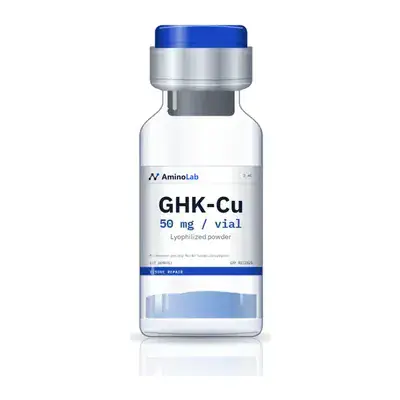
This GHK peptide dosage calculator is a lab maths tool. Enter the fill of your GHK-Cu vial and the volume of water you added, and this tool returns the strength of the solution plus the millilitres and U-100 syringe units that hold any target amount. It opens on the AminoLab GHK-Cu 50mg vial by default. Pick the 100mg fill instead, or type in custom values for a vial from another lot.
Most research peptides ship in fills of 5 or 10 mg, but the copper tripeptide comes in far bigger amounts, and that changes the numbers. Add 2 mL of bacteriostatic water to a GHK-Cu 50mg vial and you get 25 mg in every mL. Put 3 mL into the 100mg vial and the strength sits near 33 mg per mL. Because every graduation on a U-100 syringe then carries 0.25 mg or more, even a modest target only fills a handful of units.
The table lists the strength you get from each fill and water volume. Remember that on a U-100 insulin syringe 100 units equals 1 mL, so 10 units equals 0.1 mL.
| Vial fill | Water added | Strength | Held in 10 units (0.1 mL) | Held in 1 unit |
|---|---|---|---|---|
| 50 mg | 2 mL | 25 mg/mL | 2.5 mg (2500 mcg) | 250 mcg |
| 50 mg | 3 mL | 16.667 mg/mL | 1.667 mg (1666.667 mcg) | 166.667 mcg |
| 100 mg | 2 mL | 50 mg/mL | 5 mg (5000 mcg) | 500 mcg |
| 100 mg | 3 mL | 33.333 mg/mL | 3.333 mg (3333.333 mcg) | 333.333 mcg |
Throughout this page, the phrase GHK peptide dosage refers only to the quantity of GHK-Cu a researcher draws from a stock solution into an experiment. That quantity may be written in milligrams, in micrograms, or as molarity once diluted into the medium. It is a piece of lab arithmetic and never an amount meant for a person or an animal.
Published cell culture work with GHK-Cu generally reports nanomolar working levels, minute next to a stock at 25 mg/mL. This copper complex has a mass of roughly 404 g/mol, though salt forms differ, so confirm the value printed on your certificate. On that figure a 25 mg/mL stock is close to 62 mM. A 1 micromolar solution carries about 0.4 mcg in each mL, so bringing 10 mL of medium to 1 micromolar calls for about 4 mcg of GHK-Cu. Pulling that directly from the stock would mean measuring far less than a microlitre. A better route is a 1 in 1,000 intermediate dilution to 25 mcg/mL, from which you transfer roughly 0.16 mL.
Use the GHK peptide dosage calculator above after every mix, and buy GHK-Cu at AminoLab in the fill that suits your series.
Mixing GHK-Cu peptide is quick, and its blue tint makes errors easy to see. First bring the vial up to room temperature so moisture does not condense on the powder. Clean the rubber stopper with an alcohol swab. Then let the bacteriostatic water trickle down the glass wall instead of hitting the cake directly. Roll or swirl the vial gently until nothing solid remains, avoiding shaking, which can make the liquid foam. A good result is clear, uniformly blue and free of specks. Mark the label with the strength and the date, keep the vial at 2 to 8 °C out of the light, and finish it inside 28 days. Our full walkthrough on how to reconstitute peptides covers the bench technique in more depth.
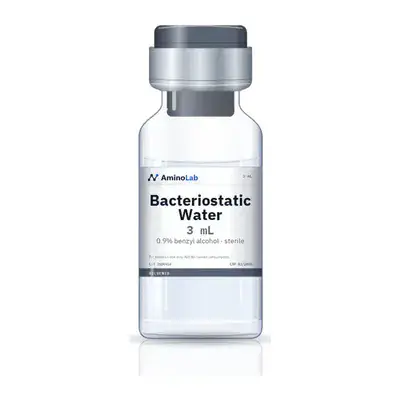
When labs reconstitute the GHK-Cu peptide 50mg vial, 2 mL is the common pick since the maths comes out at an even 25 mg per mL. Teams that work with very small amounts often go to 3 mL instead, which gives 16.667 mg per mL and spreads each target over more syringe marks. If you want that setup ready to go, the GHK-Cu Starter Kit bundles one 50 mg vial together with 3 mL of water.
Coordination bonds hold the copper ion to the GHK tripeptide, and those bonds give way to strong acids, reducing agents and chelating agents. On the bench, store GHK-Cu stock well apart from thiols like glutathione and from ascorbic acid, since both reduce the copper. Keep it away from EDTA and similar chelators as well, because they draw the metal out of the complex. Acidic buffers loosen the binding too. When a stock fades to pale blue or turns colourless, the copper has gone.
Plenty of readers ask whether they can mix copper peptides with retinol, whether you can mix copper peptides with vitamin C, or whether you can mix copper peptides with niacinamide. Those are cosmetic formulation questions rather than lab ones, and the chemistry behind them is set out in our GHK-Cu serum guide. On combining GHK-Cu with other peptides, our advice is not to pool separately reconstituted research stocks in a single vial, since no stability data exists for such a mixture. If a study design calls for a pairing, look at the GLOW and KLOW blends, which are manufactured and tested as single products at a fixed ratio.
strength (mg/mL) = mg of GHK-Cu in the vial ÷ mL of water added
U-100 units = target amount (mg) ÷ strength (mg/mL) × 100
Targets entered in micrograms are first divided by 1,000. The tool handles arithmetic and nothing else. It does not suggest any amount, and AminoLab supplies GHK-Cu strictly for laboratory research use only, to adults 18 and over.
You will find plenty of material online about a GHK-Cu peptide injection dosage chart PDF, GHK peptide dosing or GHK-Cu peptide dosage, and nearly all of it is aimed at people. AminoLab does not publish anything like that. We sell GHK-Cu as a laboratory reagent, so a GHK peptide dose here simply means the quantity measured into an experiment. What we offer in its place is the reference researchers rely on, namely strength per mL plus U-100 unit equivalents for each fill, 50 mg or 100 mg, so you can draw any GHK Cu peptide dose in micrograms precisely from a reconstituted vial.
Every GHK-Cu peptide dosage calculation on the bench comes down to two inputs, the fill of the vial and the volume of water. Alter either one and every figure in the chart shifts, which is why the calculator refreshes the moment you edit a field.
Asking about a GHK Cu peptide injection dose brings the same answer, that this is lab-only material. In our context GHK Cu peptide dosing describes the volume taken from a stock of known strength and placed into an assay tube or culture well, and nothing beyond that.
Figures such as a GHK-Cu peptide dosage for hair growth, a GHK-Cu peptide dosage per day or a GHK-Cu peptide injection dosage per day all describe human use, so you will not find them here. The copper peptides dosage tables that circulate online have no approved basis in Australia, because no GHK-Cu product is a registered medicine here. At the bench, the equivalent choice is what working level each experiment uses, which comes from the published method you are reproducing. For more on why injected use falls outside the evidence, read our GHK-Cu side effects review.
You can buy the 50 mg vial or the 100 mg vial, and the larger fill costs less per milligram. A short single study is best served by the 50 mg fill, since less material goes to waste within 28 days. When repeated assays need to share a single lot and certificate, the larger 100 mg vial is the better buy. We explain how each lot is checked on our lab tested peptides page, and other compounds that have dedicated tools are gathered in the main peptide calculator.
Know the strength you want? Order the GHK-Cu 50mg vial or step up to the 100mg. Prefer everything in one box? Shop the GHK-Cu starter kit, which comes with water and a syringe. The lot certificate for every blue cake is posted online so you can read it before checkout, a far more reliable route than a copper peptide near me search when you need a lab-grade supplier.
GHK-Cu vials hold five to ten times more powder than typical peptide fills, so expect the strength line to read in the tens of milligrams per mL. Its companion line, mcg in each 0.1 mL, equals the strength multiplied by 100, so it climbs into the thousands. The volume and unit lines reveal how small a quantity of blue liquid contains your target, keeping in mind that one unit on a U-100 syringe is 0.01 mL.
Since a standard vial holds only about 3 mL, the 100mg GHK-Cu fill cannot drop below 33 mg/mL while it stays in the vial, and 1 mg still occupies just 3 units. For targets that small, pipette a known volume of blue stock into its own tube and dilute that tenfold or further. Then rerun the calculator using the milligrams you moved and the new total volume.
What sits in the vial is the copper complex at about 404 g/mol, rather than the bare GHK tripeptide, so any molar calculation must use the complex weight. Worked that way, the 100mg vial in 3 mL works out near 82 mM, while 2 mL of water gives around 124 mM. Read what GHK-Cu is for more background on the complex.
Most labs add between 2 and 3 mL, which a standard 3 mL vial can hold. With 2 mL the strength is 25 mg per mL, and with 3 mL it drops to about 16.7 mg per mL. Extra water spreads the peptide across more syringe units, so small targets become easier to read.
A standard vial tops out at roughly 3 mL, giving a strength near 33 mg per mL. At that dilution one unit on a U-100 syringe carries about 0.33 mg.
The blue comes from the copper ion attached to the peptide. A clear blue liquid is exactly what you should see, while any cloudiness or floating particles signal a problem.
Here it refers to the mass of GHK-Cu present in a set volume drawn from your reconstituted solution, used when preparing dilutions and assays. Type in the fill, the water volume and your target, and the tool gives back the matching volume and U-100 units. It never suggests an amount for use in humans or animals.
Store GHK-Cu stock apart from reducing agents like glutathione and ascorbic acid, from chelators like EDTA, and from acidic buffers. Any of these can weaken or remove the copper, and a stock that fades to pale or colourless no longer holds it. We also recommend against pooling separately reconstituted peptide stocks into one vial, as no stability data covers such a mixture.
AminoLab sells a 50 mg fill and a 100 mg fill, and the 100 mg works out cheaper per milligram. The certificate covering identity and purity for every lot sits in our COA library.
50 mg vial, 100 mg vial
3 mL, 3 mL + 1 syringe, 10 mL, 10 mL + 1 syringe, 30 mL, 30 mL + 1 syringe
Research use onlyAminoLab supplies research compounds for laboratory and in-vitro use, not for human or animal consumption. By continuing you confirm you are 18 or older and buying for research.
Leave