BPC-157
10 mg vial, 60 capsules
From $69
Here is how to reconstitute peptides in one paragraph, and the rest of this AminoLab guide is detail. Give the unopened vial time to reach room temperature. Clean its rubber top with an alcohol swab. Add a known volume of bacteriostatic water so that it runs down the glass, not straight onto the powder. Swirl, slowly, until nothing solid remains and the liquid is clear. Divide the milligrams in the vial by the millilitres you added and you have your concentration, for example 10 mg with 2 mL equals 5 mg/mL. Put that figure and today's date on the label, then refrigerate at 2 to 8 °C. Everything that follows explains the choices hidden inside those steps.
Many bench errors are decided before the vial is touched, so plan the arithmetic first. Remember that the diluent never adds or removes peptide. The amount sealed in the glass is fixed at manufacture, and the liquid only decides how strong each millilitre will be. Every calculation you need is one of these two.
Before dividing, put everything into the same units. A milligram is 1,000 mcg and a millilitre is 1,000 µL. Mixing mcg and mg partway through a sum is behind roughly half of the calculation questions that land in our inbox.
| Strength reached | Peptide fill | Water added | Content of 0.1 mL | mL that contains 250 mcg |
|---|---|---|---|---|
| 2 mg/mL | 5 mg | 2.5 mL | 200 mcg | 0.125 mL |
| 4 mg/mL | 10 mg | 2.5 mL | 400 mcg | 0.0625 mL |
| 5 mg/mL | 5 mg | 1 mL | 500 mcg | 0.05 mL |
| 5 mg/mL | 10 mg | 2 mL | 500 mcg | 0.05 mL |
| 10 mg/mL | 20 mg | 2 mL | 1,000 mcg | 0.025 mL |
| 20 mg/mL | 50 mg | 2.5 mL | 2,000 mcg | 0.0125 mL |
Favour volumes that give tidy results. Two millilitres in a 10 mg vial produces whole numbers, whereas three millilitres leaves a recurring 3.33 in every later dilution. And if a planned transfer would be smaller than about 0.02 mL, increase the diluent volume so you stay where your pipette or syringe is reliable. To skip the sums entirely, use our peptide reconstitution calculator, which handles any fill.
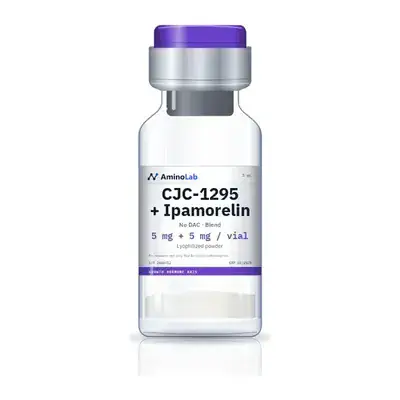
Products like the Wolverine Blend or the CJC-1295 and Ipamorelin Blend put two peptides in the one cake. Do the maths on the individual compound you are measuring, taking its own milligram figure from the label. Using the combined vial weight throws every answer out by the blend ratio. At the other extreme, NAD+ (500 mg) and glutathione (1,500 mg) ship in 10 mL vials precisely because so much material needs more room and more liquid, so budget a bigger diluent volume for those two.
The liquid you pick sets two things, the useful life of the solution and, for a minority of sequences, whether the cake dissolves in the first place.
| Option | Make up | Pick it if | Watch out for |
|---|---|---|---|
| Bacteriostatic water | Sterile water containing 0.9% benzyl alcohol as a preservative | You plan many withdrawals from one vial during refrigerated storage over a few weeks at 2 to 8 °C | Some cell culture readouts can be confounded by the benzyl alcohol |
| Sterile water | Plain sterile water, unpreserved | The whole stock is consumed in a day, or portioned and frozen straight after mixing | After the first puncture, microbes face no barrier at all |
| 0.6% acetic acid | Weak sterile acetic acid, slightly acidic | A hydrophobic or basic peptide refuses to clear in neutral water | Its acidity may have to be buffered before assay use |
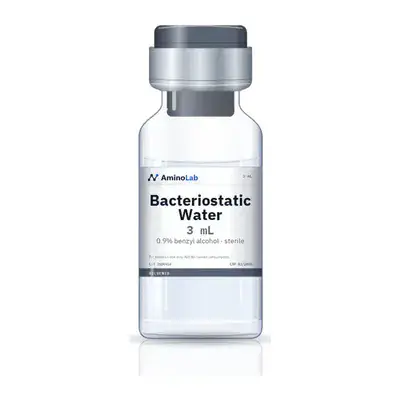
Our default across nearly the whole catalogue is bacteriostatic water. Treat 0.6% acetic acid as the spare tyre, a small 3 mL vial kept on hand for the occasional sequence that will not cooperate.
Stopping mid-procedure to find a swab is exactly when fingers brush a stopper or a volume slips your mind. Collect all of this before you begin.
Some advice on quantity, based on the orders we pack each week. A lone 5 mg or 10 mg vial seldom uses over 3 mL of liquid. The 30 mL size is good value only for a lab preparing a run of vials over several weeks. For one vial, most of a big bottle simply expires on the shelf.
Every lyophilised vial AminoLab sells needs dissolving before use. Three formats do not. BPC-157 and SLU-PP-332 are also offered as capsules in bottles of 60, and DSIP, Selank and Semax are available as 10 mL nasal spray solutions. If your order includes vials, add the right diluent at the same time instead of placing a second order later. Our entire range is supplied for laboratory research to buyers aged 18 and over, and none of it is for human or veterinary use. With a stock prepared, the peptide storage guide covers how long it lasts and how to split it.
Every item this guide mentions sits on one Australian stock list, so a single online order covers the lot. Choose bacteriostatic water in 3, 10 or 30 mL vials, adding a U-100 syringe if needed. For sequences such as IGF-1 LR3 that prefer an acidic solvent, keep 0.6% acetic acid on hand. A 30 pack of insulin syringes handles the diluent transfer as well as fine volume work. Add your research compound, from BPC-157 to anything in the metabolic range, knowing every vial has a certificate tied to its lot. Anything else you need is in the lab supplies range. Ordering diluent and peptide together means both are waiting on the bench on day one.
Dissolving the dry cake in a measured volume gives the peptide a known strength so that precise amounts can be drawn later. The molecule itself is untouched by the process. The price you pay is shelf life, because peptides in solution degrade much faster than they do as powder.
For nearly every AminoLab compound the answer is bacteriostatic water. Its 0.9% benzyl alcohol keeps the vial usable across many withdrawals. Keep 0.6% acetic acid for the rare peptide that stays hazy in water or whose solubility notes ask for an acid.
Choose a volume that delivers a neat concentration. With a 5 mg vial, 2.5 mL lands on 2 mg/mL and 1 mL lands on 5 mg/mL. Neat figures mean fewer slips in later dilutions, and the peptide reconstitution calculator sorts out any odd combination.
Warm the closed vial so moisture cannot condense on the powder. Swab each stopper with 70% isopropyl alcohol and wait for it to evaporate. Run the liquid gently down the inner wall of the vial. Swirl or roll, never shake, until the solution is clear. Label it with strength and date.
Fine graduations on a 1 mL barrel beat any large syringe for accuracy. The AminoLab U-100 insulin syringes hold 1 mL, use a 29G needle and are marked in units, with 0.1 mL equal to 10 units, so they are a good match for dosing diluent into a 3 mL peptide vial.
Bacteriostatic water stock kept dark at 2 to 8 °C is generally finished within 28 days. Sterile water stock lasts a few days at most, so use it promptly or freeze single use portions on the same day you make it.
Most researchers use 2 mL, which makes 5 mg/mL, or 500 mcg in each 0.1 mL. Nothing forces that choice, however. Go down to 1 mL for a more concentrated stock, or up to 4 or 5 mL when tiny quantities must be measured accurately. Write the chosen volume and strength on the vial the moment you finish.
Sterile water dissolves peptides perfectly well. The difference is that nothing in it stops bacteria, so once pierced the vial can be contaminated in days. That makes it right for one session preparations, or for cell assays that benzyl alcohol would disturb, with leftovers frozen as small portions the same day. Vials you will return to for weeks need bacteriostatic water.
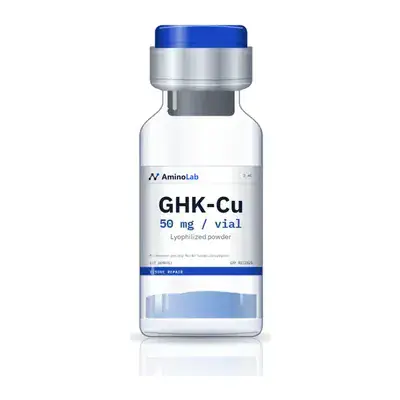
Either some peptide is still undissolved or molecules are starting to stick together. Warm the vial back to room temperature, roll it slowly for several minutes and leave it to sit. Blue is normal for GHK-Cu, KLOW and GLOW. A milky look or visible particles that persist mean the stock is unfit for measurement.
It does more harm than good. Shaking traps air, and peptides tend to unfold and clump at the bubble surfaces it creates. Gentle circular swirling or rolling the vial between your palms is the way. If powder is still there after ten minutes, cool the vial briefly and go back to swirling.
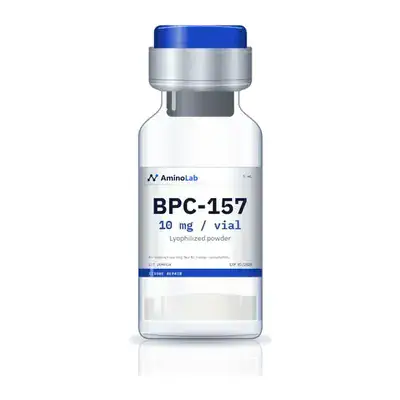
Small peptides, KPV, BPC-157 and ipamorelin among them, typically clear in a minute or two. Longer molecules like tesamorelin or thymosin alpha-1 can need five to ten minutes. A big fill such as the 1,500 mg glutathione vial wants extra diluent and extra patience. Never apply heat to hurry it, since warmth accelerates breakdown.
Yes, bacteriostatic water, 0.6% acetic acid, insulin syringes and freeze dried research peptides all sit in the same Australian online store, so one order brings the vial and its liquid together. Each peptide lot has an independent certificate for identity and purity. Everything is laboratory material and is never for human or veterinary use.
10 mg vial, 60 capsules
50 mg vial, 100 mg vial
10 mg vial
3 mL, 3 mL + 1 syringe, 10 mL, 10 mL + 1 syringe, 30 mL, 30 mL + 1 syringe
Research use onlyAminoLab supplies research compounds for laboratory and in-vitro use, not for human or animal consumption. By continuing you confirm you are 18 or older and buying for research.
Leave