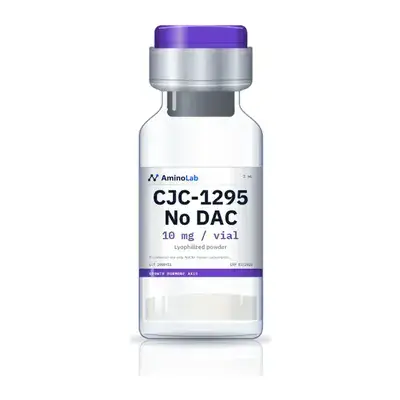
CJC-1295 No DAC
10 mg vial
$79
$59 AUD, GST included
Minimum order before shipping, and you can mix any products to reach it.
In stock, ready to ship from Australia
Frequently ordered with
 Bacteriostatic Water
Sold to buyers aged 18 and over only.
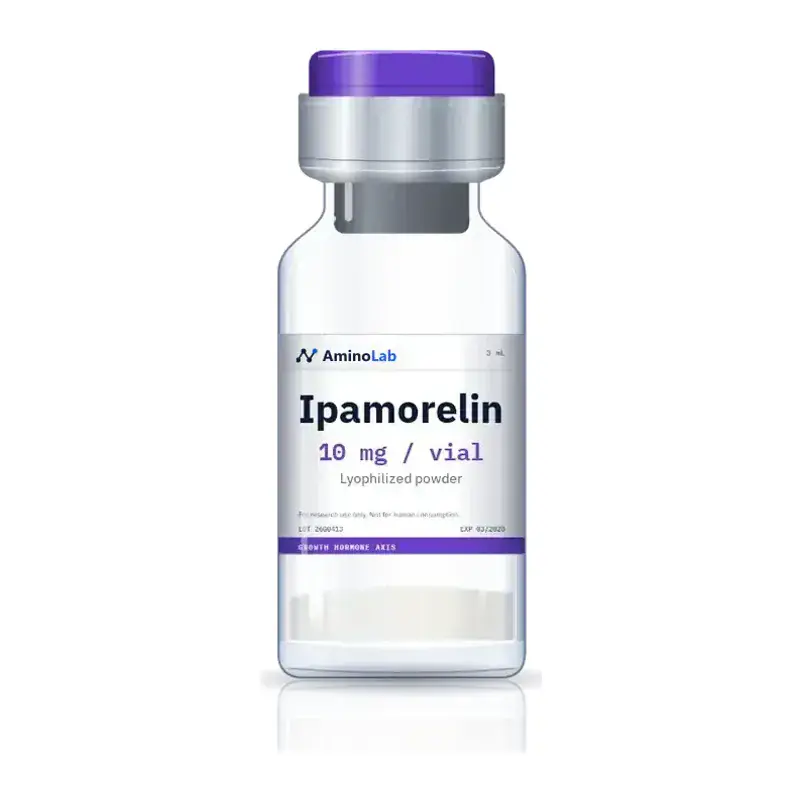
Shop Ipamorelin at AminoLab and buy the 10 mg vial from stock kept here in Australia. Ipamorelin Australia supply at AminoLab means a single 10 mg freeze-dried vial, packed in Australia with its certificate already published for the lot you receive. Of all the growth hormone releasing peptides in the catalogue this one is the most selective. The structure is a synthetic pentapeptide, written Aib-His-D-2Nal-D-Phe-Lys-NH2, and it acts at GHS-R1a, the ghrelin receptor, with published models reporting little change in ACTH, cortisol or prolactin. Identity data to check before paying are CAS 170851-70-4, C38H49N9O5 and a mass of 711.9 g/mol, all verified by mass spectrometry, while HPLC reports the purity figure. Volumes and concentrations are handled by the CJC-1295 and ipamorelin calculator. To examine the ghrelin and GHRH routes side by side, add CJC-1295 No DAC, which makes the CJC 1295 ipamorelin combination that the literature has used for years. Dry powder only is in the glass, so bacteriostatic water goes in the cart separately. Store sealed vials at -20 °C. Order your Ipamorelin online today from AminoLab's Australian stock, for laboratory research by buyers aged 18 and over.
For laboratory research use only. Not for human or veterinary use. Not TGA approved. See our research use policy.
| Listed as | Ipamorelin |
|---|---|
| Stock | In stock |
| Permitted use | Laboratory in vitro research only |
| Structure | The pentapeptide Aib-His-D-2Nal-D-Phe-Lys-NH2 |
| Chain | Five residues, three of them non-natural, finished with a C-terminal amide |
| Empirical formula | C38H49N9O5 |
| Mass | 711.9 g/mol |
| CAS registry | 170851-70-4 |
| How it ships | A white freeze-dried cake in a sealed 3 mL glass vial, purple flip-off cap |
| Included | A single 10 mg vial per unit, with diluent purchased separately |
| Keep it at | -20 °C while sealed, dry and dark, then 2 to 8 °C once reconstituted |
| Testing per lot | Mass spectrometry for identity, HPLC for purity, certificate issued |
Older secretagogues bring hormonal noise with them. This one does not, which is why it suits any study that needs the ghrelin route isolated. Sales put it among the leaders in our growth hormone category, and the paperwork for a lot goes up before anyone buys it. Order the vial here and it ships from AminoLab's Australian stock.
Five amino acids, made in a laboratory, that copy ghrelin at a single receptor. Bind that receptor on pituitary cells and they discharge a burst of the growth hormone they already hold. There is no growth hormone inside the vial, and nothing in it can substitute for the hormone. Everything described in the literature depends on cells that produce the hormone themselves, which is the first consideration when you pick a model.
GHS-R1a, the target, is a G protein coupled receptor sitting on anterior pituitary somatotrophs and on hypothalamic neurons. An agonist binding there triggers Gq signalling, intracellular calcium climbs, and granules of stored growth hormone are released. Compare that with natural ghrelin, a 28-residue peptide produced largely in the stomach, which activates the receptor only while an octanoyl fatty acid remains bonded to residue three. No such modification is needed for the ipamorelin peptide. Five residues, an amide cap and a handful of mirror-image building blocks are enough to occupy the same pocket.
Chronologically, this field ran backwards from what most people expect. In 1996 a Merck team cloned the receptor, using synthetic secretagogues as the bait, and this molecule was already being characterised by the time a Japanese group isolated ghrelin from rat stomach in 1999. So for a few years compounds of this type were keys fitting a lock whose natural key remained unknown.
Human pharmacology is cleanest in Gobburu and colleagues, writing in Pharmaceutical Research in 1999. Eight healthy men were infused intravenously at each of five rates. Plasma levels tracked the infusion rate proportionally, the terminal half-life landed near 2 hours, and growth hormone came out as one discrete episode with a peak around the 40 minute mark. No second wave followed.
From that profile we draw a practical conclusion. Think of this compound as a timing tool above all. Take samples at quarter-hour intervals over the first hour and a half and the whole curve is yours, while a single reading four hours in will probably register nothing at all. The model matters just as much. In hypophysectomised animals, or cell lines without working somatotrophs, the result is flat, simply because there is no stored hormone available for release. What the clinical studies actually measured is set out in our guide to what the published trials measured. That clean, single pulse is the main reason labs buy ipamorelin from AminoLab over older secretagogues.
A 1998 description from Novo Nordisk in Denmark introduced it as the first secretagogue that could be called selective. Its family line goes back to the GHRPs that Cyril Bowers pioneered, so GHRP-2 and GHRP-6 are relatives, but the brief here was narrower, namely releasing growth hormone while leaving the adrenal axis alone. The founding paper, covering rat pituitary cells and pigs, found growth hormone output on par with GHRP-6 and ACTH and cortisol broadly flat.
Selectivity is the reason to buy it. As a probe it fits work on growth hormone pulsatility, on how ghrelin and GHRH signalling cooperate, and on IGF-1 feedback, with some groups extending it to rodent gut motility. Because adrenal and prolactin readouts barely move, any shift in growth hormone output can be pinned on the ghrelin receptor more confidently than with an older GHRP, and reviewers of secretagogue comparisons often expect it to appear as the benchmark. None of this makes it a medicine. It has no TGA approval, and the whole family is grouped in our growth hormone peptides category.
Inside the box is one clear glass vial, 10 mg of dry white cake, nothing blended with it and no liquid included. Danish secretagogue chemistry at Novo Nordisk produced the molecule in the 1990s, and it did not last long as a drug candidate. Under licence, Helsinn ran an intravenous phase 2 study in post-operative ileus after bowel surgery, publishing in 2014 that the primary endpoint had missed statistical significance, and development then faded out. No regulator anywhere has approved a medicine based on it.
So where does the law sit? Controlled rather than unaddressed. Two entries apply under the June 2026 Poisons Standard instrument, which was still current in October 2026. One places it in Schedule 4, the prescription-only schedule. The other falls under Appendix D, clause 5, the list of poisons that cannot lawfully be possessed without authority. Those controls date from the TGA scheduling committee's group review of growth hormone releasing peptides over 2014 and 2015, which caught CJC-1295, GHRP-2 and GHRP-6 as well. Because no approved product exists, the ARTG carries nothing containing it, there is no pharmacy equivalent, and it circulates only as a research chemical.
Athletes face a second set of rules. On the 2026 WADA Prohibited List it appears in class S2 with the growth hormone secretagogues. That prohibition covers competition periods and everything in between, and Sport Integrity Australia enforces the list here.
For laboratories after a local source, AminoLab holds ipamorelin for sale in Australian stock as a research reagent, sold to adults 18 and over, for in vitro work only, with human and veterinary use excluded. Where a GHRH receptor agonist is wanted as a contrast, the sermorelin acetate vial is the usual second reference.
Only one size is offered. Because the molecule is light, near 712 g/mol, each milligram holds far more molecules than a milligram of a 29-residue GHRH analogue, and a single vial usually spans a whole cell or rodent study.
Order a few vials at once and, stock permitting, they stay on a single lot under a single certificate. Open one, keep the rest sealed and frozen. Buyers must be 18 or above and declare a laboratory purpose before payment is taken.
Non-natural residues account for three of the five. They are D-phenylalanine, D-2-naphthylalanine and aminoisobutyric acid at the N-terminus. With the C-terminal amide in place, the chain resists proteases and carries a distinctive mass, so a certificate should show a measured value near 711.9 g/mol before you read across to that lot's HPLC trace and purity figure.
A badge on a web page says nothing about the vial on your bench, whereas a lot-matched report says everything. Ours are filed in the COA library by the code on your label, so the figures can be set against any other supplier's data before you commit. Check those figures, then order the lot that suits your series.
Orders are placed here and sent from our warehouse in Australia to laboratories in every state and territory. No store and no collection point exists. A group buying research peptides in Melbourne and a lab in Broome draw on one shelf. Beat the 3pm cut-off on a business day and the vial goes out that afternoon with tracking, and delivery information lists the timeframes.
Add bacteriostatic water to the same cart. Preparation is quick, because the powder dissolves with very little encouragement. Bring the vial up to room temperature, aim the liquid at the glass wall and swirl it gently. One millilitre in a 10 mg vial makes 10 mg/mL and 2 mL makes 5 mg/mL, with the reconstitution calculator handling the rest.
Freeze sealed vials at -20 °C. Solution keeps at 2 to 8 °C, and across a long series aliquots beat a second freeze and thaw.
Ipamorelin acetate, the usual salt form, shows up in catalogues, and older material carries the development code NNC 26-0161. In chemical shorthand the structure reads Aib-His-D-2Nal-D-Phe-Lys-NH2, sometimes with an H- prefix on the Aib, and every variant means CAS 170851-70-4.
Some receptor terminology is worth having at hand. GHS-R1a stands for the growth hormone secretagogue receptor, the same one ghrelin activates, and classifications for this compound include GHRP, GH secretagogue and ghrelin mimetic. Older papers list it with the GHRPs of the 1980s and 1990s, newer reviews put it among ghrelin receptor agonists, and the vial holds the same molecule regardless. Whichever name you know it by, order it at AminoLab as a 10 mg vial.
These two compounds complement rather than compete. One works at the ghrelin receptor. The other, CJC-1295 No DAC in a 10 mg vial, is a GHRH analogue acting at the GHRH receptor. Synergy studies need both, and separate vials are generally better because each quantity can then be set on its own, which is what makes it the best peptide to stack with ipamorelin for most designs.
Protocols that fix an equal ratio are simpler with the CJC-1295 and Ipamorelin Blend, which holds 5 mg of each. Keep to the single vial when the ghrelin arm must stand free of GHRH input. Still choosing a GHRH partner? Our CJC-1295 DAC vs No DAC guide covers the difference. AminoLab stocks the single vials and the premixed blend, so either route can be ordered today.
This small synthetic peptide switches on the ghrelin receptor. Across the models studied, growth hormone is released while other pituitary hormones stay put, and it is in stock now.
A sealed vial of 10 mg powder. Diluent is sold separately, so bacteriostatic water goes in the cart as well.
Labs buy it to study pulsatile growth hormone release, how it interacts with the GHRH pathway, and gut motility in animals, all of it preclinical or in vitro.
Because the No DAC form of CJC-1295 hits the GHRH receptor instead, the two are very often ordered as a pair.
Sealed vials go in the freezer and solution in the fridge. Dissolution is close to instant, which makes aliquoting straightforward.
HPLC and mass spectrometry run on each lot, with the certificate published for checking before an order goes in.
Add the 10 mg vial to your cart and pay through the checkout here. Orders in before 3pm on a business day leave the warehouse that afternoon, tracked. Bacteriostatic water can ride along in the same parcel, and purchasers need to be at least 18.
No reseller is involved, whatever your postcode. Every order is filled from one Australian stockholding of lot-tracked material with a published certificate, and the per-vial price is the same whether delivery is metropolitan or regional.
A separate published report exists for each lot. An independent laboratory confirms a mass close to 711.9 g/mol by mass spectrometry and records purity by HPLC. The report shares the lot code on your vial and sits in the COA library, open to review before ordering or after delivery.
Most published designs use the GHRH analogue CJC-1295 No DAC, since the pair act at separate receptors and what they do together to growth hormone release is the actual question. Two vials give you control over each quantity, whereas the CJC-1295 and Ipamorelin Blend, with 5 mg of each, fits fixed equal-ratio work.
Its 1998 founding studies showed growth hormone release equal to GHRP-6 with no meaningful lift in ACTH or cortisol. By contrast, hexarelin and GHRP-6 raise prolactin and cortisol as well. A cleaner profile like that is why researchers reach for it when the ghrelin receptor contribution alone is being measured.
Laboratories treat it as a selective ghrelin receptor probe, in pituitary cells and animal models, for growth hormone pulsatility, GHRH cooperation and IGF-1 feedback, with gut motility a further application for some groups. Supply covers bench work only and never administration to people or animals.
10 mg vial
5 mg vial
10 mg vial
13 mg + 3 mg vial
Research use onlyAminoLab supplies research compounds for laboratory and in-vitro use, not for human or animal consumption. By continuing you confirm you are 18 or older and buying for research.
Leave