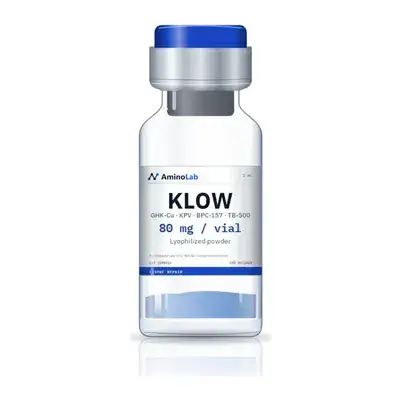
KLOW
80 mg vial
$139
$49 AUD, GST included
Minimum order before shipping, and you can mix any products to reach it.
In stock, ready to ship from Australia
Frequently ordered with
 Bacteriostatic Water
Sold to buyers aged 18 and over only.
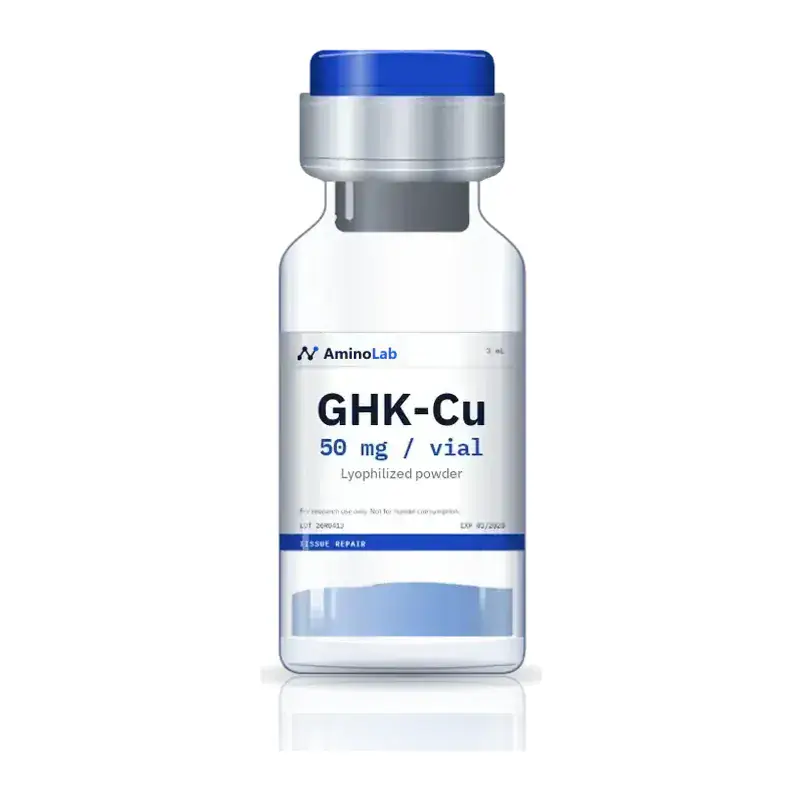
Buy GHK-Cu online from AminoLab, available in Australia as the 50 mg vial or 100 mg vial. AminoLab supplies GHK Cu peptide Australia researchers can order in two fills, a 50 mg vial and a 100 mg vial, both blue lyophilised powder posted from local stock. If you want to buy GHK Cu peptide online, what arrives is a tested complex in which one copper(II) ion sits on the tripeptide glycyl-L-histidyl-L-lysine. First found in human plasma in 1973, it is now the most researched of the copper peptides in work on collagen, extracellular matrix and copper transport. Before paying, compare the certificate with the reference data, a CAS of 89030-95-5, the formula C14H22CuN6O4 and a molar mass of 401.9 g/mol. Each lot is checked by HPLC for purity and by mass spectrometry for identity. Use the GHK-Cu calculator to turn a diluent volume into a concentration. Want BPC-157 and TB-500 in the picture too? The GLOW blend puts all three together. Since no liquid comes in the vial, order bacteriostatic water as well, or take the starter kit where diluent is already packed. Store sealed at -20 °C in the dark. Buy GHK-Cu online now while it is in stock, supplied by AminoLab to adults aged 18 and over for research use.
For laboratory research use only. Not for human or veterinary use. Not TGA approved. See our research use policy.
| Product | GHK-Cu (copper tripeptide-1) |
|---|---|
| Structure | Copper(II) complex of Gly-His-Lys |
| Residues | 3 amino acids |
| Formula | C14H22CuN6O4 |
| Molecular weight | 401.9 g/mol |
| CAS | 89030-95-5 |
| Appearance | Blue lyophilised cake, sealed 3 mL glass vial, blue cap |
| Quality checks | HPLC purity plus mass spectrometry identity, certificate issued lot by lot |
| In the box | One GHK-Cu vial (50 mg or 100 mg), no diluent unless you buy the starter kit |
| Storage conditions | -20 °C unopened, protected from light and moisture, 2 to 8 °C after mixing |
| Stock status | In stock in both 50 mg and 100 mg |
| Intended use | Lab research, in vitro only |
Pick your fill by workload. A first order usually starts with 50 mg, while repeated runs justify 100 mg. Expect a blue cake, because the colour is the bound copper and it is the first thing worth checking when the parcel is opened. Stock of each size sits here in Australia with lot certificates posted online.
Think of GHK-Cu as a very small courier. Three amino acids, Gly, His and Lys, wrap around one copper ion, and in research models the complex carries that copper to the cells and enzymes that use it. It also sets itself apart from most of our catalogue by being natural, since human plasma contains it at measurable levels.
Three nitrogen atoms near the glycine-histidine end of the chain form the pocket that holds copper. At the opposite end, lysine and its long, positively charged side chain stay free to interact with cell surfaces. Copper(II) is held tightly, but not so tightly that albumin cannot compete. Published binding studies place GHK roughly level with albumin's strongest copper site, and the metal moves back and forth between them. So picture a shuttle bus, not a locked box. Enzymes that construct and protect connective tissue need copper to function, lysyl oxidase (which cross-ties adjacent collagen fibres) and superoxide dismutase being two key examples. Handing them copper in a harmless, soluble package is the most widely accepted reason for much of GHK-Cu's activity in cell culture.
Blood is not the only source. Back in 1994, Lane and colleagues, including Iruela-Arispe and Sage, reported in The Journal of Cell Biology that protease digestion of SPARC releases both GHK and KGHK. SPARC is a matrix protein laid down around damaged tissue, and the released fragments encouraged new vessel growth in their experiments. Type I collagen carries the same three-residue sequence in its alpha 2 chain. A working hypothesis follows from that. If damaged matrix releases GHK exactly where repair must begin, it would explain why copper peptides for wound healing were the first line of this research.
A flaw runs through many copper peptide skin studies. Free copper salts are biologically active by themselves, so testing GHK-Cu alone cannot show whether the metal or the peptide produced the effect. Our advice is to run at least three arms, the GHK Cu peptide complex itself, a copper-matched salt like copper(II) chloride, and plain GHK with no metal. Albumin in serum-containing medium will also trade copper with the peptide, so write down the serum percentage in every method. Discovery history and gene expression data are covered in our full guide to GHK-Cu. Order it online from AminoLab as that same defined copper complex, ready to reconstitute for your own matrix assays.
The story starts in 1973, when Loren Pickart pulled Gly-His-Lys out of plasma albumin and went on to publish the copper binding work everyone still cites. Our vials contain the synthetic version, already complexed, with peptide nitrogens gripping a Cu2+ ion that colours the powder and any solution blue. Later work reported that plasma GHK declines with age, a result that steered a lot of subsequent research.
Why do labs order this copper peptide GHK-Cu? Mostly to see how a tiny copper carrier changes fibroblast output of elastin, collagen, decorin and glycosaminoglycans, and how it shifts the balance between matrix metalloproteinases and their inhibitors. Rodent wound models build on the cell data, while datasets like the Connectivity Map link GHK to sweeping changes in gene expression, though only by correlation. Research on copper peptides for skin builds on these results, as do copper peptides hair follicle experiments, yet the vial remains a research reagent, not a medicine or a cosmetic. Related compounds are in the skin and hair peptides range.
How do copper peptides work in these systems? Most researchers point to copper reaching enzymes such as lysyl oxidase, the cross-linker of collagen and elastin. Copper peptides for hair research centre on cultured follicles and papilla cells, while copper peptide hair growth studies measure cell proliferation and follicle size both in culture and in mice. Copper peptides skin projects follow fibroblast output, while copper peptide skin explant models add real tissue structure. Nearly all copper peptides collagen data come from animals and cells, and rodent studies of copper peptides for wound healing are the oldest branch of GHK Cu peptide research. For a side-by-side look at these designs, read the peptides for skin guide. The GHK-Cu lab results guide is blunt about the limits of what GHK Cu peptide studies show.
For most people the first encounter with this molecule is a skincare label, where it is listed as copper tripeptide-1, usually a small percentage within a serum or cream. Our vial is a completely different thing. Inside is a dry blue cake, 50 mg or 100 mg of pure copper complex, with no carrier, emulsifier, preservative or scent added. It carries reagent labelling for laboratories, not consumer packaging. The cream and the vial share one molecule and that is where the resemblance ends.
Regulation follows that split. Cosmetics with purely cosmetic claims are policed through AICIS, the industrial chemicals regulator, and through consumer law. Once pure GHK-Cu is pitched for injection or therapy, the TGA takes over. Its April 2026 advisory on unapproved peptides named GHK-Cu next to CJC-1295, retatrutide, TB-500 and BPC-157, noting that none had ARTG entries or any assessment of efficacy, quality or safety. No GHK-Cu medicine was registered in Australia as at October 2026, which is why GHK-Cu Australia supply in pure form comes from research suppliers and never from a pharmacy.
So, GHK-Cu peptide where to buy in Australia? Realistically, from a reagent business willing to post its own test results. Among research peptides Australia GHK-Cu buyers can source locally, ours comes in either fill as a research chemical for in vitro work. Adults 18 and over can buy GHK Cu peptide Australia stock through AminoLab, never for human or veterinary use. This complex also gives the KLOW four-peptide vial its blue tint. Chemistry and history are covered at more length in our GHK-Cu background guide.
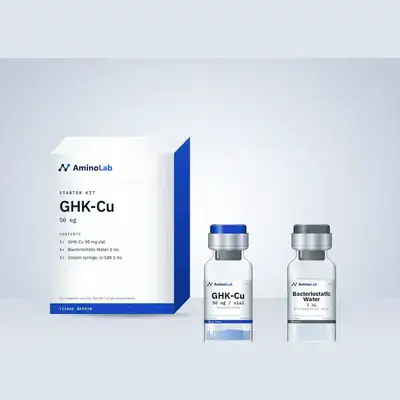
Newcomers to copper peptides, pilot assays and method development all suit the 50 mg vial, which is also what the GHK-Cu Starter Kit contains, plus a syringe and diluent. Teams running plate after plate for weeks get more for their money from the 100 mg vial. In short, the GHK Cu peptide price depends on fill, and the larger fill brings the GHK Cu peptide cost per milligram down.
When you buy GHK copper peptide for a series of experiments, note each vial's lot code so the right certificate is filed with every run. Short sequences are cheap to make, so GHK-Cu peptides tend to be weighed in tens of milligrams, which explains why both fills outsize most vials in our catalogue. Only adults 18 and over can check out.
Is the copper really there? Look, then read. A proper cake is unmistakably blue, and white suggests a missing metal. On paper, the mass should sit near 401.9 g/mol, the value for the copper-bound form. The HPLC section then states purity for that lot and the date it was analysed. Expect that same blue copper peptide shade, the normal GHK Cu peptide colour, in any GHK Cu peptide vial from us.
Every report is filed by lot code in the COA library, open to read before ordering. Shopping around for GHK Cu peptides? Lay other suppliers' certificates alongside this one. Also note that HPLC purity is not the same figure as net peptide content, which matters when you make stock solutions by weight and need a pure copper peptide powder whose peptide mass is actually known.
The GHK Cu copper peptides on this page are sold online only. No walk-in store exists. We pack from Australian shelves and post with tracking to all states, and anything paid for by 3pm on a business day is dispatched that day. Wondering how to get GHK Cu peptide onto the bench without an overseas wait? Use a local supplier that shows its certificate. When you buy copper peptides from this page, we ship GHK peptide Australia wide, and every copper peptide Australia customer gets the identical tested complex, whichever fill they pick. That is why the GHK Cu peptide buy choice is usually just about size. All copper peptides Australia orders from AminoLab come with the same documentation.
Warm the vial up first. Run bacteriostatic water gently down the inside wall and give a light swirl, and the powder will dissolve within moments. As a worked example, 2 mL makes 25 mg/mL in the 50 mg vial and 50 mg/mL in the 100 mg vial. Steer clear of buffers with EDTA or reducing agents, which strip or change the copper. Other volumes are handled by the GHK-Cu reconstitution calculator.
How to store GHK Cu peptide comes down to three words for GHK-Cu peptide powder, cold, dark and dry. Unopened vials go in a -20 °C freezer, shielded from light. Split any solution into aliquots kept between 2 and 8 °C, finish them within 28 days, and bin anything cloudy, green or faded.
Chemists write it out in full as glycyl-L-histidyl-L-lysine copper(II), cosmetic chemists use copper tripeptide-1, and catalogues mix GHKCu, GHK-Cu and copper GHK. Shop listings add the GHKCu copper peptide, while a reagent sheet might simply say GHK copper peptide. Journal articles often just write GHK, or GHK peptide. Of all the copper peptides 1 complex dominates the literature, and supplier catalogues group it with relatives like AHK-Cu, which has a different sequence. You may also see copper peptides GHK Cu, or the reversed form peptide GHK-Cu, both naming this vial. On invoices it can appear as GHK Cu peptide 100mg or as GHK Cu peptide 50mg. Older price lists bundle GHK copper peptides, Cu GHK peptide and GHKCu copper peptides into one line. As for the difference between peptides and copper peptides, it is simply the metal. Remove it and you get plain GHK, which does not behave the same way at the bench.
Whatever the label, the formula is C14H22CuN6O4 and the CAS number 89030-95-5. Reviews describing GHK-Cu peptide benefits are condensing cell and animal results, and we make no such claims for this product. The same caution applies to the benefits of GHK peptide reported in papers, to general copper peptide benefits, and to the published benefits of copper peptides for skin cells, every one of them measured in culture, explants or animals. Expect to see it discussed alongside terms such as TIMP, MMP, decorin, copper chaperone, fibroblast and collagen types I and III. At AminoLab all of them point to this one listing.
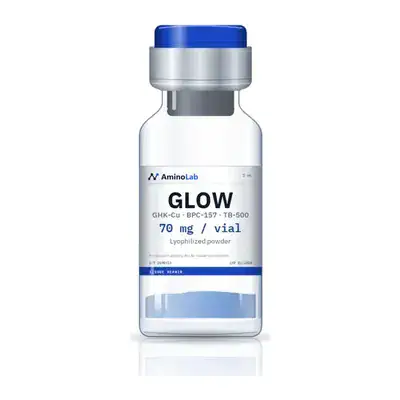
If copper is the thing you are testing, or you need to dial the tripeptide concentration up and down freely, buy the single vial. If your method already fixes a 50 to 10 to 10 mix of GHK-Cu, BPC-157 and TB-500, GLOW saves a step. Bear in mind that ratios inside a blend are permanent, so individual vials are the more flexible route.
For the differences between the two blends, read GLOW vs KLOW. Both include the copper peptide this page sells by itself.
Of all the peptides Australia researchers order for skin and hair studies, GHK-Cu is the one we ship most. Each 50 mg or 100 mg vial is the same copper peptide complex, GHK bound to copper(II), and both sizes carry a lot certificate for identity and purity. If your study compares a topical form with the research vial, read our GHK-Cu serum guide first.
Copper peptides have a long research history in wound healing, collagen remodelling and hair follicle models, which is why so many labs ask about copper peptides benefits before they order. The vial is sold as a research reagent only and is never for injection or human use.
GHK-Cu is a lab-synthesised copy of a plasma molecule, made of glycine, histidine and lysine around one copper ion, and it is in stock in Australia.
Each holds blue powder only, so add bacteriostatic water to your order or buy the starter kit.
Collagen output, matrix turnover and copper handling are measured in rodent wounds and cultured fibroblasts, never outside the lab. Work on GHK Cu peptide for skin research typically uses explants and dermal fibroblasts.
Choose this listing for the copper peptide by itself, or GLOW for a premix that adds TB-500 and BPC-157.
Freeze the unopened vial and keep mixed solution refrigerated in aliquots. Discard anything that goes green or fades.
Every lot is tested by HPLC and mass spectrometry, and its certificate is in the COA library under the code on the label before you order.
Order it from the AminoLab online store, which ships from local stock to every state and territory. Choose a fill, check out, and if you pay before 3pm on a business day you get same-day dispatch. We have no shop or pickup point, so all labs order online.
Not from us. We are online only, and the vial travels by tracked delivery from our Australian stock to cities and country towns alike. Skincare shelves in shops hold formulated cosmetics, a separate category from this lyophilised reagent, and buying online lets you read the lot certificate first.
Start with the 50 mg vial for pilot runs and method work. Move to the 100 mg vial for better value per milligram when your team runs repeat assays and can use the solution within 28 days of mixing. Record each vial's lot code so the matching certificate is filed with your data.
Copper(II), clamped by nitrogens on the histidine and glycine. Deep blue powder means the complex has formed. Pale or white powder hints that copper is absent, and a solution that clouds or turns green belongs in the bin.
Yes. Every lot is checked by mass spectrometry for the copper complex and by HPLC for purity, with each report searchable in the COA library by the code on your label. Confirm the powder is blue when it arrives, then keep the lot code with your study notes.
No. It is sold as a research reagent for in vitro lab work, only to adults aged 18 and over. Nobody has formulated or approved it as a skin treatment, therapeutic good or cosmetic, and it must not be used on people or animals.
Research use onlyAminoLab supplies research compounds for laboratory and in-vitro use, not for human or animal consumption. By continuing you confirm you are 18 or older and buying for research.
Leave