BPC-157
10 mg vial, 60 capsules
From $69
Short answer first. A GHK-Cu serum and copper peptide serum are skincare products, liquids or creams with a tiny amount of copper peptide stirred in, and the ingredient panel calls that peptide copper tripeptide-1. AminoLab sells none of them. Our product is the pure peptide as a dry powder in a sealed vial for laboratory work. Below we explain how to read a cosmetic label properly and why a research vial is a completely different thing.
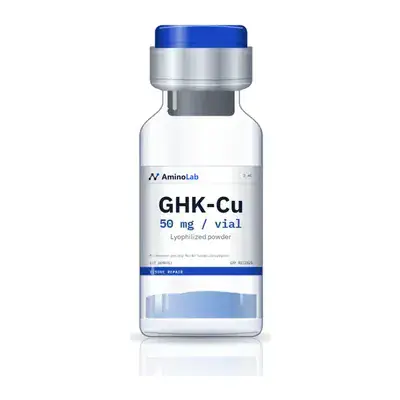
It helps to be clear from the start, because many people reach us expecting skincare. We do not produce, stock or endorse face serums, body creams, lotions or scalp treatments of any kind. AminoLab is a laboratory supplier. We sell freeze-dried GHK-Cu in glass vials so that researchers can weigh a known amount into an experiment.
The molecule in both is the same, but almost nothing else is. A skincare bottle is a finished recipe. It is mostly water, plus ingredients that hold moisture, stop microbes growing and thicken the texture, all designed to survive months on a bathroom shelf. A vial is one ingredient with a test report and no recipe at all. If you would like to understand the peptide itself before going further, start with our explainer on what GHK-Cu is.
GHK-Cu is a chain of three amino acids, glycine, histidine and lysine, wrapped around a copper ion. Skincare labels never print the letters GHK-Cu, though. They must use the INCI system, an international set of standard names for cosmetic ingredients, and under that system the copper complex is called copper tripeptide-1. A US expert panel, the Cosmetic Ingredient Review, examined this ingredient and its relatives and reported in 2018 in the International Journal of Toxicology that they were considered safe at the levels then used in cosmetics.
That review also shows why you should read the name carefully, because the GHK family has several members with confusingly similar names.
In short, a bottle labelled simply peptide serum may hold GHK with no copper whatsoever. Genuine serums with copper peptides should show copper tripeptide-1, or another copper form, somewhere on the panel.
Australian rules for skincare differ from those for medicines. New cosmetic chemicals are introduced through AICIS, the national industrial chemicals scheme, and the ACCC polices the 2020 cosmetics information standard. Under that standard, ingredients appear by their INCI names from highest to lowest concentration, except that anything making up 1% or less can be listed in any order at the bottom. The TGA steps in only when a product claims to treat something. In its guidance, a line about collagen helping fine lines look smoother is a cosmetic claim, whereas a line about switching on collagen to repair skin cells is a therapeutic one.
Skincare uses remarkably little of this peptide. The ingredient review found that GHK-type peptides were usually added at under 10 parts per million, and one company reported using between 1 and 30 parts per million. The highest level anyone reported across the whole group was 0.002%, and that figure belonged to a different peptide in a leave-on product. Put another way, 10 parts per million means 0.001%, which is just 10 micrograms of peptide in every gram of cream. Compare that with a research vial, which holds 50 or 100 milligrams of nothing but GHK-Cu.
A low level is not automatically useless, because lab studies on cells see responses at astonishingly small concentrations. A 2023 article in Pharmaceutics, which looked at GHK-Cu packed into liposomes, mentioned reports of more collagen and elastin at between 0.01 and 100 nanomolar. The harder problem is getting the peptide through skin in the first place.
GHK-Cu loves water, and water-loving molecules find it hard to pass the tough outer layer of skin, a point the same Pharmaceutics team made. That is the reason the best-known controlled human study, published by Badenhorst and co-workers in the Journal of Aging Science in 2016, carried GHK-Cu inside tiny lipid particles. It is also why so much formulation work focuses on liposomes. The Pharmaceutics group, for example, loaded 0.5 mg of peptide into each cubic centimetre of liposome suspension and held the pH at 6.
The practical takeaway is simple. When judging a topical GHK-Cu peptide product, the delivery system and the pH reveal more than any percentage printed on the front. If you want to know what the human cream studies measured and for how long, our GHK-Cu before and after study summary sets it out.
People who already own several bottles often ask what they can layer together. Much of the answer comes down to chemistry.
GHK grips its copper with three nitrogen atoms, one at the glycine end, one along the peptide backbone and one in the ring of histidine. How firmly it grips depends on acidity. Bossak-Ahmad's group published figures in the International Journal of Molecular Sciences in 2020 showing the binding constant changing from about 0.24 picomolar at pH 7.4 to about 20.9 picomolar at pH 6.5, a big weakening for a small shift. Push the pH lower still and hydrogen ions start fighting copper for those nitrogen sites. That is why strong acid exfoliants and copper peptides make poor partners.
A 2001 paper by Pinnell and colleagues in Dermatologic Surgery found that L-ascorbic acid has to be made up below pH 3.5 to enter skin, a level where the copper complex is far from stable. On top of that, copper accelerates the oxidation of vitamin C, flipping between two charge states and releasing hydrogen peroxide in the process, as summarised in a 2021 Scientific Reports review. Combine them in one bottle and they wear each other down, which is why many brands sell them separately.
Ufnalska and her colleagues reported in Inorganic Chemistry in 2021 that glutathione strips electrons from the copper in GHK-Cu via a short-lived middle complex. Biologically, that might be one way GHK delivers copper to cells. Practically, it means a formula holding both is not two stable actives side by side.
We searched for a controlled trial that tested GHK-Cu together with a retinoid, in one product or one routine, and found none. A small 1998 biopsy study that is often mentioned did compare GHK-Cu with a retinoic acid cream, but as separate groups, not as a combination. So claims that copper peptides and retinol help each other, or cancel each other, are unproven in both directions. Anyone asking can you use copper peptides with retinol deserves an honest reply, which is that the chemistry neither forbids nor supports it, and that the acidity and preservatives of each product matter more than the pairing. Personal routine questions belong with a dermatologist, not a chemical supplier.
Copper is what makes GHK-Cu blue. Without copper, GHK is colourless. Open one of our 50 or 100 mg vials and the powder is a vivid blue. A cosmetic holding only a few parts per million may look completely clear, so clarity proves nothing, and a deeply blue serum either contains more of the complex or has added colour. If a serum that started clear turns cloudy or leaves sediment, something has dropped out of solution.
Purity matters as much as colour. The ingredient review mentioned that commercial copper tripeptide-1 came in at roughly 95% purity and sometimes carried traces of mildly neurotoxic leftovers that an extra purification step could mostly remove. No skincare label discloses that. A batch certificate does, and this is the point where cosmetics and research reagents go completely different ways.
Most people shopping for a copper peptide serum Australia wide start with a brand name. The most famous is The Ordinary Multi-Peptide + Copper Peptides 1% Serum, which was once called Buffet + Copper Peptides 1%. The 1% in its name refers to the copper peptide portion. The same brand sells a multi-peptide serum with no copper, so check the label carefully. When someone mentions a 1% copper peptide serum, they almost always mean that bottle or a competitor modelled on it.
| Product type or name | Base | Where it sits in the market |
|---|---|---|
| The Ordinary Multi-Peptide + Copper Peptides 1% Serum | Watery serum | Budget pick that mixes copper and non-copper peptides |
| NIOD copper peptide serums | Serum, sister brand | Premium tier with higher claimed strength |
| Biossance Squalane + Copper Peptide Rapid Plumping Serum | Squalane oil base | Richer feel than a water serum |
| GHK-Cu peptide creams and lotions | Cream | Heavier texture, often with ceramides |
| Copper peptide hair serums | Light liquid or mist | Made for the scalp, usually with botanicals |
We name product types rather than copy ingredient lists, because recipes change and only the box in your hand is reliable. A copper peptide facial offered by a clinic normally means a serum applied after another treatment, so judge whatever product they use with the same label rules. For cosmetic peptides that contain no copper, see our wider guide to peptides for skin.
| Feature | Skincare product | AminoLab vial |
|---|---|---|
| Purpose | Daily cosmetic use | Laboratory experiments |
| Label name | Copper tripeptide-1 | GHK-Cu with fill in mg |
| Peptide content | Parts per million, often unstated | 50 mg or 100 mg, stated |
| Everything else inside | Water, moisturisers, preservatives, thickeners, scent | Nothing |
| Proof of identity and purity | Seldom shared | Batch report with mass and HPLC results |
| How to store | Shelf, for months | Freezer at -20 °C until dissolved |
| Rules in Australia | AICIS and the ACCC labelling standard | Lab chemical, research use only |
| Do we sell it | No | Yes |
In a lab, only the vial works, because an experiment depends on knowing exactly what you added. A serum blends a dozen ingredients at unknown amounts, so it cannot serve as a test sample for GHK-Cu. A vial offers a single compound at a known weight, checked by an independent lab, ready to dissolve to the strength your method calls for. Our GHK-Cu peptide calculator handles the maths for both sizes, and every batch report sits in the COA library.
We sell GHK-Cu strictly for lab research, under our research use only policy. The vials are not cosmetics, were never made or tested for skin, and must not be turned into serums, creams or anything for personal use.
Whatever it is called, a GHK Cu peptide serum shares one molecule with our vials and little else. Copper peptides serum products list copper tripeptide-1 at parts per million in a preserved liquid, and a GHK Cu peptide cream does the same in a thicker base. Labelling varies a great deal. You may see GHK copper peptide serum, GHK Cu peptides serum, or even the run-together spelling GHKCu peptide serum, and each of these should still show copper tripeptide-1 on the panel, because without it there is no copper. A GHK-Cu peptide serum sold as the best copper peptide serum earns that title only through its label, so check the name, the carrier and whether the pack keeps out light and air.
Talk of GHK Cu peptide topical use really comes down to penetration. Any GHK Cu topical peptide, or topical GHK Cu peptide, has to cross the skin's outer barrier before it can do anything, which is why the liposome and lipid particle studies above matter more than the number on the bottle. If you are comparing the best copper peptide serum Australia shops stock, use the five-point check on each one and ignore price and packaging. The same advice applies across all copper peptide serums and other copper peptide skincare products.
Copper peptides reach the shelf in two main textures. A serum is thin and watery, absorbs quickly and usually comes in a dropper bottle. A copper peptide cream is thicker, often built on oils, waxes and emulsifiers, and usually sold in a jar or pump. The texture changes how a product feels, but it also changes how well the peptide survives. Jars let in air and light every time they are opened, and both can slowly affect a copper complex. Airless pumps and opaque bottles protect it better.
The base also affects how much peptide reaches skin. Oily creams can help some ingredients sit longer on the surface, while watery serums spread thinly and dry fast. For a water-loving molecule such as GHK-Cu, neither format solves the penetration problem on its own, which is why formulators turn to carriers such as liposomes. When choosing between the two, look at the packaging, the pH and whether the brand names its delivery system. Those details say more about quality than whether the product is called a serum or a cream.
For researchers, none of this applies. A lab does not need a base, a fragrance or a pump, only the pure compound with a test report, which is exactly what our vials provide.
A copper peptide serum for hair is normally a leave-on liquid or mist applied to the scalp, often blended with plant extracts. Copper peptide serum hair products follow the same labelling rules as face products, so copper tripeptide-1 should appear on the panel. Take care with any copper peptides serum for hair growth that promises new hair, because regrowing hair is a therapeutic claim and such a product would need ARTG listing in Australia. A cosmetic copper peptide hair serum may only talk about how hair looks and feels.
If your work is laboratory research, buy the compound itself rather than a cosmetic. AminoLab supplies GHK-Cu as pure blue freeze-dried powder in 50 mg and 100 mg vials, sent from Australian stock with a batch certificate. New labs often start with the GHK-Cu Starter Kit, which adds water and a syringe, while the GLOW blend pairs GHK-Cu with two repair peptides. Read the safety research in our GHK-Cu side effects guide, see how batches are verified on the lab tested peptides page, and browse every compound on peptides for sale in Australia. If what you want is a GHK-Cu serum and copper peptide serum for your own skin, buy a finished product from a skincare shop, because our vials are research reagents only.
They are the same compound under two names. Skincare panels must use the INCI name, copper tripeptide-1, for GHK carrying copper. Watch for look-alikes, because tripeptide-1 has no copper and palmitoyl tripeptide-1 has a fatty tail and no copper either.
Not well in a single formula. Vitamin C as L-ascorbic acid needs a very acidic pH to work in skin, where the copper complex comes apart, and copper also speeds up vitamin C breakdown. Brands usually sell them in separate bottles. For advice on your own routine, see a dermatologist.
Very little, typically under 10 parts per million according to the US Cosmetic Ingredient Review, with one maker reporting 1 to 30. Many labels give no number. The delivery system matters just as much, since GHK-Cu struggles to pass through skin unaided.
No. Our vials are lab reagents for research only. They contain no preservatives, were never tested as cosmetics, and we provide no guidance on making skincare from them. Buy a finished serum from a skincare retailer instead.
No controlled study has tested them together. Formulators tend to keep them in separate products, because retinoid recipes often use a pH and antioxidants that do not suit the copper complex. Whether they suit your skin is a question for a dermatologist. AminoLab sells GHK-Cu as a research reagent only.
Yes, for lab research. AminoLab ships freeze-dried GHK-Cu in 50 mg and 100 mg vials from Australian stock, each batch certified by an outside laboratory. It is a reagent rather than a cosmetic, so it is not made or tested for skin, and anyone wanting a serum should buy one from a skincare store.
10 mg vial, 60 capsules
50 mg vial, 100 mg vial
10 mg vial
3 mL, 3 mL + 1 syringe, 10 mL, 10 mL + 1 syringe, 30 mL, 30 mL + 1 syringe
Research use onlyAminoLab supplies research compounds for laboratory and in-vitro use, not for human or animal consumption. By continuing you confirm you are 18 or older and buying for research.
Leave