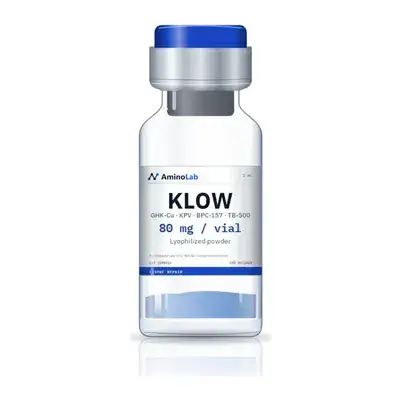
KLOW
80 mg vial
$139
$129 AUD, GST included
Minimum order before shipping, and you can mix any products to reach it.
In stock, ready to ship from Australia
Frequently ordered with
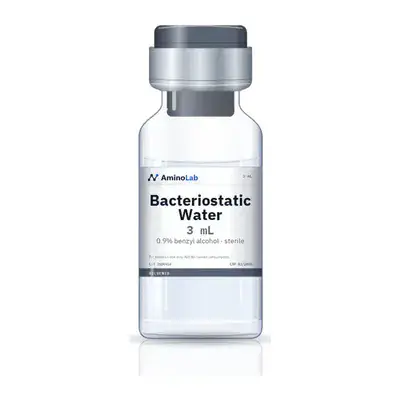 Bacteriostatic Water
Sold to buyers aged 18 and over only.
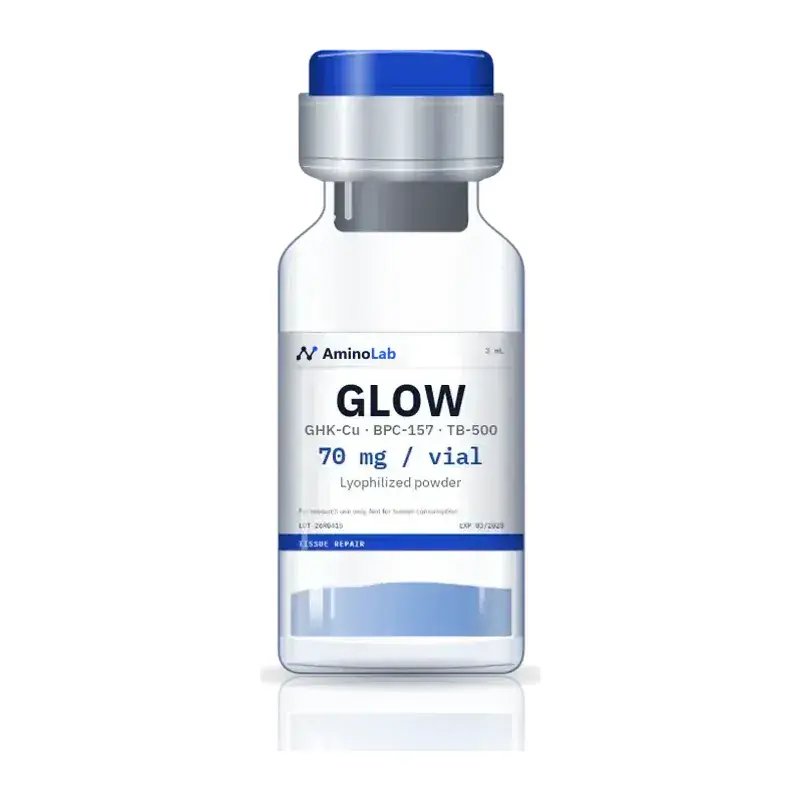
Buy GLOW Peptide in Australia from AminoLab, with the 70 mg vial in stock and ready to ship. Our GLOW peptide Australia listing comes down to a single item, a vial weighing in at 70 mg. Inside, 50 mg of GHK-Cu shares one freeze-dried cake with a 10 mg portion each of TB-500 and BPC-157. The copper tripeptide is the bulk of the fill, which is where the blue colour comes from, and the two smaller partners round the recipe out to the 50 to 10 to 10 proportion that many remodelling protocols ask for. Because the mixing is done for you, there is one vial to dissolve and one certificate to file, not three. Each lot is run through mass spectrometry, which must find every one of the three peptides, and through HPLC for purity, and you can read that report while the vial is still in your cart. If a fourth peptide, KPV, belongs in your design, look at the KLOW blend. The cake ships dry, so pick up bacteriostatic water and plan strengths with the peptide calculator. Freeze the unopened vial at -20 °C in darkness. Place your GLOW Peptide order today and we send it from Australian stock, strictly for laboratory work by adult buyers.
For laboratory research use only. Not for human or veterinary use. Not TGA approved. See our research use policy.
| Listing | GLOW blend (GLOW 70) |
|---|---|
| Recipe | 50 mg of GHK-Cu, the Gly-His-Lys copper complex, plus 10 mg of TB-500, a synthetic thymosin beta-4 fragment, plus 10 mg of BPC-157, a chain of 15 amino acids |
| Appearance | A blue lyophilised cake inside a sealed 3 mL glass vial, topped with a blue cap |
| Release checks | HPLC for purity, and mass spectrometry that must detect all three peptides, documented on one certificate per lot |
| Packed contents | Just the 70 mg vial of blended powder, with diluent bought separately |
| Keeping it | Frozen at -20 °C and sealed in the dark, moving to a 2 to 8 °C fridge after reconstitution |
| Can I order now | In stock |
| Sold for | Laboratory in vitro research only |
Pick this vial when the design wants the trio held at one fixed ratio and documented under one lot. Stock sits in Australia, and a lot only goes on sale after every check on it has cleared.
Strip away the catchy name and the GLOW peptide is a convenience blend. One of its three parts is a copper carrier, GHK-Cu. Another, BPC-157, traces back to a stomach protein. The third, TB-500, is a short piece of thymosin beta-4 that binds actin. Some sellers call it a GHK Cu glow peptide, and that is fair, because by any measure it is mostly copper peptide with two repair compounds stirred through. No fresh molecule is created when they are lyophilised side by side.
Lab models of wound healing tend to describe four stages that overlap, starting with clotting and inflammation and moving on to proliferation and finally remodelling. This blend is pitched at stages three and four. Proliferation needs cells to migrate into the wound and capillaries to sprout after them, roughly the territory of TB-500 for the first job and BPC-157 for the second. Remodelling is when fibroblasts lay collagen down and later reorganise it, and turnover of that matrix is the area where copper tripeptide research runs deepest. Nothing anti-inflammatory is included, by design, and that gap is what separates GLOW from the four-peptide KLOW. For each ingredient on its own, see GHK-Cu, the copper carrier and TB-500, the thymosin fragment.
Any blend containing copper invites a sensible worry, namely that the metal might hop onto neighbouring peptides in solution. In peptides, copper clings most strongly to histidine and cysteine. TB-500 has neither residue, and BPC-157 has neither either, so GHK should keep hold of its copper. On that basis this particular combination is chemically defensible, and not every cleverly named blend can say the same.
Run those numbers and most GHK Cu peptide vs GLOW peptide disputes resolve themselves. On a molecule count the vial is mainly copper tripeptide, so in a fibroblast plate it will act a great deal like GHK-Cu plus small additions. That explains why glow peptide for skin research mostly happens in dermal fibroblast cultures, skin explants and wound closure work in rats and mice, where the useful question is whether the two minor ingredients move closure rate or capillary density past what copper tripeptide does by itself. To answer that, set up a copper-only control at an equal concentration. Mixed with 2 mL, this vial carries 25 mg/mL of GHK-Cu, and without a matching control arm the blend data floats free of any comparison. AminoLab sells it for labs that want those three compounds in one vial and one certificate.
Every part of GLOW arrived with its own research trail. GHK-Cu was first pulled out of human plasma, and much of its work concerns collagen made by fibroblasts. BPC-157, fifteen residues long and based on a gastric protein, has been tested in gut, tendon and soft tissue models. TB-500, a synthetic stretch modelled on thymosin beta-4, is known mostly for actin binding and for effects on how cells migrate. Put together, it becomes a glow copper peptide blend carrying two repair partners, which is different from a single novel compound.
No new mechanism appears when they are combined. What changes is logistics, because a lab can examine the combination in angiogenesis, fibroblast or wound closure models without making three separate stocks. Since copper tripeptide accounts for the colour and most of the weight, base your figures for the two minor ingredients on their own fraction of the fill. AminoLab lists it purely as a research reagent, with no cosmetic or medical standing, in the peptide blends section. Whatever the name hints at, the product has nothing to do with glowing peptides in the fluorescent sense, and tags like glow skin peptide are marketing labels rather than promises. Order the blend online and it ships from Australian stock with all three ingredients documented.
Hold it up and you will find one tight blue cake at the bottom of the 3 mL vial with the blue cap on top. The copper tripeptide accounts for 50 mg of the total, and the two repair peptides split the last 20 mg between them evenly. No liquid, no buffer and no fourth compound is present, and once the blend is filled the parts cannot be pulled apart. GLOW is a catalogue label, not a molecule with an inventor or papers of its own, so its legal position simply adds up the three ingredients.
Two of its ingredients need a prescription. Schedule 4 of the Poisons Standard has covered BPC-157 since 1 June 2024, and TB-500, along with the parent thymosin beta-4, has Schedule 4 listings too. The copper component, the GHK Cu glow peptide part of the mix, was singled out by name when the TGA published its April 2026 advisory on unapproved peptide products. No medicine on the ARTG contained any of the three at October 2026, which means no pharmacy can lawfully hand over a registered version. Sport is closed off as well, because WADA lists two of the ingredients (BPC-157 under S0 and TB-500 under S2). Copper tripeptide-1 face creams on retail shelves fall into a different cosmetic category and tell you nothing about this vial.
All of this is why anyone wanting to buy GLOW peptide in Australia ends up at a research supplier. AminoLab stores the 70 mg glow peptide GHK Cu blend locally strictly as a lab reagent for in vitro work, sold to adults 18 and over and never for any human or veterinary purpose. If your work needs the copper tripeptide on its own, without either repair partner, start from the GHK-Cu Starter Kit instead, and read the GHK-Cu explainer for background on that dominant ingredient. AminoLab sells it strictly as a research reagent to buyers aged 18 and over.
We make it in a single size, 70 mg. Recreating that recipe from stand-alone vials would leave you mixing three products and filing three certificates, which is why the blend suits work where the proportions are locked before the first run. Should one of the three need to change, buy the single-compound vials and combine them yourself.
A vial reconstituted with 2 mL usually stretches across a typical cell culture series before its 28 day limit. If a project runs longer, buy the vials together and log every label's lot code next to its matching certificate. Only adults aged 18 and over can check out, and age is confirmed at that step.
Testing a single peptide is simple, but a three-part blend has to show that each part is genuinely there, not merely the biggest one. Our certificates list mass spectrometry hits for the copper tripeptide and for both repair peptides, and add the HPLC trace and the analysis date. A deep blue cake is normal. Pale or white powder would hint at too little copper peptide.
By weight the copper tripeptide is five times each partner, so it dominates the chromatogram, and it is the two small peaks you should hunt for. From a lab point of view, the best glow peptide is the vial whose certificate accounts for every ingredient, whatever the box claims. Type your label's lot code into the COA library, where multi-peak blend reports are kept alongside single-compound ones. Read that report before you order, so you know exactly what the lot contains.
There is no counter to visit. GLOW is ordered from this page and leaves our Australian stock with tracking for any address in the country, and anything ordered by 3pm on a working day goes out that afternoon.
Let the vial warm to room temperature before you add bacteriostatic water, aiming the stream at the glass wall and swirling lightly until the blue liquid turns clear. At 2 mL the solution holds 35 mg of total peptide per mL, which breaks down as 25 mg/mL copper tripeptide and 5 mg/mL each of the two repair peptides. For any other volume, let the peptide calculator do the arithmetic.
Unopened vials belong in a -20 °C freezer, kept dark. Mixed solution goes into a 2 to 8 °C fridge as aliquots, should be used up within 28 days, and must be discarded if it clouds or fades. Store it standing upright so the stopper stays dry between withdrawals, and follow the reconstitution guide for technique.
Look around and you will find the same product sold as GLOW 70, the GLOW stack, or glow blend peptides GHK-Cu, and occasionally described only by what is in it. Spellings such as GHK Cu GLOW peptide and peptide glow GHK Cu circulate as well, and a handful of listings write the ingredients out in full, copper tripeptide-1 with body protection compound 157 and a thymosin beta-4 fragment. Some shops sell it as a skin glow peptide, and round-ups of skin glow peptides tend to group it with other copper blends, yet at AminoLab it remains a laboratory reagent for fibroblast and wound models.
Every one of these labels points at an identical 70 mg fill in the 50 to 10 to 10 recipe. Research phrases that cling to it, such as angiogenesis, extracellular matrix, tissue remodelling or fibroblast migration, name areas of study and do not signal a different product, ratio or testing standard. At AminoLab every one of those labels points to this single 70 mg listing.
Comparing GLOW peptide vs GHK-Cu comes down to how many variables you want. Stay with GLOW when the protocol asks for copper tripeptide and both repair peptides at once. Switch to GHK-Cu by itself when copper should be the one thing that changes, since a premixed blend cannot be re-weighted afterwards. Step up to KLOW if KPV, the alpha-MSH derived tripeptide used in inflammation research, belongs in the design, which raises the fill to 80 mg.
For a detailed comparison, our GLOW vs KLOW guide sets out both blends. When neither recipe suits, separate vials of each ingredient give full control, with the trade-off of extra preparation and more certificates to manage. All three are in stock, so whichever route your design takes can be ordered today.
A copper tripeptide and two repair peptides are lyophilised together at 50 to 10 to 10 to make the 70 mg GLOW fill, in stock in Australia.
The blue vial contains powder only, so bacteriostatic water should go in the cart beside it.
Labs buy it for fibroblast cultures, wound closure studies and blood vessel formation models that call for all three compounds at once, strictly for research.
KLOW adds KPV to the same trio and reaches 80 mg, while GLOW stops at three peptides.
Freeze the sealed vial at -20 °C, then refrigerate the reconstituted solution in aliquots and finish it inside 28 days.
Each lot's certificate shows mass spectrometry hits for all three peptides plus an HPLC purity result, filed in the COA library before the lot goes on sale.
AminoLab ships the 70 mg vial from local stock, with same-day dispatch when you order before 3pm on a working day. The certificate for the lot is online before you pay, so you can check that all three peptides were detected. The powder comes dry, so bacteriostatic water is a sensible add-on.
Our online store is the stockist, sending tracked parcels to all states and territories. With no walk-in shop, a regional lab and a city lab buy exactly the same way, from one Australian stock, and both see the certificate before spending a cent.
A 70 mg vial carries 50 mg of copper tripeptide (GHK-Cu) and 10 mg each of the two repair peptides, BPC-157 and TB-500, in one blue cake. Reconstituted with 2 mL it holds 35 mg of total peptide per mL, and the peptide calculator rescales that for any other volume.
Yes. Mass spectrometry confirms each of the three peptides in every lot and HPLC reports purity. Find the report in the COA library using the lot code printed on your vial, before or after you buy.
Choose GLOW for the copper tripeptide plus both repair peptides at a set ratio. Choose GHK-Cu on its own when copper is the only variable. Choose KLOW when KPV, the alpha-MSH derived tripeptide, should join the mix. Any other proportion means buying the ingredients individually.
No. It is a research blend supplied for in vitro laboratory work only, to buyers aged 18 and over. It is not a cosmetic, therapeutic good or skin product, carries no outcome claims and is never supplied for human or veterinary use.
Research use onlyAminoLab supplies research compounds for laboratory and in-vitro use, not for human or animal consumption. By continuing you confirm you are 18 or older and buying for research.
Leave