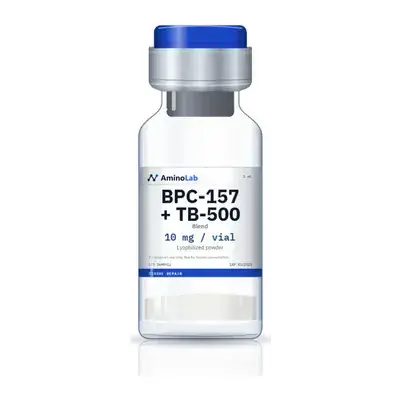
Wolverine Blend (BPC-157 + TB-500)
10 mg vial
$69
AminoLab stocks peptide blends Australia labs can order online in one vial instead of two, three or four. On the shelf are two copper peptide blends, GLOW and KLOW, the Wolverine Blend (BPC-157 with TB-500), and two secretagogue pairings built on ipamorelin, one with CJC-1295 and one with tesamorelin. Each component in every blend is lab-tested, each lot is tied to its certificate of analysis by number, and all orders leave from within Australia.
10 mg vial
80 mg vial
10 mg vial
13 mg + 3 mg vial
70 mg vial
A blend is two or more peptides freeze-dried together into a single cake. That means one reconstitution, one lot number to record and one container on the bench rather than a row of them. What you give up is flexibility, since the ratio is set when the vial is made and no single component can be adjusted on its own. Blends make the most sense when the combination is itself the thing under study and the protocol has already fixed the proportions. If the question is how one compound stacks up against a second, separate vials serve better.
Running single vials as controls beside a blend is good practice. Every part of a blended cake has seen the same storage and the same handling, so that source of variation between arms disappears. The catch is that a blend on its own cannot reveal which ingredient drove a result, and the single compound controls are what make that attribution possible.
The Wolverine Blend is a 10 mg vial split evenly between BPC-157 and TB-500, 5 mg apiece. BPC-157 is a 15 amino acid sequence taken from a protein in gastric juice, while thymosin beta-4 is the parent of the synthetic TB-500. Each works by its own mechanism in wound, muscle and tendon models, and they turn up together so often that many research groups prefer a combined vial. For a look at each compound on its own terms, read our BPC-157 vs TB-500 guide.
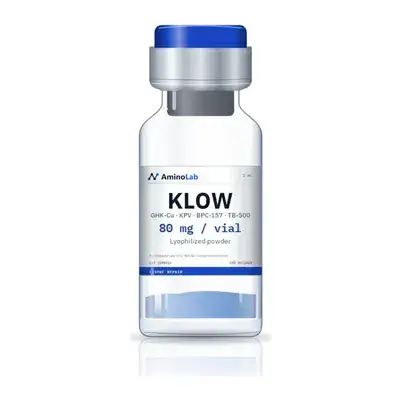
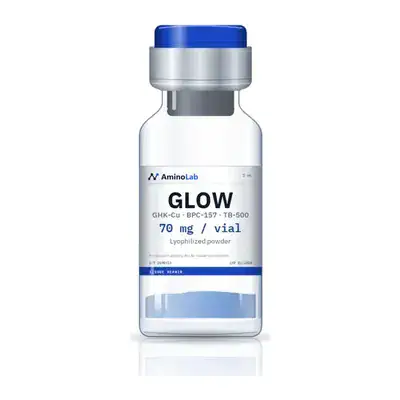
GLOW takes that pair and adds the copper peptide GHK-Cu, which makes up most of a 70 mg vial. KLOW goes one step further with KPV, the Lys-Pro-Val tripeptide of interest in inflammation models, supplied as an 80 mg vial. Expect both powders to look blue, which comes from the bound copper. Choose KLOW when KPV has a role in the design.
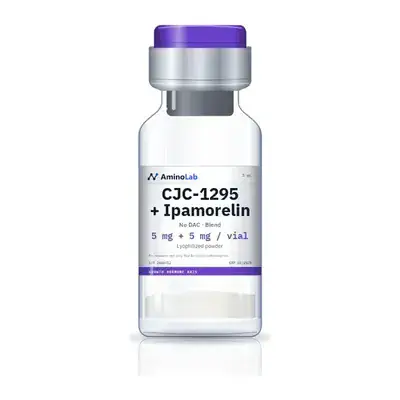
For pulsatile release work, the CJC-1295 and ipamorelin blend pairs CJC-1295 No DAC with ipamorelin. The first is a GHRH analogue, also known as Modified GRF 1 to 29, which clears in roughly 30 minutes (its half-life). The second is a selective ghrelin receptor agonist. Together they reach the pituitary by two different routes, all in one 10 mg vial, and because the CJC part acts briefly, each pulse stays short.
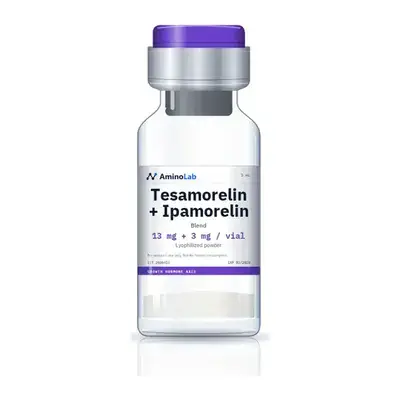
Only the tesamorelin and ipamorelin blend has uneven parts. Inside sit 13 mg of tesamorelin, which is the complete 44 amino acid GHRH analogue, and 3 mg of ipamorelin. Labs mostly pick it for body composition designs that want GHRH to dominate while still engaging the ghrelin receptor route. Further secretagogues are sold individually within the growth hormone peptides range.
Tissue repair models that need no copper are best served by the Wolverine Blend. GLOW fits work where skin remodelling and repair sit side by side, and KLOW is the step up once an inflammation endpoint joins the protocol. Pulsatile growth hormone release points straight to the CJC-1295 with ipamorelin vial, and the tesamorelin and ipamorelin blend fits designs that lean on GHRH. Should the method call for shifting one component's share, order the parts individually. A blend generally undercuts the matching singles on price, but separate vials hand you control of the ratio. In practice, the best peptide blends for a given study are those whose fixed ratio already matches the protocol.
Put bacteriostatic water in the cart too. Before mixing, note the total fill weight shown on the product page, because every component's strength depends on what fraction of that total it makes up. Where the two parts are equal, each compound accounts for half the fill. The tesamorelin and ipamorelin vial divides 13 to 3. Keep lyophilised blends frozen at minus 20 °C out of the light, and 2 to 8 °C is fine for short spells. A reconstituted vial lives in the fridge and is usually finished within 28 days, as set out in our peptide storage guide.
One weak ingredient undermines the whole vial, which is why nothing is left unchecked. Mass spectrometry from an independent laboratory confirms every compound expected in each lot, along with HPLC for purity. Enter the lot number printed on the vial into the COA library and the certificate comes up. Pay before 3pm on a business day and the order ships the same day, tracked, to every state and territory. The peptide calculator takes the total fill weight if you need the post-mixing concentration. All blends are sold for laboratory research only to adults 18+, are not TGA approved, and we offer no advice on their use in humans or animals.
| Blend | Fill | Format |
|---|---|---|
| Wolverine Blend | 10 mg (5 mg BPC-157, 5 mg TB-500) | Freeze-dried, in glass |
| CJC-1295 and Ipamorelin Blend | 10 mg | Freeze-dried, in glass |
| Tesamorelin and Ipamorelin Blend | 13 mg + 3 mg | Freeze-dried, in glass |
| GLOW | 70 mg | Freeze-dried, in glass |
| KLOW | 80 mg | Freeze-dried, in glass |
It is one vial where at least two research peptides were freeze-dried together into one cake. AminoLab carries five of them, namely GLOW, KLOW, the Wolverine Blend and the two ipamorelin pairings with CJC-1295 and tesamorelin. You reconstitute once and keep every component on the same lot, in exchange for a ratio you cannot change.
Generally, yes. Paying a little extra for singles buys you control over each compound's share.
BPC-157 is derived from a protein found in gastric juice, and TB-500 is synthesised to resemble thymosin beta-4. The two are studied for distinct mechanisms across wound, tendon and muscle models.
Each blend lot goes to an independent laboratory, where mass spectrometry confirms every component and HPLC measures purity. Type the label's lot number into our COA library to bring up its certificate and check the exact batch you hold before mixing it.
Work from the total fill weight on the label. For example, a 10 mg Wolverine vial mixed with 2 mL of bacteriostatic water holds 5 mg of combined peptide in every mL, which is 2.5 mg per mL for each part. Our peptide calculator copes with any fill weight and volume.
Research use onlyAminoLab supplies research compounds for laboratory and in-vitro use, not for human or animal consumption. By continuing you confirm you are 18 or older and buying for research.
Leave