BPC-157
10 mg vial, 60 capsules
From $69
$79 AUD, GST included
Minimum order before shipping, and you can mix any products to reach it.
In stock, ready to ship from Australia
Frequently ordered with
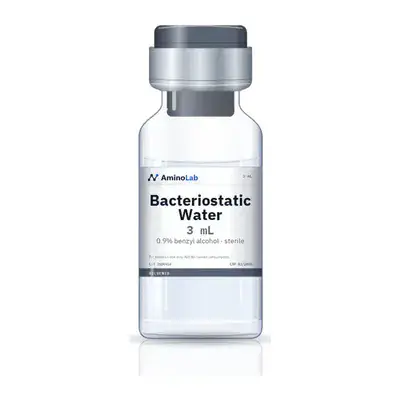 Bacteriostatic Water
Sold to buyers aged 18 and over only.
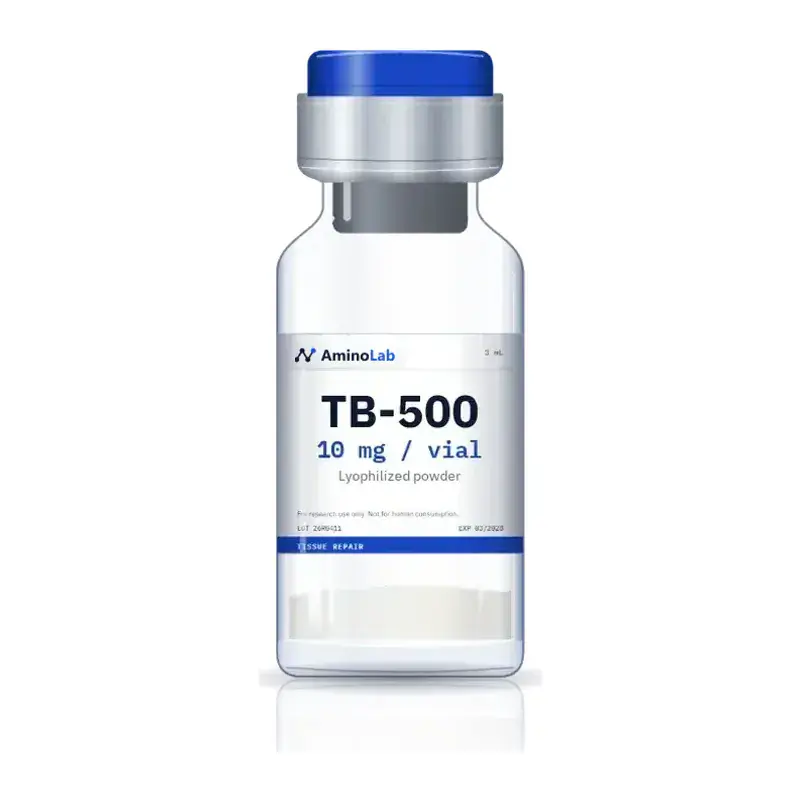
Order TB-500 Australia wide from AminoLab, packed as one 10 mg lyophilised vial and posted from local stock, with the lot certificate already online for you to read. The vial holds the acetylated seven-residue peptide Ac-Leu-Lys-Lys-Thr-Glu-Thr-Gln. In thymosin beta-4 numbering this is the 17 to 23 actin-binding segment, a small slice rather than the whole 43-residue protein. For the record, the formula reads C38H68N10O14, CAS is 885340-08-9 and molar mass is 889.0 g/mol. Since each certificate reports a measured mass you can tell straight away which molecule you have. No lot goes on sale until it has passed HPLC and mass spectrometry. Keep the TB-500 calculator handy, as it converts any diluent volume into a concentration. Researching two repair routes at once? Put BPC-157, the gastric pentadecapeptide linked to growth factor signalling, in the same order. No liquid is supplied with the powder, so add bacteriostatic water too. Hold the sealed vial at -20 °C in a dry, dark spot, and refrigerate it after mixing. Add TB-500 to your cart now and it ships from our Australian warehouse, sold to adults for in vitro research only.
For laboratory research use only. Not for human or veterinary use. Not TGA approved. See our research use policy.
| Product | TB-500, the acetylated 17-23 fragment of thymosin beta-4 |
|---|---|
| Sequence | Ac-Leu-Lys-Lys-Thr-Glu-Thr-Gln (Ac-LKKTETQ) |
| Residues | Seven amino acids with an N-terminal acetyl group |
| Formula | C38H68N10O14 |
| Molecular weight | 889.0 g/mol |
| CAS | 885340-08-9 |
| Appearance | Freeze-dried white cake, 3 mL sealed glass vial, blue flip-off cap |
| Quality checks | Identity by mass spectrometry, purity by HPLC, certificate posted per lot |
| In the box | Each unit is a single 10 mg TB-500 powder vial, diluent sold separately as bacteriostatic water |
| Storage conditions | -20 °C while sealed, dry and dark, moving to 2 to 8 °C once reconstituted |
| Stock status | In stock |
| Intended use | Laboratory research, in vitro only |
Plenty of sellers stretch the TB-500 name to cover other molecules. At AminoLab it only ever means the 889 g/mol heptapeptide, and each lot proves it. With just one fill on offer, choosing is easy and the records stay tidy. Order the vial here and it ships from Australian stock.
In plain terms, TB 500 is a short lab-made peptide, seven residues long, that copies the piece of thymosin beta-4 used to hold actin. Actin is the protein a cell strings into filaments every time it divides, changes shape or crawls. You could picture the fragment as the business end of a much bigger tool, snapped off and produced by itself, so the question becomes whether the tip still cuts with no handle attached.
A cell keeps actin in two forms. Loose single units, G-actin, drift through the cytoplasm. When they lock together at the front edge of a moving cell they become filaments, F-actin. Thymosin beta-4 pairs with loose units one for one and holds them back, building a reserve while stopping runaway filament growth. Once the cell has to head toward a wound edge or scratch, the reserve is let go and filaments lengthen fast. The binding contact is LKKTETQ. A near copy, LKKTET, crops up inside the WH2 domains of several unrelated actin regulators, which says a lot about how basic this sequence is to actin handling.
Why study the fragment by itself at all? The best answer is a 2003 FASEB Journal study from the group of Hynda Kleinman, with Deborah Philp as an author. Their seven-residue actin binder matched the whole thymosin beta-4 protein in two assays, endothelial cell migration and sprouting from aortic rings, and truncated versions lacking part of the motif did nothing. Those were cell and explant experiments rather than an animal efficacy study, yet they remain the main justification for working with the fragment.
One mistake comes up again and again. Researchers lump TB500 peptide and thymosin beta-4 together as a single compound with shared evidence, then apply a corneal or cardiac paper to their vial. Most of the time that is wrong. Choose assays that measure the actin link directly and include a scrambled seven-residue peptide as a negative control. Data built that way belongs to the fragment itself. Our full guide to the TB-500 fragment names the protein studies people tend to borrow. AminoLab sells that isolated tip so labs can answer the question directly.
Allan Goldstein's laboratory first extracted thymosin beta-4 from calf thymus. Later work showed it is present in almost every cell, keeping monomeric G-actin in storage. Mapping experiments then pinned much of the actin binding to the brief LKKTETQ segment. TB-500 reproduces that segment synthetically and adds an acetyl cap that guards it against aminopeptidases.
What does that let you test? A narrow one. Does the short motif, with nothing else attached, reproduce what the parent protein does to migrating cells? That remains unresolved, since most published experiments relied on the complete thymosin beta-4 molecule. Remember that TB-500 is a reagent for research, holds no TGA approval and is not a medicine. Related compounds sit in our recovery peptides range. Buy TB-500 at AminoLab and you receive that fragment, with the mass to prove it.
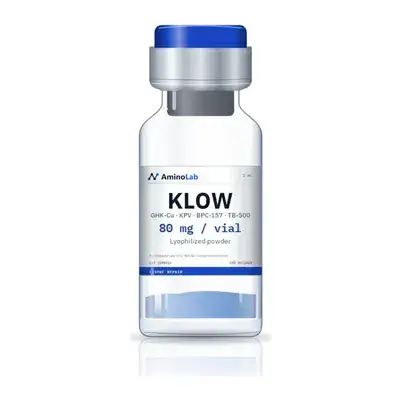
A single TB-500 unit is a 3 mL glass vial carrying 10 mg of white lyophilised powder. There is no diluent inside, no carrier peptide and no other compound. The same heptapeptide is an ingredient in three of our premixed vials (GLOW, KLOW and the Wolverine Blend). This listing, by contrast, is the lone fragment for experiments that must measure it in isolation.
For such a small molecule, the regulatory treatment is strict. Both thymosin beta-4 and TB-500 now sit in Schedule 4 of the Poisons Standard, meaning prescription only, a decision the TGA made after the Advisory Committee on Medicines Scheduling looked at them. No product containing either had TGA approval or an ARTG entry as at October 2026. The men's health body Healthy Male also stresses that printing "for research only" on a vial does not make it legal to have or use one without a prescription. That is why TB-500 listings in Australia come almost wholly from research suppliers. There is no registered product to sell any other way.
The Essendon Football Club supplements affair put thymosin beta-4 in Australian headlines, and it ended in January 2016 with 34 players found guilty of anti-doping breaches by the Court of Arbitration for Sport. Under the WADA code, every derivative of thymosin beta-4, TB-500 included, is an S2 substance (the class for peptide hormones, growth factors and related substances) and is never permitted. Sport Integrity Australia applies the same list here.
Planning to buy TB500 for a lab project? We hold the 10 mg vial in Australia, supplied as an in vitro research reagent. We sell it only to adults aged 18 or older and never for human or veterinary use. Read our TB-500 background guide for the fragment's history and the papers behind it.
There is one fill, the 10 mg vial. For most labs that is enough for one migration experiment series or the outline of a rodent protocol. Reconstituted peptide is best used within weeks, so a moderate fill also keeps waste down if a project stalls.
Each vial's lot code links to its own certificate, so record it against every run in your series. Buyers of TB 500 must be 18 or over and must state their age and lab purpose at checkout.
Lysine and threonine dominate the sequence, which makes the peptide very water soluble, while the acetyl on the front end contributes an extra 42 mass units. On the certificate, expect a measured mass close to 889 g/mol. The complete thymosin beta-4 protein would read around 4963 g/mol, so the two are impossible to confuse.
Look at the HPLC trace and purity figure too, which appear on the same report, filed under the lot number in our certificate library. Read it before you pay, and match the code on your label once the vial lands.
That habit also strengthens your write-up. Before you set your results next to a published study, find out which molecule its authors really used, since many thymosin papers worked with whole protein, recombinant or synthetic, rather than this short piece. Logging the lot code, measured mass and HPLC figure in the lab notebook lets you show reviewers precisely what went into each well and each animal group. That paper trail is exactly why a published certificate beats a supplier's verbal promise. AminoLab publishes that certificate for every lot it sells.
We have no shop counter and no click-and-collect point. You order TB-500 online on this page, and we post it from Australian stock to any address, metro or regional, including labs that source research peptides in Perth. Get your order in before 3pm on a business day and it is dispatched the same day. Progress shows on the order tracking page.
Running low on diluent? Add bacteriostatic water to the order. Warm the vial to room temperature first. Trickle a measured volume along the glass wall, then roll the vial slowly until clear, with no foaming. A 2.5 mL addition gives 4 mg/mL in the 10 mg vial. For other volumes, open the TB-500 concentration calculator.
Unopened vials stay frozen at -20 °C away from light. Once mixed, refrigerate between 2 and 8 °C, preferably in small aliquots so you only thaw one portion at a time.
You will find it sold as TB-500, TB 500, TB500 or thymosin beta-4 fragment, and written as sequences such as Ac-LKKTETQ or acetyl-LKKTETQ-OH. Certain catalogues call it thymosin beta-4 (17-23) or the Tb4 actin-binding fragment instead. All of those names describe the same acetylated seven-residue chain, CAS 885340-08-9.
Full-length thymosin beta-4, sometimes named after its gene TMSB4X, is a separate and far bigger molecule. With no receptor involved, the vocabulary around the fragment revolves around cell motility, lamellipodia and G-actin sequestration.
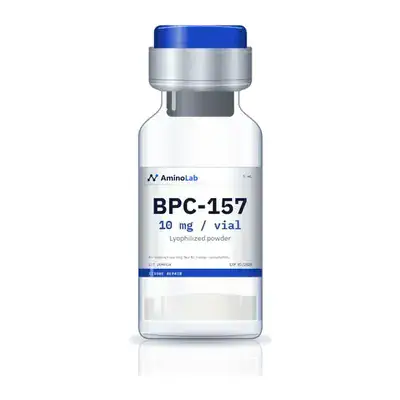
Reach for TB-500 when your culture experiment is about actin turnover, cytoskeletal remodelling or migration toward a scratch. BPC-157, a 10 mg vial, suits nitric oxide, growth factor or gut lining models better. Two separate vials mean you set each amount yourself and keep proper single-compound controls. Both mechanisms are compared in more depth in the BPC-157 vs TB-500 comparison.
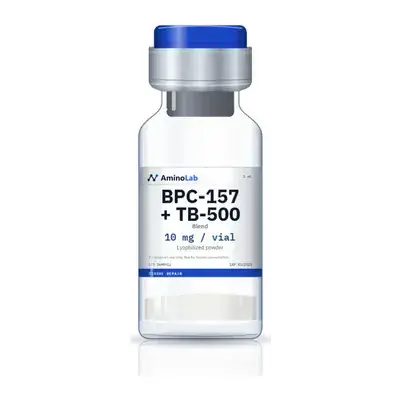
If your protocol already uses equal amounts of the two, the Wolverine Blend puts 5 mg of each into a single vial. AminoLab stocks all three options, so the design you choose can be ordered today.
Seven synthetic residues with an acetyl cap, copied from the part of thymosin beta-4 that binds actin, the scaffold every moving cell depends on, in stock now.
It comes without liquid, so put bacteriostatic water in your cart separately.
Labs order it for cell culture and animal studies that follow migrating cells and tissue reorganisation after injury. These are mechanisms under study, not medical uses.
BPC-157 is about twice the length, derives from a stomach protein and works through other pathways. The full thymosin beta-4 protein is six times longer than TB-500.
Powder in the freezer, solution in the fridge, both kept dark. Aliquoting the solution spares it from repeated freezing and thawing, which slowly breaks peptides down.
HPLC and mass spectrometry are run on every lot, and a reading close to 889 g/mol confirms you have the fragment. Certificates are public before you purchase.
Put the 10 mg vial in the cart and pay on this page. We post from Australian stock, same day for orders in by 3pm on a business day. Include bacteriostatic water for diluent, and tick the box confirming you are an adult of 18 or more.
Only online, because AminoLab runs no retail shop or pickup point. Labs in Perth, Cairns or Wagga Wagga all receive the same 10 mg vial and published lot certificate, sent with tracking from local stock, and delivery times are on our delivery information page.
Look for proof of identity first. The best TB500 peptide comes with a certificate stating three things, an HPLC purity result, a lot code identical to the label and a mass reading close to 889 g/mol. An outside lab analyses each of our lots, and its report is in our COA library before you buy.
Match the compound to the pathway. Actin and migration work points to TB-500, while gut lining, nitric oxide and growth factor projects point to BPC-157. The molecules share nothing structurally, so labs often order both as single vials with separate controls, or take the Wolverine Blend when a fixed equal ratio is already decided.
No. Our vial holds the acetylated 17 to 23 piece at 889 g/mol, whereas the parent is 43 residues and roughly 4963 g/mol. One glance at the certificate mass tells you which is which, which matters whenever you compare results with papers that used the whole protein.
Its job is to separate one motif, the actin binder, from the rest of thymosin beta-4. Scratch assays, endothelial or keratinocyte migration work and rodent tissue models all use it to check whether the fragment alone can match what the whole protein reportedly does. It is sold for in vitro and laboratory research only.
10 mg vial, 60 capsules
10 mg vial
10 mg vial
80 mg vial
Research use onlyAminoLab supplies research compounds for laboratory and in-vitro use, not for human or animal consumption. By continuing you confirm you are 18 or older and buying for research.
Leave