BPC-157
10 mg vial, 60 capsules
From $69
$59 AUD, GST included
Minimum order before shipping, and you can mix any products to reach it.
In stock, ready to ship from Australia
Frequently ordered with
 Bacteriostatic Water
Sold to buyers aged 18 and over only.
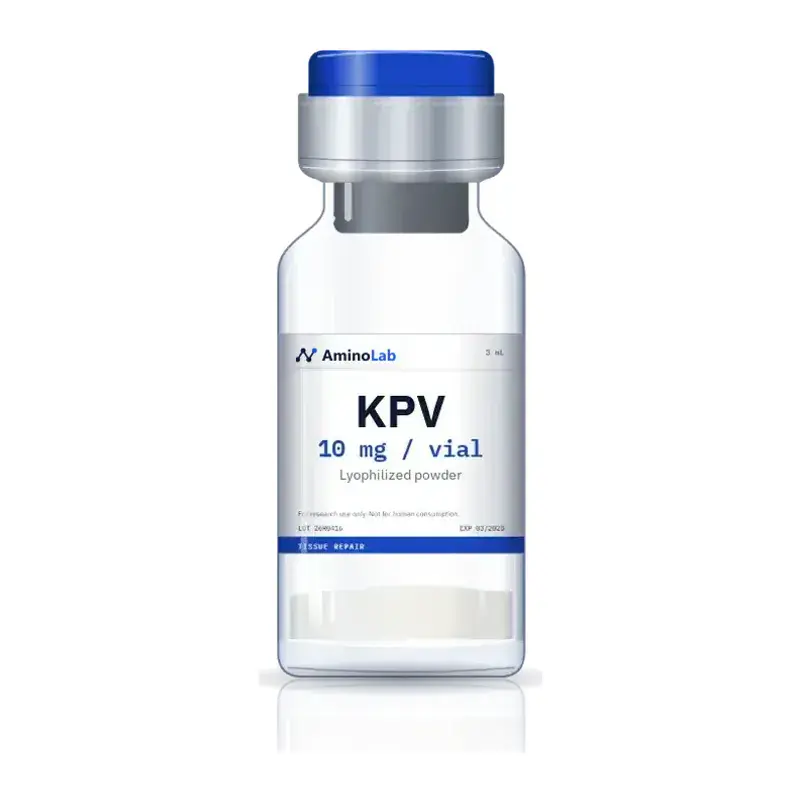
Buy KPV online from AminoLab, available in Australia as the 10 mg vial. KPV peptide Australia orders from AminoLab ship as a single 10 mg vial of freeze-dried powder, packed from our local shelf, and you can read the lot certificate before you pay. KPV is only three amino acids long, lysine, proline and valine, and it matches the last three positions of alpha-MSH, a hormone made from the POMC precursor. A chain this short is easy to identify. Its formula is C16H30N4O4, its molar mass is 342.4 g/mol and its CAS number is 67727-97-3. KPV does not contain the His-Phe-Arg-Trp motif that activates melanocortin receptors, so labs buy KPV peptide for work on inflammation in epithelial cells rather than on skin colour. Each lot is checked by mass spectrometry and HPLC before we list it. The peptide calculator converts your chosen water volume into mg per mL. If your project also looks at gut repair, BPC-157 is often ordered alongside it. No liquid comes with the vial, so put bacteriostatic water in the cart too. Freeze the sealed vial at -20 °C and keep it dark and dry. Buy KPV online now while it is in stock, supplied by AminoLab to adults aged 18 and over for research use.
For laboratory research use only. Not for human or veterinary use. Not TGA approved. See our research use policy.
| Peptide | KPV |
|---|---|
| Residues | Lysine, proline, valine (positions 11 to 13 of alpha-MSH) |
| Chain length | Three |
| Formula | C16H30N4O4 |
| Molecular weight | 342.4 g/mol |
| CAS | 67727-97-3 |
| Supplied as | Freeze-dried white powder, 3 mL glass vial with a crimped stopper |
| Quality testing | Mass spectrometry for identity, HPLC for purity, certificate online for each lot |
| In the box | One 10 mg vial, no diluent |
| Storage | Freezer at -20 °C while sealed, fridge at 2 to 8 °C after mixing |
| Stock | Available now |
| Intended use | In vitro research |
This is the vial to buy when a project asks how inflammatory signals are handled inside gut or skin cells. A three-residue chain is cheap to make well and simple to verify, and the low molecular weight means 10 mg equals about 29 micromoles, enough for many plates of cell work.
Put simply, KPV is the last three amino acids of alpha-MSH, cut free from the rest of the hormone. Alpha-MSH is a 13-residue peptide that the body produces from a large precursor called POMC, in the pituitary gland, in skin and in immune cells. The full hormone affects both pigment and inflammation. The short tail keeps a good share of the anti-inflammatory effect, but it cannot drive pigment because the receptor-binding core is missing. In nature the final valine is capped with an amide. Most cell studies, and our vial, use the uncapped acid form.
The surprising part of the KPV story is where it acts. Rather than binding a receptor on the outer membrane, it appears to be carried into the cell first. A 2008 study in Gastroenterology by Dalmasso, Merlin and co-workers tested KPV on Caco-2 intestinal cells. These cells have the MC3R and MC5R melanocortin receptors, yet KPV produced no rise in cAMP. The key was PepT1, a membrane pump whose normal job is to absorb di- and tripeptides from food, and which is found at higher levels in an inflamed colon. Once inside, 10 nanomolar KPV dampened NF-kappa B, reduced phosphorylation of the ERK1/2, JNK and p38 kinases, and lowered secretion of IL-8, the chemokine that draws neutrophils in. Adding an excess of the dipeptide Gly-Leu, which competes for PepT1, wiped out the response.
Keratinocytes, the main cells of the outer skin, run their own melanocortin and cytokine pathways, so they are the other common model. Most KPV peptide benefits mentioned in skin research come from these keratinocyte studies, and none come from human use. Browse our immune signalling peptide range for related tools.
Our advice is to confirm PepT1 expression in your chosen cell line before planning around this peptide. Cells with little of the pump take up less KPV, and a flat result may then be an uptake problem. Running a Gly-Leu competition well alongside your treatment wells makes the first experiment far easier to interpret. Plan that control before you buy KPV, and both arms can start the day your vial arrives.
We offer KPV in one size only, 10 mg, listed in our recovery peptides range. Because each molecule weighs so little, a milligram of KPV holds many more molecules than a milligram of a 15 or 40 residue peptide, so one vial lasts.
Ordering two or more vials together means they come from the same lot whenever stock permits, which keeps a long study consistent. Checkout asks every buyer to confirm they are at least 18 and buying for research.
The anti-inflammatory activity of this fragment was reported back in 1989, when Hiltz and Lipton found that alpha-MSH residues 11 to 13 reduced ear swelling in mice. The peptide has stayed a research compound ever since. What you receive is a small glass vial with 10 mg of white powder inside. KPV is also one of the four ingredients in the KLOW blend, which some labs use for combination work.
Here is what we can say with confidence. At October 2026, no medicine containing KPV is approved in Australia. We have not found a specific named listing for KPV in the Poisons Standard, which is different from BPC-157 and TB-500, but that does not turn it into a consumer product. The TGA advised in April 2026 that labelling a peptide "for research only" does not change the law if it is actually supplied for people to use. Sport is covered separately, because WADA's S0 class bans any substance without government approval for human therapeutic use.
In short, AminoLab sells KPV in Australia purely as a laboratory reagent, online, to adults, and never for use in humans or animals. Planning a mixed protocol? Weigh up the KLOW 80 mg blend against the single vial, and view the current lot in our certificate archive before you order.
With only three residues, a substituted or missing amino acid would produce a powder you could never tell apart by eye. That is why the measured mass matters most. Look for a result near 342.4 g/mol and an HPLC trace dominated by a single peak, with the purity percentage stated. The three residues are all the natural L form, and both ends of the chain are free.
Every report sits in the COA library under its lot code, so you can review it before you buy and compare it with the vial label later.
Purity data is also easier to trust for a peptide this small. Only a handful of side products are possible, for example a two-residue fragment or valine that has converted to its D form, and a reversed-phase HPLC column pulls these well away from KPV itself. For a lab that wants to start checking incoming reagents in house, KPV is an easy place to begin, and it writes up neatly in a methods section. In our view, the KPV worth buying is the one whose paperwork you can confirm yourself.
Gut projects usually work with Caco-2 monolayers and the mouse colitis models described above. Skin projects use cultured keratinocytes and rodent models of inflamed skin, measuring cytokines and NF-kappa B. In both settings KPV is a research probe, and the results reported so far, such as less cytokine output from keratinocytes and milder inflammation scores in rodent skin, come only from cells and animals. Our peptides for skin research guide sets KPV beside the other skin model compounds we stock. If you want to reproduce this work, you can order the vial online today.
AminoLab is an online store, so you do not need a stockist near you or a supplier of research peptides on the Gold Coast. We send every order from one Australian warehouse, and anything paid by 3pm on a business day is dispatched that day with tracking. Our delivery information page lists typical times for each state.
KPV dissolves readily, so bacteriostatic water is the usual choice and can go in the same order. Allow the vial to warm to room temperature, let the water run down the side of the glass, then swirl slowly rather than shaking. Two millilitres into 10 mg gives 5 mg per mL, and the reconstitution calculator handles any other volume.
Unopened powder is best kept frozen, dark and dry. After mixing, keep the solution in the fridge and split it into small portions so you only thaw what you need.
Papers and catalogues may write KPV as Lys-Pro-Val, H-Lys-Pro-Val-OH, lysyl-prolyl-valine or alpha-MSH 11-13, and some describe it only as the C-terminal tripeptide of that hormone. All of these mean the same molecule, CAS 67727-97-3, C16H30N4O4. At AminoLab you can order it simply as KPV.
You will also meet words such as POMC, melanocortin, PepT1 or SLC15A1, NF-kappa B and IL-8 in KPV papers. Melanotan peptides are a different family, because they keep the receptor-binding core that KPV lacks.
Labs studying the gut often ask which of these two to order. BPC-157 is a 15-residue sequence taken from a stomach protein and is studied mainly for blood vessel growth, nitric oxide and tissue repair in rodents. KPV is a hormone fragment of three residues, used to follow inflammatory signalling inside the cells lining the gut. Pick KPV for questions about barrier cells and cytokines, and BPC-157 for questions about blood supply and wound healing.
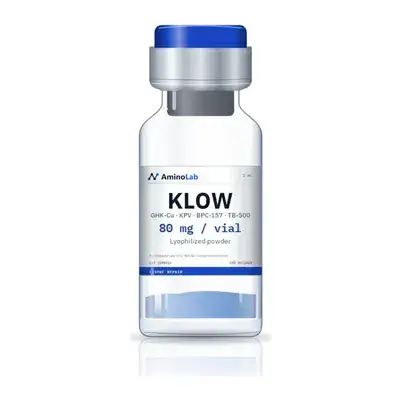
The KLOW blend suits protocols that already run all four of its peptides at that fixed ratio. If you want KPV alone, buy the single vial. Both are in stock, so they can ship in one parcel.
Lysine, proline and valine, the final positions of alpha-MSH, synthesised and freeze-dried. KPV is in stock in Australia.
Each unit is a single sealed vial with 10 mg of powder. Water for mixing is sold separately in our lab supplies.
To study how gut and skin cells switch inflammation on and off, in culture or in mouse colitis models. Research use only.
BPC-157 is five times longer and comes from a stomach protein, while KPV comes from a hormone and works through different routes.
Keep the powder frozen. Once mixed, refrigerate it and finish it within a few weeks, using the calculator to get volumes right.
HPLC and mass spectrometry results for each lot are online, matched to the lot number on the label.
Put the 10 mg vial in your cart here and check out. We ship from stock held in Australia, and payments received by 3pm on a business day go out that afternoon with tracking. Only powder is supplied, so include bacteriostatic water if your lab has none. You must be 18 or older to order.
Wherever you are in Australia, you order KPV online from AminoLab. There is no shopfront or local agent, and all orders come from one Australian stock with the lot report already published. Tracked parcels reach both city and country addresses.
Only laboratory findings exist. In colitis mice and in cultured gut and skin cells, KPV has reduced signs of inflammatory signalling, including NF-kappa B activity and cytokine output. These results say nothing about effects in people, and we supply KPV only so researchers can repeat and build on that work.
Yes. An independent lab tests every KPV batch. Mass spectrometry must show about 342.4 g/mol, and HPLC reports the purity. For a three-residue peptide, the mass is what proves you have the right molecule. Find the report in our COA library with the lot code on your label.
Choose the single KPV vial if you want to test the tripeptide by itself or control your own ratios. Choose KLOW only when your design already uses KPV, GHK-Cu, BPC-157 and TB-500 together at the blend ratio, since a premixed vial cannot be split back into its parts.
Researchers use it as a small, well-defined probe of the anti-inflammatory side of alpha-MSH, without switching on pigment receptors. Typical models are gut and skin cell lines and mouse colitis. AminoLab sells every vial for in vitro and bench research only, never for human or veterinary use.
10 mg vial, 60 capsules
10 mg vial
10 mg vial
80 mg vial
Research use onlyAminoLab supplies research compounds for laboratory and in-vitro use, not for human or animal consumption. By continuing you confirm you are 18 or older and buying for research.
Leave