KLOW
80 mg vial
$139
80 mg vial
70 mg vial
10 mg vial
10 mg vial
AminoLab sells peptide stacks Australia researchers can order in one of two shapes. A blend puts several peptides into a single lyophilized cake inside one vial. A bundle keeps every peptide in its own vial and simply packs them into one carton. Whichever you pick, it ships from Australian stock and each lot has its own certificate. Check the ratios in the table, decide which format suits your protocol, and buy peptide stacks online in a few clicks.
| Stack | Fill per vial | Components |
|---|---|---|
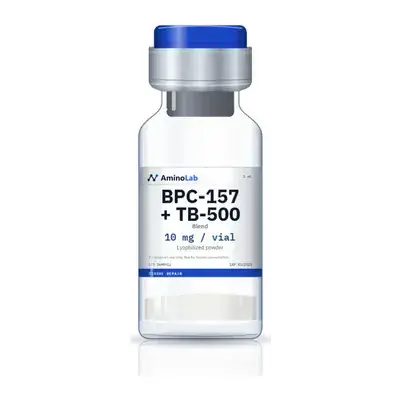
| Wolverine Blend | 10 mg | TB-500 plus BPC-157 |
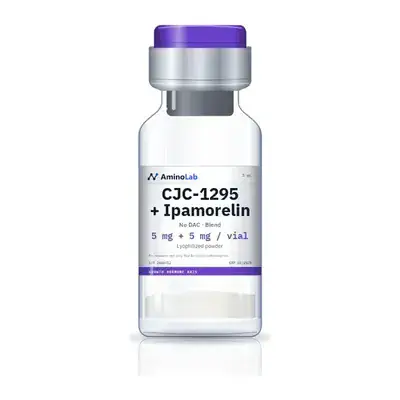
| CJC-1295 and Ipamorelin | 10 mg | Ipamorelin 5 mg with CJC-1295 No DAC 5 mg |
| Tesamorelin and Ipamorelin | 16 mg | Ipamorelin 3 mg with tesamorelin 13 mg |
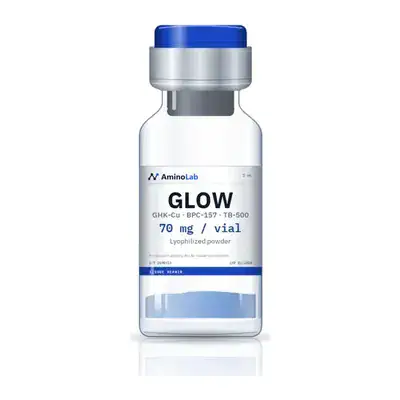
| GLOW | 70 mg | TB-500 10 mg, BPC-157 10 mg and GHK-Cu 50 mg |
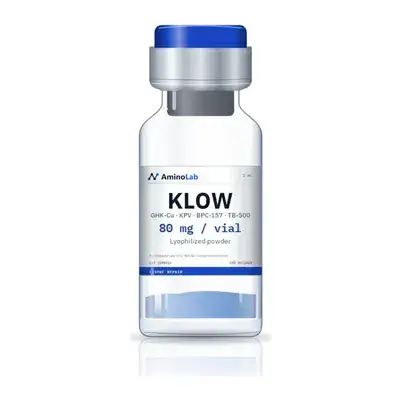
| KLOW | 80 mg | TB-500, BPC-157, KPV and GHK-Cu |
Two sellers can use the same blend name and fill the vial at different ratios. Trust the label and the certificate, not the name.
Start with GLOW. Here the copper tripeptide GHK-Cu meets the pair of repair compounds our customers buy most often, TB-500 and BPC-157, and the copper is why its freeze-dried cake is blue. That is the GLOW stack peptide in a sentence. KLOW keeps all three and adds KPV, a short anti-inflammatory fragment of alpha-MSH, hence the K. No reason to include KPV? Then GLOW is the simpler choice. When an inflammation readout is built into the study, order the KLOW vial. The GLOW vs KLOW guide compares them in detail.
Ask around a peptide lab and "Wolverine stack" means TB-500 together with BPC-157. The two keep turning up in the same protocols because they are studied for different things. BPC-157 work focuses on nitric oxide and growth factor signalling, while TB-500, a piece of thymosin beta-4, is researched for cell migration and actin regulation. Our BPC-157 vs TB-500 comparison sets out the contrast. Note that the World Anti-Doping Agency prohibits both compounds.
Growth hormone release from the pituitary runs through two pathways, and this pairing probes both. CJC-1295 No DAC is a GHRH analogue with a short action, and ipamorelin is a selective agonist at the ghrelin receptor. Swap CJC-1295 for tesamorelin, a GHRH analogue spanning all 44 amino acids, and you have the second blend. Both live in our growth hormone peptides range, and after reconstitution the CJC-1295 and ipamorelin calculator gives the concentration.
Bundle vials are not cut-down versions. Each is the full single product with a lot number and report of its own. The kits and bundles category gathers every carton, while fixed-ratio vials are grouped in the peptide blends range.
The trade-off is simple. Mixing is a one-way door. From then on, no single peptide in that vial can be measured or varied by itself.
Our advice. Use a blend only when your written protocol already pairs those exact peptides at that exact ratio. The reward is a single reconstitution and a single report instead of three or four. Pick individual vials, or a bundle, whenever you are still comparing, tuning one compound or settling the ratio. Unsure? Start with separate vials. We are talking about experimental design here, not about anyone combining peptides for personal use.
Nothing in this range is listed until an outside lab has measured purity by HPLC and confirmed the mass of every molecule in the batch. Enter the code printed on your vial at the COA lookup page and the report opens. For blends, make sure each component has its own line. Our methods are on the quality and testing page. Larger buyers should use wholesale, and if you want to add a single compound to a blend order, the full list is on our peptides for sale in Australia page.
All stacks are sold as laboratory reagents and are never for people or animals. In April 2026 the TGA warned about unapproved peptides and named four that appear here, CJC-1295, GHK-Cu, TB-500 and BPC-157. Our team will not give dosing or stacking advice.
Looking for peptide stacks near me? We have no shopfront, and you do not need one. Every blend and bundle sits in Australian stock and is sold online to researchers all over the country, so a Darwin or Hobart lab receives exactly what a Sydney lab receives, down to the certificate. Open the peptide shop, add your stack plus some bacteriostatic water, and check out.
Match the stack to the pathways in your model, and that is the best peptide stack for the study. Muscle growth models most often use the CJC-1295 and ipamorelin blend. If a study wants the best peptide stack for muscle growth and fat loss in one design, it usually sets a metabolic compound beside a growth hormone secretagogue, each in its own vial. Repair models lean on the Wolverine Blend. A fixed-ratio blend saves you a vial, and separate vials let you adjust each concentration.
Use this table as a starting map from model to product. A premixed blend is named when one exists. Otherwise the suggestion is a set of single vials, and every one of them comes with its own report.
| Area of study | Suggested starting point |
|---|---|
| Tissue repair and recovery | Wolverine Blend |
| Matrix and skin work | GLOW, or KLOW where inflammation is also measured |
| Lean mass and muscle growth | CJC-1295 and ipamorelin blend |
| GH axis with a longer GHRH analogue | Tesamorelin and ipamorelin blend |
| Metabolic and fat loss work | Tirzepatide with cagrilintide, or retatrutide with MOTS-C |
| Mitochondria and cell energy | SS-31 with MOTS-C and NAD+ |
The literature points to one combination as the best muscle building peptide stack for lean mass and growth models. It joins a ghrelin receptor agonist to a GHRH analogue. Because each works through its own pituitary route, the growth hormone pulses they produce stack on top of each other. Our CJC-1295 and ipamorelin blend is the standard version, and it is also what most labs mean by the best HGH peptide stack. Bulking and bodybuilding enquiries end at that pairing too. Tesamorelin only makes sense if a protocol insists on the complete 44-residue GHRH chain.
For metabolic work, single vials are the rule. In the published literature these compounds follow their own timetables, which a shared cake could never accommodate. The pairing with the deepest record joins cagrilintide, an amylin analogue, to a GLP-1 based agonist. Newer designs put MOTS-C next to retatrutide to bring mitochondrial biology into play. Whether a lab is after the best weight loss peptide stack or the best peptide stack for cutting, the research answer is identical.
The Wolverine Blend is the best peptide stack for healing and recovery models, giving you both repair compounds at a set ratio in one vial. For skin work, GLOW layers GHK-Cu on top. KLOW goes a step further with KPV, the pick when inflammation is measured. And the best beginner peptide stack? In a lab, it is whichever option covers the model with the fewest ingredients, since every extra compound is another variable.
Questions about the best peptide stack for men, the best peptide stack for women, the best peptide stack for men over 40, the best female peptide stack, or the best peptides to stack with TRT and testosterone are about personal use. We do not answer them. AminoLab sells reagents for laboratories only, and none of our products may be used by people. Anyone with a question about their own health or hormone levels should book in with a GP or an endocrinologist.
In peptide research, a stack is just an informal term for two or more peptides used in one protocol. We sell it in two forms. Blends share one cake and one lot code. Bundles are cartons of individual vials, each vial still carrying its own code and report.
We weigh each peptide to its target, combine them, then lyophilise the lot in a single vial, which is why the stated fill equals the sum of the components. GLOW shows the arithmetic, 50 mg GHK-Cu plus 10 mg TB-500 plus 10 mg BPC-157 equals 70 mg. Likewise, 13 mg tesamorelin and 3 mg ipamorelin make a 16 mg vial.
Each peptide in a blend is diluted in line with its share of the fill. Put 2 mL of bacteriostatic water into the 10 mg CJC-1295 and ipamorelin vial and you get 2.5 mg per mL of each, since they split the fill evenly. Our CJC-1295 and ipamorelin calculator does the division automatically, and GLOW's three components follow the same rule.
Wolverine, GLOW and KLOW are trade nicknames rather than standards, so what is in the vial depends on who filled it. Read the components and fill printed on the label, then check that the certificate identifies every named peptide. Our GLOW listing spells out the 50, 10 and 10 mg split.
GHK-Cu turns the GLOW and KLOW cakes blue. The growth hormone pair and the Wolverine Blend stay white. A blend report in the COA library needs one mass line per peptide, so expect KLOW's to be longer than a single-compound report. Bundles from kits and bundles are verified vial by vial.
A single lyophilized cake combining GHK-Cu, BPC-157 and TB-500. The total fill is 70 mg, of which the copper peptide makes up 50 mg and the two repair compounds 10 mg apiece. Look for the lot code on the label to find the matching certificate of analysis.
Yes. Every blend we make, GLOW, KLOW, Wolverine, tesamorelin with ipamorelin and CJC-1295 with ipamorelin, ships from stock in Australia, along with cartons of single vials. Reports in the COA library list each component. Choose your stack, confirm the lot, add bacteriostatic water and pay in a single checkout.
The two repair peptides, TB-500 and BPC-157. Our Wolverine Blend packs both into a single 10 mg lyophilized vial. For studies that compare them or adjust one independently, single vials of each are the better purchase.
A blend makes sense when the protocol already uses those peptides together at that fixed ratio, because it means fewer reconstitutions and fewer lot codes to track. Separate vials, or a bundle, are better when you need to measure or tweak one compound by itself, since nothing can be pulled back out of a mixed cake.
Lean mass and muscle growth studies typically pair a ghrelin receptor agonist with a GHRH analogue. We supply that pairing as the CJC-1295 and ipamorelin blend, each compound at 5 mg in one 10 mg vial. If the design calls for the longer 44-residue GHRH analogue, choose the tesamorelin and ipamorelin blend.
Labs usually build metabolic stacks from single vials, keeping a separate concentration and report for each compound. The most studied combination joins the amylin analogue cagrilintide to a GLP-1 based agonist such as tirzepatide. For mitochondrial endpoints, MOTS-C with retatrutide is another route. Everything is sold for laboratory research only.
Research use onlyAminoLab supplies research compounds for laboratory and in-vitro use, not for human or animal consumption. By continuing you confirm you are 18 or older and buying for research.
Leave