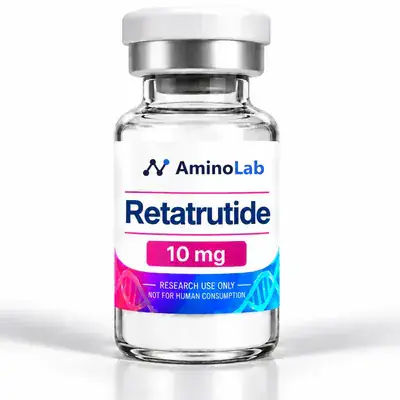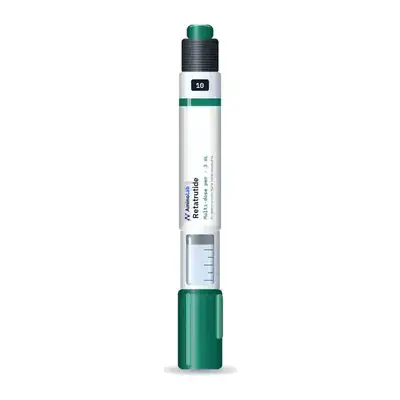
Retatrutide Pen
10 mg pen, 3 mL
$149
$79 AUD, GST included
Minimum order before shipping, and you can mix any products to reach it.
In stock, ready to ship from Australia
Frequently ordered with
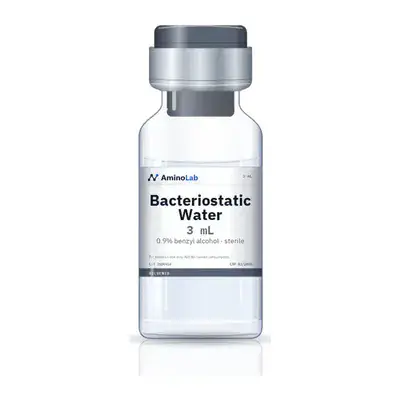 Bacteriostatic Water
Sold to buyers aged 18 and over only.
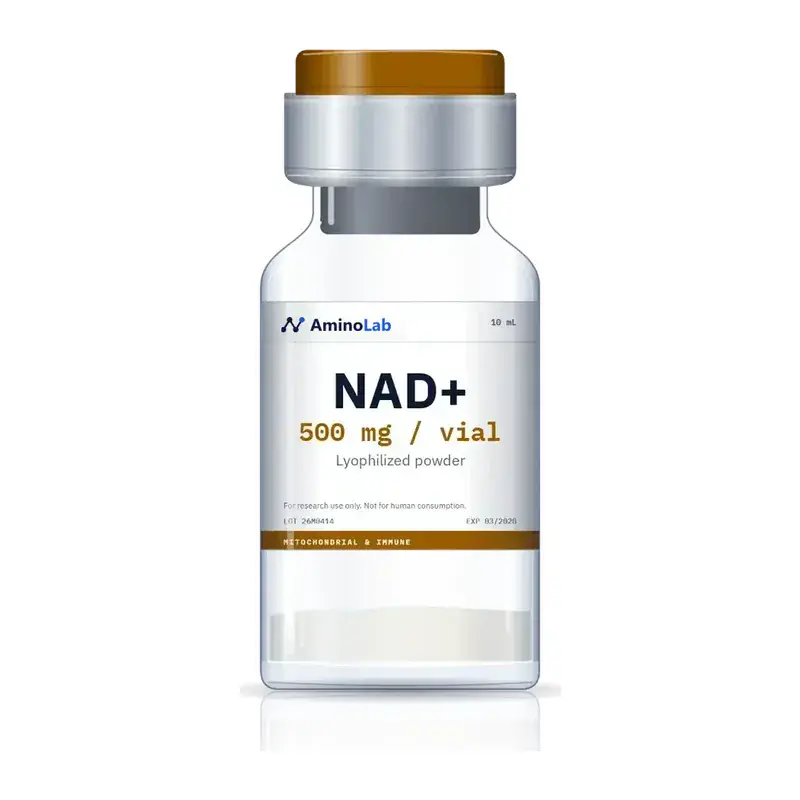
Buy NAD+ online from AminoLab, available in Australia as the 500 mg vial. NAD+ Australia orders from the AminoLab online store ship as a single 500 mg freeze-dried vial from our local shelf. Despite sitting among peptides, NAD+ is a coenzyme, the oxidised form of nicotinamide adenine dinucleotide, with the formula C21H27N7O14P2, a molar mass of 663.4 g/mol and CAS number 53-84-9. You are buying the coenzyme itself, not a building block such as NMN or NR that cells must convert first. The generous fill comes in a 10 mL glass vial so there is space to dissolve it properly. We confirm identity by mass spectrometry and purity by HPLC on every lot, and the certificate is online before you pay. Labs studying how cells lose nicotinamide often add 5-Amino-1MQ to the same order. No diluent is included, so add bacteriostatic water, and use the peptide calculator to set your concentration. Keep the sealed vial frozen at -20 °C, dry and dark. Secure your NAD+ from AminoLab now, available to researchers aged 18 and over for in vitro use.
For laboratory research use only. Not for human or veterinary use. Not TGA approved. See our research use policy.
| Compound | NAD+, nicotinamide adenine dinucleotide in its oxidised form |
|---|---|
| Structure | Two nucleotides, one carrying nicotinamide and one carrying adenine, linked by a pyrophosphate bridge. Not a peptide |
| Formula | C21H27N7O14P2 |
| Molecular weight | 663.4 g/mol |
| CAS | 53-84-9 |
| Supplied as | Freeze-dried solid in a sealed 10 mL glass vial |
| Quality testing | Mass spectrometry and HPLC on each lot, certificate published |
| In the box | One vial containing 500 mg, diluent sold separately |
| Storage | Frozen at -20 °C, dry and dark while sealed, 2 to 8 °C once dissolved |
| Stock | Available now |
| Intended use | In vitro research |
Buy this large fill when your enzyme assays or culture media get through a lot of coenzyme. Every lot is tested and documented before it goes on sale, and the vial is ready to ship from Australia.
In plain terms, NAD+ is a small carrier molecule. Cells use it to move electrons from the nutrients they break down to the systems that produce energy. It is also the raw material for several enzymes that repair DNA and switch genes on or off. Some catalogues call it an NAD+ peptide, but it contains no amino acids. It is built from nucleotides.
It helps to understand the chemistry before planning an assay. NAD+ picks up two electrons and a proton as a single hydride at carbon 4 of its nicotinamide ring, which turns it into NADH, while a second proton is released into solution. The reaction runs both ways, so one molecule can be loaded and unloaded thousands of times. Cells also hold the two forms at very different ratios in different places. Free coenzyme in the cytosol sits at roughly 700 oxidised molecules per reduced one, while in mitochondria the figure is closer to 10 to 1. Those ratios decide which way a dehydrogenase will drive its reaction, so a cell-free assay needs a set ratio, not just a set amount.
Moving electrons does not use NAD+ up, but another set of enzymes does. Sirtuins, PARPs and CD38 split the molecule, keep the ADP-ribose part and release nicotinamide, which the salvage pathway then rebuilds into new coenzyme. This breakdown is why the pool turns over quickly, and why DNA damage, which sharply raises PARP activity, leads to a measurable drop in NAD+. Slowing the loss from the other side is the idea behind the NNMT inhibitor 5-Amino-1MQ.
One point every buyer should know. NAD+ does not cross the outer membrane of a cell well. When it is added to culture medium, enzymes on the cell surface break much of it down, and the cell then takes up the smaller pieces. An experiment designed to raise NAD+ inside cells may therefore be measuring those fragments and the receptors they activate. For cell studies, add a nicotinamide riboside arm to tell the two routes apart, or switch to permeabilised cells or purified mitochondria if the pool inside the cell is what you actually want to study. None of this matters in cell-free enzyme work, where NAD+ behaves like any other clean reagent. Labs can buy it here knowing exactly which design suits it.
NAD+ is central to how cells handle energy. As sugars and fats are broken down, it picks up electrons and becomes NADH, and NADH hands those electrons on to the respiratory chain inside mitochondria. Sirtuins, PARPs and CD38 also use it as a substrate, which links its supply to how genes are controlled, how DNA is mended and how cells signal.
Order this vial when you need a known amount of the oxidised coenzyme with nothing else mixed in. Results from precursor studies with NMN, NR or nicotinamide do not translate directly, because cells must convert those compounds into NAD+ first. AminoLab supplies it for the bench only, never as a health product. Compounds often bought with it are listed in our longevity peptides range.
You will notice this vial is bigger than most. Half a gram of powder needs a roomier container, so this one holds 10 mL and has a flip-off top. The contents are pale, close to white, and consist only of NAD+ in its oxidised state. Nothing is blended in. Because the powder pulls water out of the air, leave the seal intact and keep the vial in the freezer until you are ready to use it.
NAD+ was discovered, not designed. Back in 1906 Arthur Harden and William John Young found a heat-stable factor in yeast extract that fermentation could not proceed without, and named it cozymase. That work helped earn Harden a share of the 1929 Nobel Prize in Chemistry, together with Hans von Euler-Chelpin, and scientists worked out its role as an electron carrier over the following decades. It is still one of the most widely used reagents in enzyme and metabolism research.
Because it occurs naturally in every living cell and was never developed as a drug, chemical companies have offered NAD+ as a standard reagent for generations, and our vial follows that path. No registered medicine or listed supplement is involved, and it has never been through TGA assessment. We hold it locally and sell it only to adults, for test-tube and cell research, not for people or animals. Researchers who buy NAD+ in Australia to study mitochondria frequently pair it with the cardiolipin-binding peptide SS-31 in a parallel group.
We sell one size, 500 mg, roughly three quarters of a millimole. Since enzyme and media protocols tend to work in the millimolar range, so one vial supports several stock solutions from the same lot.
One vial is usually enough to start, because the dissolved stock should be used within a few weeks. Buy a second vial at the same time only when a follow-up run is already planned, and we will send it from the same lot wherever stock allows so both runs share one certificate. Every buyer has to be an adult.
We chose the bigger vial on purpose. Half a gram only dissolves fully when there is space for plenty of liquid, and having that space means you can prepare your stock directly in the original vial, with less waste and less chance of contamination than transferring powder.
The molecule links two nucleotides through a pyrophosphate bridge. The nicotinamide half is where electrons land, and the adenine half anchors the molecule in enzymes. NAD+ itself is transparent at 340 nm, but the reduced form, NADH, does. Many enzyme assays rely on this difference, and it gives you a quick way to check your stock. Measure a freshly made solution at both 260 and 340 nm and any NADH that has formed by accident will show up.
On the certificate, look for a measured mass that matches 663.4 g/mol, the identifier 53-84-9 and a purity figure from HPLC. Every report can be opened in the COA library using the batch code on the label, so check it before you place your order.
AminoLab has no counter to visit. Everything is ordered through the website and posted from our warehouse here, reaching labs that buy research peptides in Sydney just as readily as those in country towns. Pay before 3pm on a business day and the parcel leaves that day, and you can follow it on the order tracking page.
The powder dissolves easily. Allow the cold vial to warm up first. Then trickle bacteriostatic water along the glass and rotate it gently until nothing solid remains. Five millilitres into the half-gram vial makes 100 mg per mL, roughly 150 mM, which is a handy stock to dilute into assay buffer.
Until it is opened, the vial belongs in a -20 °C freezer, away from damp and light. Dissolved NAD+ breaks down faster than the dry solid, and faster still above pH 7, so keep stock solutions refrigerated in small tubes, wrapped against light, and finish them inside four weeks.
Labels and papers use NAD+, plain NAD, beta-NAD, the full chemical name, or the historic term diphosphopyridine nucleotide, shortened to DPN. Some sellers market it as an NAD peptide or even as the best NAD+ peptide available, though it has no amino acids. The registry number 53-84-9 belongs to the oxidised molecule, and AminoLab lists it plainly as NAD+.
Similar names belong to different compounds. NADH is the reduced form, NADP+ is a phosphorylated relative used in building molecules, NMN is nicotinamide mononucleotide and NR is nicotinamide riboside. Every one of them has a different registry number, so compare those numbers before assuming two labels mean the same thing.
Think of the cell's NAD+ supply as a tank with an inlet and a drain. Our vial tops the tank up from outside. 5-Amino-1MQ partly closes one drain by inhibiting NNMT, the enzyme that methylates nicotinamide so it can no longer be recycled. Pick the vial if your assay simply needs cofactor present, pick the inhibitor if the question is how well recycling is protected, and buy both if you want the two strategies compared head to head.
Customers often raise the GHK-Cu peptide vs NAD+ question, since shops tend to file both under ageing research. Chemically they have little in common. GHK-Cu is three amino acids holding a copper ion, used in culture work on matrix proteins and gene activity, whereas NAD+ shuttles electrons. A study of NAD copper peptides normally keeps them in different wells with their own controls.
Any talk of NAD peptide benefits for skin refers to dish experiments, where researchers track NAD+ and sirtuin activity in fibroblasts and keratinocytes, and our peptides for skin guide summarises them. Weighing NAD vs collagen peptides means comparing an electron carrier with chopped-up protein, so an NAD collagen peptides experiment on skin cells should treat each one separately.
When the research is about how cells sense energy rather than how much cofactor they hold, look at MOTS-c, which acts via the AMPK sensor, or SS-31, which binds the inner membrane of mitochondria. AminoLab stocks both, and either one adds a useful extra arm to an NAD+ Australia order focused on mitochondria.
Oxidised NAD+, the electron carrier that sirtuins, PARPs and CD38 also consume. A nucleotide, not a peptide.
500 mg of powder in a roomy 10 mL vial. Add bacteriostatic water from our supplies if you need it.
Kinetics, redox experiments and culture media that call for the cofactor directly, all in vitro.
One adds NAD+ from outside, the other slows the loss of its recycled building block.
Keep the sealed vial frozen and dark. Refrigerate the solution in portions and use it within 28 days.
We publish mass and purity results for every batch in the COA library.
Choose the half-gram vial here, place it in your basket and pay. It leaves our Australian stock the same afternoon when payment arrives before 3pm on a business day. You can read the lot certificate first, and bacteriostatic water for mixing can go in the same cart.
Order it from the AminoLab online store, which delivers to every state and territory from one Australian stock. We have no shopfront, so every buyer gets the same vial, the same lot certificate and the same dispatch cut-off wherever their lab is.
Strictly speaking it is no peptide. NAD+ is a two-nucleotide coenzyme weighing 663.4 g/mol that simply shares shelf space with peptides. For kinetics work the things to check are that it is the oxidised form, that its mass is confirmed and that the HPLC purity is high, and the batch report shows all three.
Yes. Before a batch is released we confirm what it is by mass spectrometry and how pure it is by HPLC. You will find the report in our COA library filed by the batch number on your label, ready to review before you buy and to keep afterwards.
Go for NAD+ if your experiment needs the cofactor dissolved and ready. Go for 5-Amino-1MQ if you want to switch off NNMT so cells hold on to the nicotinamide they recycle. With both in one order, a single project can test topping up against conserving.
Of course. Put both in the same basket, then treat them as separate groups in your design. GHK-Cu is a copper peptide and NAD+ is an electron carrier, so make up and store their solutions apart. You receive a separate batch report for each.
10 mg pen, 3 mL
10 mg vial, 20 mg vial, 30 mg vial
2 mg vial
With 10 mg vial, With 20 mg vial, With 30 mg vial
Research use onlyAminoLab supplies research compounds for laboratory and in-vitro use, not for human or animal consumption. By continuing you confirm you are 18 or older and buying for research.
Leave