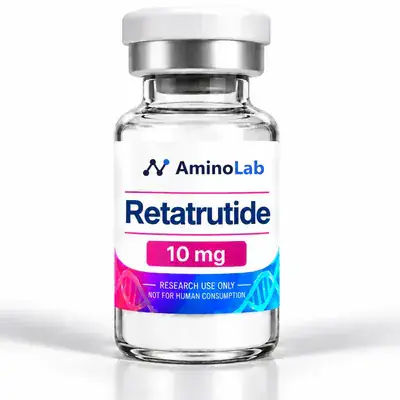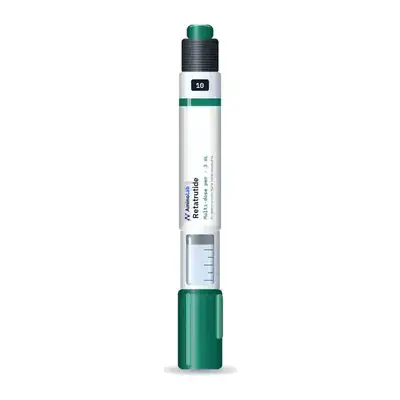
Retatrutide Pen
10 mg pen, 3 mL
$149
$69 AUD, GST included
Minimum order before shipping, and you can mix any products to reach it.
In stock, ready to ship from Australia
Frequently ordered with
 Bacteriostatic Water
Sold to buyers aged 18 and over only.
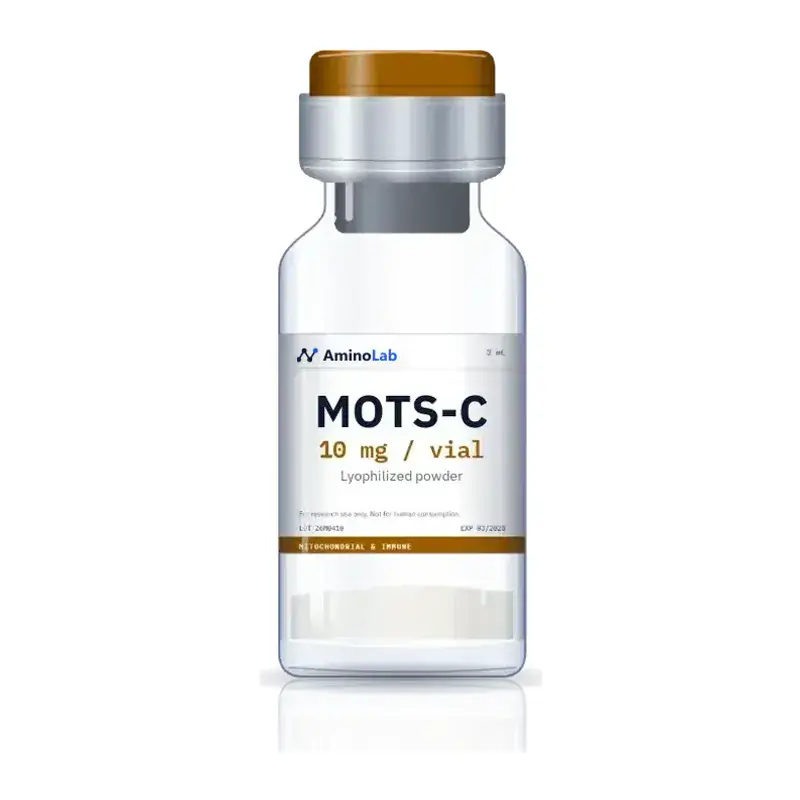
Buy MOTS-C in Australia from AminoLab, with the 10 mg vial, 20 mg vial or 40 mg vial in stock and ready to ship. MOTS-c Australia orders ship from our local shelf in three freeze-dried fills, 10 mg, 20 mg and 40 mg. Unusually for a peptide, its 16-residue sequence, MRWQEMGYIFYPRKLR, is written into mitochondrial DNA, in a short open reading frame tucked inside the 12S rRNA gene, and not into the nuclear genome at all. For your records, the CAS number is 1627580-64-6, the formula C101H152N28O22S2 and the molar mass 2174.6 g/mol. Mass spectrometry identifies every lot, HPLC assays it, and the certificate of analysis is open to read well ahead of checkout. Convert any water volume into a working strength with the MOTS-c calculator, and consider SS-31 alongside it for a broader mitochondrial project. Powder ships without diluent, so add bacteriostatic water and store sealed vials frozen at -20 °C away from light and moisture. Shop MOTS-C at AminoLab today with the batch report already in hand, for lab research by adult buyers only.
For laboratory research use only. Not for human or veterinary use. Not TGA approved. See our research use policy.
| Compound | MOTS-c, a mitochondrial-derived peptide | |
|---|---|---|
| Stock status | In stock | |
| Residue count | 16 amino acids | |
| Sequence details | ||
| CAS registry | 1627580-64-6 | |
| Molar mass | 2174.6 g/mol | |
| Empirical formula | C101H152N28O22S2 | Physical form |
| In the box | ||
| Lot testing | ||
| Storage | ||
| Permitted use | In vitro laboratory research only |
Every fill is made to the same specification and passes the same release test, so choose by how quickly your lab will work through a vial, not by any difference in the material. AminoLab holds all three sizes in Australia, ready to order.
Mitochondria were long described as power stations that take orders and never give them. MOTS-c overturned that picture. It is a short peptide the organelle produces itself and releases as a signal, reporting on the state of the cell's energy supply. That is the whole reason it appears in research catalogues, a message from a compartment once assumed to be silent.
Some context shows why it was overlooked. Nearly every human gene sits in the nucleus, but each mitochondrion also keeps a tiny ring of DNA, roughly 16,500 base pairs, a relic of its bacterial ancestry. Standard references listed 37 genes on that ring, including 13 for proteins that stay put inside the organelle. Nobody expected a peptide gene to be buried within the 12S ribosomal RNA gene, in stretches assumed to serve only a structural role, yet that is where MOTS-c turned up. Reading it correctly requires the mitochondrial version of the genetic code rather than the nuclear one, so early gene-prediction tools never flagged it.
Human genetics provides the most persuasive sign that the peptide matters. Zempo's team, publishing in Aging in 2021, looked at the East Asian mitochondrial variant m.1382A to C. It turns residue 14 of the peptide, normally lysine, into glutamine. In a big Japanese population sample, men carrying it had more type 2 diabetes, though the association held only for those who exercised least. Mouse and cell experiments in the same paper found the glutamine version weaker than the usual peptide. A lone nucleotide, a lone amino acid and a measurable effect across a population make a far stronger case for real biology than supplementation studies ever have.
Our suggestion for labs is to make that variant part of the design rather than a footnote. Pairing the standard sequence with a custom-synthesised K14Q version hands you a specificity control for free, since an effect that appears equally with both forms probably bypasses the mechanism you care about. Before fixing endpoints, read our review of what MOTS-c research has measured, since most reported effects are indirect and depend on choosing the right readout. AminoLab sells the synthetic peptide so labs can study that signal directly.
Nuclear genes code for almost every other peptide we sell. MOTS-c is the odd one out, a member of the small mitochondrial-derived peptide group that also includes humanin. Changhan Lee's group at the University of Southern California reported it in Cell Metabolism in 2015, finding that it worked chiefly in skeletal muscle by activating AMPK, the enzyme that senses cellular energy. The later literature is traced in our guide to MOTS-c benefits across cell and rodent studies.
The core research question is a sharp one. By what route does a message encoded in mitochondrial DNA reach the nucleus and shift gene expression there? This vial lets cell biologists probe exactly that. It is a research reagent unrelated to any approved medicine, and the mitochondrial peptides category gathers the compounds most often bought with it.
Open the parcel and you will find one sealed glass vial per fill, with a white lyophilised cake of pure MOTS-c inside and no added compound. The 10 mg and 40 mg vials carry amber flip-off caps, which helps tell them apart from green-capped vials, tirzepatide for example, on a crowded freezer shelf. In between, 20 mg serves groups for whom 10 mg runs short and 40 mg runs past its useful window.
Nobody designed MOTS-c as a drug. Lee's team found it by combing mitochondrial DNA for small reading frames with signalling potential, and one candidate surfaced in the 12S rRNA region, leading to the 2015 Cell Metabolism report. As of October 2026 there is no MOTS-c product on the ARTG, and we know of no regulator anywhere that has approved it as a medicine. What you buy here is a lab reagent with no prescription counterpart.
In sport the peptide now has an official classification. Under class S4 of the 2025 WADA Prohibited List, metabolic modulators, MOTS-c appears by name as an AMP-activated protein kinase activator, and that class is prohibited at all times, in competition or out of it. Locally, Sport Integrity Australia applies the identical list, making MOTS-c a prohibited substance for every athlete bound by the code.
Inside the laboratory the matter is simpler, because MOTS-c for sale in Australia is a research reagent and nothing more. AminoLab stocks the 10, 20 and 40 mg vials here, sells them online to adults 18 and over, and restricts them to in vitro work, never human or veterinary use. Groups running an ageing biology programme can find companion compounds in the longevity peptides range.
Price per milligram is only half the story, because the 28 day window often matters more. Throw away half of a large vial and the milligrams you did use cost more than if you had bought the small size twice, a month between openings. Match the fill to the speed of your experiments, not to the smallest number on the label. Every buyer must be 18 or older to check out.
Two methionines in the chain call for protection against oxidation, and a run of basic arginine and lysine residues sits close to the C-terminus. Work from Lee's lab in 2018 associated that positively charged tail with nuclear entry under metabolic stress. A 2021 study in Nature Communications then connected the peptide to exercise, with experiments that included old mice, and most cell models in use today build on that thread.
Ask any lab and the best MOTS c peptide turns out to be the one with paperwork you can actually check. Your certificate should show the full sequence, a purity value from HPLC for that exact lot, and an observed mass that agrees with the 2174.6 g/mol reference. Find it by entering the code from your vial label into the COA library. Read that report before you order, and buy again from the same lot when a series needs to stay consistent.
AminoLab has no shop counter. It is an online business shipping from Australian stock to every state, which means the same stock serves a group buying peptides in Adelaide, a lab in Cairns and a researcher on a farm postcode. Clear payment by 3pm on any business day and your parcel is dispatched that afternoon, as set out on the delivery information page.
The vial contains dry peptide only, so bacteriostatic water belongs in the same order. Allow the cold vial to warm up first, trickle the water along the inside of the glass, and use a gentle swirl rather than a shake. Two millilitres in the 10 mg size yields 5 mg/mL. The larger sizes, and every other volume, are covered by the MOTS-c reconstitution calculator.
Store unopened MOTS-c vials frozen at -20 °C. A reconstituted solution moves to the fridge, 2 to 8 °C and dark, split into aliquots so that each one thaws only once, and keep air exposure to a minimum because of those methionines.
Spelling varies between suppliers and journals. MOT-C is one shortened form, MOTS C another, and capital or lower-case c versions both appear. The name itself points to its source, a short coding stretch, type c, within the mitochondrial 12S rRNA gene. Researchers file it among the MDPs, the mitochondrial-derived peptides, and the CAS registry lists it as 1627580-64-6.
Expect the literature to mention the folate cycle, AICAR (an intermediate the 2015 authors connected to its effect) and AMPK, short for AMP-activated protein kinase. They are parts of the pathway, not things you can buy separately. At AminoLab every spelling leads to this one listing.
There is no single best peptide to stack with MOTS c, because the right partner depends on which layer of mitochondrial biology you are probing. Signalling through AMPK and gene expression is the MOTS-c layer. The membrane layer belongs to SS-31, a four-residue synthetic peptide that attaches to cardiolipin on the inner mitochondrial membrane. Signalling questions point to the first, bioenergetics and membrane questions to the second, and buying them as separate vials keeps each contribution visible in the data.
For a coenzyme arm, NAD+ sits at the heart of energy metabolism. For a route that avoids peptides entirely, SLU-PP-332 reaches the same mitochondrial programmes by switching on the estrogen-related receptors. AminoLab stocks every compound mentioned here, so a full panel can be ordered in one checkout.
Sixteen residues with a mitochondrial gene behind them, described for the first time in 2015 and now in stock in Australia.
The biggest fill gives the lowest milligram price, and water is an add-on.
Labs buy it for AMPK signalling, communication from mitochondria to the nucleus and metabolic stress, as studied in cell and rodent models.
One signalling peptide and one membrane binder together cover two layers of mitochondrial biology.
Keep sealed vials at -20 °C, and refrigerate the mixed solution in aliquots that each thaw just once.
Lot certificates in the COA library report the sequence alongside mass spec identity and HPLC purity.
Pick the 10 mg, 20 mg or 40 mg vial on this page and add it to the cart. Anything paid by 3pm on a working day is sent out from Australian stock that afternoon. The vial contains dry powder, so include bacteriostatic water too.
Yes. Without a retail outlet, every order is filled online from one local inventory, each lot has a published certificate, and the tracked parcel can be followed from our dispatch bench to your door.
Choose a lot confirmed by mass spectrometry and assayed by HPLC, with a certificate reporting the measured mass and sequence. Our certificates sit in the COA library under each vial's lot code, so you can read the report before ordering and keep it on file afterwards.
MOTS-c fits questions about AMPK signalling or traffic between mitochondria and the nucleus. SS-31 fits questions centred on the inner mitochondrial membrane and cardiolipin. Plenty of labs keep both as separate vials so each contribution can be separated in the results.
A pilot or first purchase suits 10 mg, which is simplest to use up inside the 28 day window. Two or three short runs suit 20 mg, and 40 mg offers the lowest price per milligram when an established method will use it all in time.
It lets researchers examine how a peptide encoded by mitochondria affects cellular energy sensing and nuclear gene expression. Cell and mouse studies connect it with AMPK and responses to metabolic stress. Every vial we ship is restricted to laboratory experiments.
10 mg pen, 3 mL
10 mg vial, 20 mg vial, 30 mg vial
2 mg vial
With 10 mg vial, With 20 mg vial, With 30 mg vial
Research use onlyAminoLab supplies research compounds for laboratory and in-vitro use, not for human or animal consumption. By continuing you confirm you are 18 or older and buying for research.
Leave