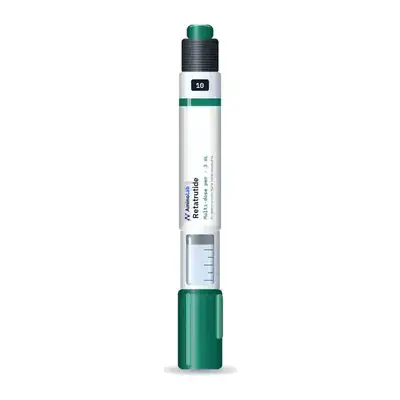
Retatrutide Pen
10 mg pen, 3 mL
$149
$79 AUD, GST included
Minimum order before shipping, and you can mix any products to reach it.
In stock, ready to ship from Australia
Frequently ordered with
 Bacteriostatic Water
Sold to buyers aged 18 and over only.
Shop SLU-PP-332 at AminoLab and buy the 5 mg vial or 60 capsules from stock kept here in Australia. AminoLab carries SLU PP 332 Australia stock in two formats, a 5 mg freeze-dried vial and a bottle of 60 capsules holding 250 mcg each, and both leave our local shelves from the metabolic peptides section. Despite where it is shelved, SLU-PP-332 is a synthetic small molecule rather than an amino acid chain. Think of it as a pan agonist for the estrogen-related receptors, hitting the alpha, beta and gamma subtypes alike. For identity checks, the formula is C18H14N2O2, the molar mass is 290.3 g/mol and the CAS number is 303760-60-3. Mass spectrometry and HPLC are run on every lot, and the matching certificate of analysis can be opened before you pay. Adding MOTS-c to the same order lets a lab set a receptor-driven route into mitochondrial biology against a peptide-driven one. No solvent is packed with the vial, which contains only dry solid, and most published cell protocols begin by making a DMSO stock for dilution. Freeze unopened vials at -20 °C, and leave the capsule bottle tightly shut somewhere dry below 25 °C. Place your SLU-PP-332 order today and we send it from Australian stock, strictly for laboratory work by adult buyers.
For laboratory research use only. Not for human or veterinary use. Not TGA approved. See our research use policy.
| Listed as | SLU PP 332 (CAS 303760-60-3) |
|---|---|
| Chemical identity | Small molecule, not a peptide, acting as a pan ERR agonist, systematic name 4-hydroxy-N'-(naphthalen-2-ylmethylene)benzohydrazide |
| Empirical formula | C18H14N2O2 |
| Molecular weight | 290.3 g/mol |
| CAS registry number | 303760-60-3 |
| Presentation | A sealed glass vial of lyophilised solid, or a capsule bottle closed with a child-resistant cap |
| How lots are tested | Mass spectrometry for identity and HPLC for purity, carried out separately for vial lots and capsule lots, each certified |
| What you receive | Either one solvent-free 5 mg vial, or one bottle containing 15 mg spread over 60 capsules of 250 mcg |
| Keeping it | Vial frozen at -20 °C, sealed, dry and dark, with capsules closed, dry and under 25 °C |
| Can I order now | In stock |
| Sold for | In vitro laboratory research only |
The vial is for making your own stock solutions, and the capsules are for when a fixed solid unit matters more. We hold both in stock and test every lot of each before it is released.
Picture a small, flat, lab-built chemical that turns up the activity of three related proteins, the estrogen-related receptors, and those receptors in turn tell cells to make more mitochondria and burn more fat. That is SLU-PP-332 in one sentence. Shops often list it as the SLU PP 332 peptide and place it next to peptides, but chemically it is a compact aromatic compound that works by changing which genes a cell switches on.
Most of the interest comes from the receptors themselves. A nuclear receptor grips DNA at a defined response element and dials the genes beside it up or down. The ERR story starts with a 1988 Nature paper from Vincent Giguere's group, who went looking for genes resembling the estrogen receptor and found two, a naming decision that still causes confusion. With no natural ligand ever confirmed, ERRs remain orphans. Odder still, they switch on without any ligand at all. Their binding pocket already sits in an active shape, and how strongly they drive target genes depends mostly on partner proteins, chiefly the coactivator PGC-1 alpha.
The three subtypes are spread differently across the body, so one pan-agonist can do quite different things depending on the tissue. Brown fat, the heart and skeletal muscle are rich in ERR alpha, kidney and heart carry most of the ERR gamma, and ERR beta turns up sparingly in a narrower range of tissues. The molecule never changes, but which receptor your cells happen to carry decides the result you record.
Here is how we would approach it. Treat the two formats as tools for different questions. At the cell level, track what the receptors do rather than chasing the compound. Hours after treatment, look at ESRRA, CPT1B or PDK4 transcripts, and over several days look at oxygen consumption on a Seahorse or at mitochondrial DNA copies. Match the DMSO percentage across all wells, vehicle wells too, since a planar aromatic compound can precipitate silently in culture medium and quietly wreck the concentrations you think you are testing. One point deserves particular weight, and our full explainer on this ERR agonist sets it out beside the mouse data. The laboratory that created the molecule has reported poor oral bioavailability. So if a design relies on the capsules, measure how much compound actually reaches the system, because nobody can assume capsules match the injected routes used in the mouse papers. AminoLab sells it as a defined small molecule so labs can probe that partner-protein effect directly.
The SLU in the name stands for Saint Louis University, where chemists working alongside Thomas Burris developed the compound series. Since 2023 that group has published papers showing the compound firing up every ERR subtype and triggering muscle gene programmes much like those seen after endurance training, hence the exercise mimetic tag it carries in the literature.
The receptor names are a trap. Estrogen plays no part, and ERRs have nothing to do with estrogen receptors. As orphan nuclear receptors they oversee the genes that build mitochondria and oxidise fatty acids. What you buy here is a research reagent for exploring that control in cell and tissue models, and it has no connection to any medicine. All published work so far is preclinical, in cell lines and mice, and covers exercise capacity, metabolic stress, kidney models and heart models. Related tools sit in our mitochondrial peptides range.
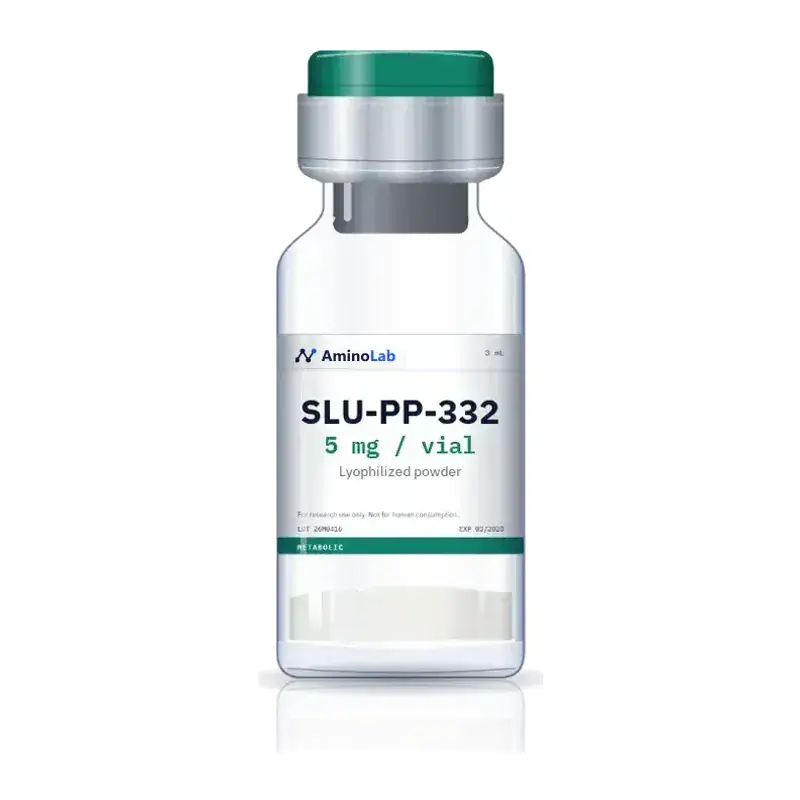
This page sells two quite different objects. The vial is glass, white-labelled under a green flip-off cap, and contains 5 mg of solid with nothing added. The bottle wears a white child-resistant cap over 60 two-tone green and white capsules of 250 mcg, totalling 15 mg. The molecule is identical, but the lots and certificates are kept separate.
The first full characterisation came from Billon and colleagues, working in the Burris group, in ACS Chemical Biology during 2023, describing it as an agonist at all three estrogen-related receptors with its greatest activity at ERR alpha. Supplier figures place its EC50 values near 98, 230 and 430 nM at the alpha, beta and gamma subtypes respectively. A structure-activity study of the scaffold appeared in 2026. Efficacy data so far comes only from mice and cultured cells. With no human trial on record, SLU PP 332 side effects in people remain unknown, and as of October 2026 not one medicine worldwide, nor any entry on the Australian Register of Therapeutic Goods, contains it.
Research suppliers are therefore the only source, so SLU-PP-332 for sale in Australia is found in reagent catalogues rather than pharmacies. Both SLU-PP-332 capsules and vials are warehoused by AminoLab in Australia, and adults 18+ can order them online for in vitro work, never for human or veterinary use. Weighing up whether to buy SLU-PP-332 in Australia at all? Read our SLU-PP-332 research overview first, which walks through the receptor biology and lists the mouse studies.
Start here for biochemical or cell assays, because you will want to prove the compound dissolves and works in your hands before scaling up.
Every capsule is a pre-measured solid with nothing to reconstitute, the same approach used across our other peptide capsules. For a longer series, buy the units together and record each label's lot code next to its certificate. Checkout is open to adults 18 and over only.
Chemically this is an acyl hydrazone, with a 4-hydroxybenzoyl group linked through a hydrazone bridge to a naphthalene ring. There is no amino acid chain anywhere. Being flat and aromatic, it repels water and dissolves far less readily than a typical peptide.
A good certificate shows an observed mass near 290.3 g/mol, states whether it covers vial or capsules, and gives that lot's HPLC purity. Vial lots and capsule lots each have their own entry in our COA library, filed under the code printed on the matching label. Read the entry for your format before you order.
All orders go through the website and ship from Australian stock, which puts a team buying peptides in Geelong on the same lots as one in Darwin. Cleared payment by 3pm on a working day means same-day dispatch, using the services listed on the delivery information page.
Cell papers using this compound typically make a strong DMSO stock first and dilute into medium afterwards. Put 1 mL of solvent into the 5 mg vial and you have 5 mg/mL, close to 17 mM, and the general dilution calculator handles any other volume. Small volumes are easiest with insulin syringes or calibrated pipettes, and the final DMSO level should stay low and equal across every arm, the vehicle control included.
Unopened vials go in a dark, dry -20 °C freezer, and stock solutions should be split into small cold aliquots. Capsules can skip the fridge entirely, provided the lid is tight, the shelf is dry and the room stays under 25 °C, since humidity is what damages solid formats.
Spellings vary, SLUPP332, SLU-PP 332, SLU PP 332 and SLU-PP-332 all refer to it, and chemical vendors may quote the systematic name or CAS 303760-60-3 instead. Retailers frequently label it an SLU PP 332 peptide, some even advertise an SLU-PP-332 peptide, but there is not one peptide bond in its structure.
Gene symbols ESRRA, ESRRB and ESRRG correspond to its three targets, the alpha, beta and gamma ERRs. PGC-1 alpha, the coactivator they partner with, appears in the same papers again and again, and technical sheets sometimes shorten the whole class to ERR agonists or pan-ERR agonists. Whichever spelling your method uses, order it here as SLU-PP-332 in a vial or capsules.
Format first. Solutions you mix yourself favour the vial, whereas identical solid units and the best price per milligram favour capsules, and the SLU-PP-332 capsules vs vial guide goes deeper. On compound, MOTS-c is a peptide encoded in mitochondria that signals through AMPK, while SLU-PP-332 acts on nuclear receptors. Testing both side by side contrasts two entry points to shared mitochondrial programmes. Bring in 5-Amino-1MQ, an enzyme-targeting small molecule, for a third arm. AminoLab stocks both compounds, so a paired design can be ordered in one checkout.
SLU-PP-332 is a young research compound, so most of what is known about SLU-PP-332 side effects comes from animal studies of exercise mimetics. Published work has focused on endurance, fat oxidation and muscle fibre changes, and long-term safety has not been established. Handle the powder with normal laboratory precautions and use it for in-vitro and animal research only.
At 290.3 g/mol this lab-made compound activates all three ERRs, alpha, beta and gamma, without being a peptide or binding estrogen receptors, and it is in stock in Australia.
Buy the 5 mg vial for solution work or the 60 capsule bottle for fixed solid units. No solvent comes with the vial.
Published mouse and cell papers use it to probe genes behind oxidative metabolism and new mitochondria. AminoLab supplies it for in vitro use only.
Pairing a nuclear receptor agonist with a mitochondria-encoded peptide gives two routes into the same energy programmes.
Vials live in the freezer and stocks in cold aliquots, while capsules stay sealed on a dry shelf below 25 °C.
Vial lots and capsule lots each go through mass spectrometry and HPLC, with their own certificate published before sale.
Add the 5 mg vial or the 60 capsule bottle to your cart on this page. Payments cleared before the 3pm business-day cut-off ship that day from Australian stock. The vial comes without solvent, and you can read the lot certificate before checkout.
Our online store delivers to any Australian address. There is no retail counter, so every buyer orders from the same local stock, reads the same published certificates and gets a tracked parcel, whether it is heading to a capital city or a country town.
No. Chemically it is an acyl hydrazone of 290.3 g/mol, built without amino acids or peptide bonds, despite sitting next to peptides in many catalogues. That chemistry makes a stable capsule possible and explains why the vial needs a solvent like DMSO for stock solutions.
Very little. All published work is in cell lines and mice, no clinical trial has been reported and no approved medicine contains it, so SLU PP 332 side effects in humans have never been studied. AminoLab sells it strictly for in vitro research, never for human or veterinary use.
Yes. Identity (mass spectrometry) and purity (HPLC) results exist for every vial lot and every capsule lot, filed separately in our COA library under the lot code on each label. Make sure the report you read matches the format you received.
Cell and biochemical assays usually start with the 5 mg vial, since you set the stock strength. Fixed solid units and lower cost per milligram point to the 60 capsule bottle. See the SLU-PP-332 capsules vs vial guide for detail, and MOTS-c is worth adding if you want a peptide route into the same mitochondrial programmes.
10 mg pen, 3 mL
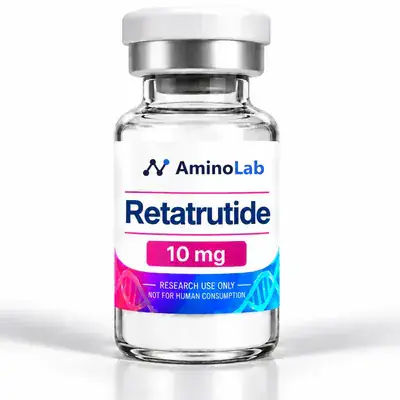
10 mg vial, 20 mg vial, 30 mg vial
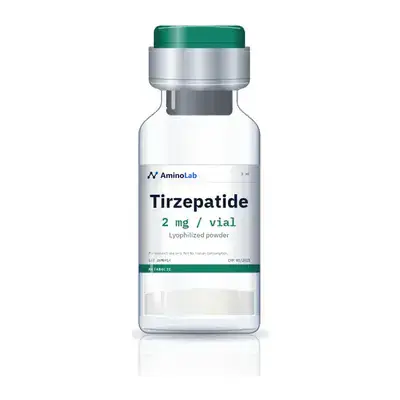
2 mg vial
With 10 mg vial, With 20 mg vial, With 30 mg vial
Research use onlyAminoLab supplies research compounds for laboratory and in-vitro use, not for human or animal consumption. By continuing you confirm you are 18 or older and buying for research.
Leave