BPC-157
10 mg vial, 60 capsules
From $69
Set the two vials next to each other and a single extra peptide separates them. GLOW, the glow stack peptide, packs GHK-Cu, BPC-157 and TB-500 into a 70 mg fill. KLOW keeps those exact three and adds 10 mg of KPV, which lifts the total to 80 mg. So the GLOW vs KLOW choice really turns on two questions, whether KPV has a place in your protocol and whether a locked, premixed ratio suits the design in the first place.
Suppliers use both names freely and the ratios behind them are not consistent from shop to shop. The figures below describe the AminoLab vials only, and each lot certificate confirms them.
| Peptide | GLOW (70 mg) | KLOW (80 mg) | Where it is usually studied |
|---|---|---|---|
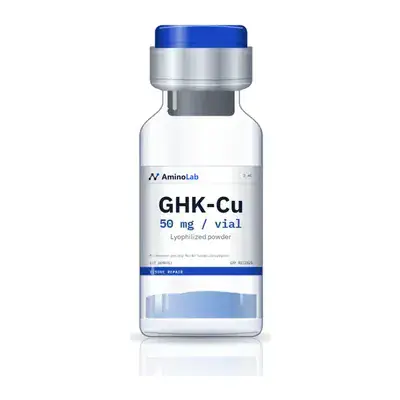
| GHK-Cu | 50 mg | 50 mg | Skin remodelling work, collagen output and copper transport |
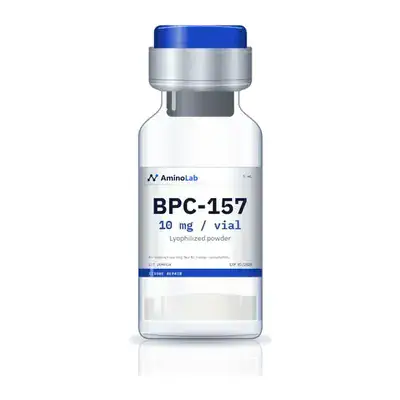
| BPC-157 | 10 mg | 10 mg | Tendon, gut and soft tissue injury studies |
| TB-500 | 10 mg | 10 mg | Cell movement, new vessel growth and wound work |
| KPV | None | 10 mg | Inflammatory signalling, chiefly in the intestine |
| Fill in total | 70 mg | 80 mg | |
| Powder colour | Blue | Blue | Caused by the copper in GHK-Cu |
By mass, GHK-Cu outweighs everything else in each vial, roughly 71% of GLOW and roughly 63% of KLOW. In practical terms, you are buying a GHK-Cu vial with repair peptides folded in either way.
The glow stack, sometimes written as glow stack.peptides or labelled a GLOW blend peptide, is a freeze-dried premix of three compounds, TB-500, BPC-157 and GHK-Cu. The name is a nod to the copper peptide, which has decades of skin research behind it. BPC-157 and TB-500 join it because no other pair has been studied as heavily in soft tissue repair models, so a single solution combines one skin remodelling peptide with two tissue repair peptides.
The K in KLOW stands for KPV, and that is the whole difference. Inside the 80 mg vial sit the same 50 mg of GHK-Cu, 10 mg of BPC-157 and 10 mg of TB-500 found in GLOW, joined by 10 mg of KPV. KPV is a tripeptide, lysine-proline-valine, identical to the closing three residues of alpha-melanocyte-stimulating hormone, or alpha-MSH. Most research attention on it concerns inflammation.
What, then, are the KLOW peptide benefits from a research point of view? The extra component opens an anti-inflammatory line of enquiry on top of the repair and remodelling themes GLOW already covers. Whether the mixture achieves more than its parts would apart has never been put to the test, and no published paper has examined either premixed vial as far as we are aware.
A 1988 FEBS Letters paper from Maquart and colleagues showed that, in cultured fibroblasts, GHK-Cu lifted collagen synthesis by about 80% at its most effective concentration. Small topical trials have since described denser skin and shallower wrinkles after 8 to 12 weeks of use. Our GHK-Cu explainer covers the wider background.
BPC-157 is a 15 amino acid chain taken from a protein that occurs in human gastric juice. Most of what has been published uses injured rodents, with tendon, ligament, muscle and gut models, and a large share of it comes from a single Zagreb research group. Well controlled human data remain thin.
Chemically, TB-500 is a short synthetic fragment cut from thymosin beta-4, a protein that binds actin and helps cells move. Sellers love to cite a rat wound paper here, yet that work by Malinda et al. (1999, in the Journal of Investigative Dermatology) tested the entire thymosin beta-4 protein, not the fragment. Treated wounds re-epithelialised 42% more than saline controls at day 4, rising to as much as 61% by day 7. A fragment is not the same as the whole protein, and marketing copy frequently glosses over that.
Dalmasso and colleagues, writing in Gastroenterology in 2008, reported KPV entering gut epithelial cells by way of the PepT1 transporter, and nanomolar concentrations dampened NF-kappaB inflammatory signalling in culture. In two mouse models, KPV supplied in drinking water also lessened the severity of colitis.
Choosing between a blend and separate compounds matters more than choosing between GLOW and KLOW. A premix cuts down on vials, reconstitution steps and record keeping, with one vial, one lot and one certificate to file. The trade-off is a locked 50 to 10 to 10 ratio (with a further 10 for KPV in KLOW), no way to isolate what any single component is doing, and no way to adjust proportions after mixing.
Whatever you settle on, check the label and certificate rather than trusting the product name, since other sellers market different ratios under both titles. For concentration calculations by component, use the GHK-Cu calculator together with the BPC-157 and TB-500 calculator. Each compound is also sold on its own through our tissue repair peptide range.
Turning the checklist above into an order is simple. If you need a control for each compound, put GHK-Cu and KPV 10 mg single vials in the cart with the blend. Both blends ship from stock held in Australia, and every lot comes with its own third-party certificate. To compare every premixed vial before checkout, shop the full peptide blends range.
All of these products, the blends and their single components alike, are sold by AminoLab strictly as laboratory research material and are not for human or veterinary use.
The only change is KPV. GLOW from AminoLab weighs 70 mg, split into 50 mg of the copper peptide plus 10 mg apiece of BPC-157 and TB-500. KLOW keeps every one of those amounts and adds 10 mg of KPV, the anti-inflammatory tripeptide derived from alpha-MSH, which brings the fill to 80 mg.
Think of it as a four peptide research premix, freeze-dried into one vial, combining KPV, TB-500, BPC-157 and GHK-Cu. Our 80 mg version contains 50 mg of the copper peptide and 10 mg of each remaining compound. Most people read the name as GLOW with a K for KPV.
Three compounds, GHK-Cu, BPC-157 and TB-500. In our GLOW vial that works out to 50 mg, 10 mg and 10 mg in that order, 70 mg altogether. Its blue colour comes from the copper bearing GHK-Cu, about 71% of the mix. Other suppliers use other ratios, so always read the certificate.
Not on the blend itself, as no published study has examined KLOW as a mixture. The reasoning behind it draws on separate research for each part, collagen synthesis work for GHK-Cu, rodent tissue repair for both BPC-157 and TB-500, and KPV for lower inflammatory signalling in mouse colitis models. A combined effect has never been tested.
AminoLab stocks both blends locally, GLOW as a 70 mg vial and KLOW as an 80 mg vial. Independent identity and purity reports for each batch sit in our COA library, matched to the lot number on the vial. Both are research materials only and are not for use in people or animals.
10 mg vial, 60 capsules
50 mg vial, 100 mg vial
10 mg vial
3 mL, 3 mL + 1 syringe, 10 mL, 10 mL + 1 syringe, 30 mL, 30 mL + 1 syringe
Research use onlyAminoLab supplies research compounds for laboratory and in-vitro use, not for human or animal consumption. By continuing you confirm you are 18 or older and buying for research.
Leave