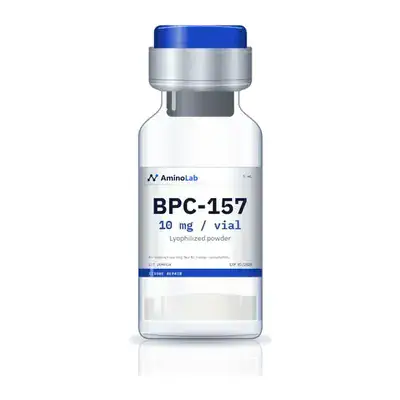
BPC-157
10 mg vial, 60 capsules
From $69
What is GHK-Cu peptide, chemically speaking? It is glycyl-L-histidyl-L-lysine, three amino acids long, carrying a single copper(II) ion. Loren Pickart isolated it from human blood plasma back in 1973. Today labs probe how it influences gene activity, collagen and wound repair, while the cosmetics industry puts this very copper peptide into creams labelled copper tripeptide-1.
Start with the sequence, glycine then histidine then lysine. That bare tripeptide has no colour. It has a strong pull towards copper(II), though, and grabs the ion on contact to form the complex written GHK-Cu. That complex is the research reagent, and it is also the copper tripeptide-1 on a cosmetic label. Histidine, helped by the backbone nitrogens, grips the metal. The grip is strong enough to carry copper through tissue fluid and weak enough to release it to a cell.
The metal changes the appearance too. Nearly every other lyophilized peptide is a white powder. GHK-Cu is blue, both as a dry cake and once dissolved, and in the lab that blue tint is the very first identity check you can do on a vial.
Take the copper out and you are left with GHK alone, known on cosmetic labels as tripeptide-1. Blogs swap the two names freely. A lab cannot. The free peptide is colourless and lighter, whereas the complex is blue and heavier by the mass of one copper ion. If you are ordering the peptide GHK-Cu, you need the complex, and its certificate should confirm the copper-bound form.
It is a nickname. Blue copper peptide simply means GHK-Cu, a name borrowed from how the dry powder and the dissolved liquid look. No separate molecule hides behind it, and any blue copper peptide product ought to show copper tripeptide-1 in its ingredient list.
Pickart and his co-author Martin Thaler reported it in 1973 in the journal Nature New Biology. Their starting observation was odd. A portion of the albumin in human plasma pushed liver tissue taken from older people to make proteins in a younger pattern. They traced that activity, tentatively, to glycyl-L-histidyl-L-lysine, and copper binding was mapped in follow-up work.
The body makes GHK on its own. According to Pickart's reviews, plasma carries around 200 ng/mL at 20 years of age and only about 80 ng/mL by 60. That fall with age is a big part of why ageing researchers find it interesting.
Talk of GHK-Cu peptide benefits usually blurs strong and weak evidence together. Below are the research lines with published data, running from the firmest human findings to the most preliminary.
A fair verdict on GHK-Cu benefits is that the gene and cell data are wide-ranging, while the human data stop at small topical skincare trials. Trial by trial, the measurements are set out in GHK-Cu before and after studies, and the primary papers are collected in our GHK-Cu research library.
Nobody has found one receptor for GHK-Cu, a contrast with the GLP-1 agonists or BPC-157. The literature offers three overlapping ideas instead. One is copper transfer, where GHK delivers copper(II) into cells and to enzymes that need it, lysyl oxidase and superoxide dismutase among them. Another is broad gene regulation, since cell data show GHK nudging large sets of genes, which would account for effects spread across many pathways. The third comes from early experiments in which GHK drew endothelial and immune cells toward a wound. How copper peptide works in a particular model likely draws on more than one of these.
Skin work mostly measures what copper peptide does in dermal fibroblasts, where readouts include elastin, collagen and glycosaminoglycans, plus rodent wound contraction. On the hair side, the models are mouse hair cycle studies and dermal papilla cells, and there is no big controlled trial in people behind the marketing of copper peptide hair products. Cosmetic questions are handled in the GHK-Cu serum and copper peptide cream guide. For what is known and unknown about reactions, read the GHK-Cu side effects summary.
Keep three cautions in mind with nearly any GHK-Cu claim. To begin with, many of the reviews summarising the field were written by Pickart, who discovered the peptide, so truly independent replication is thinner than the citation count implies. Next, the human trials used creams, frequently at low strength, never injections. Finally, a list of genes that move in a dish of cells is not evidence of any clinical effect.
Those limits do not make GHK-Cu dull. They make it a compound with a genuine track record that, cosmetics aside, is still largely preclinical.
Copper tripeptide-1 skincare is sold here as cosmetics, a category separate from therapeutic goods. For any other use, consult the latest Poisons Standard (SUSMP) and current TGA guidance directly, because supplier websites are not a reliable source. Our GHK-Cu is sold purely as a research chemical for laboratory work.
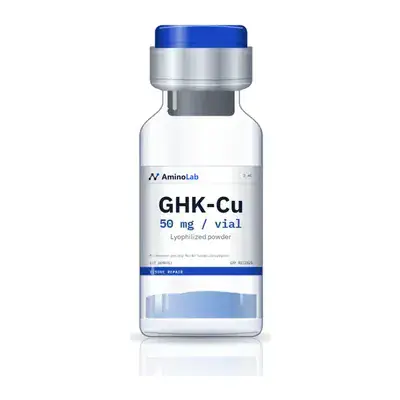
We carry GHK-Cu in two fills. Choose the 50 mg vial for new projects and method development, or the 100 mg vial when a lab runs repeated assays and wants one lot with one certificate. Each fill ships in a sealed 3 mL glass vial, and freezing at minus 20 °C is the best way to hold it before you add diluent. Use the GHK-Cu peptide calculator for concentrations with either size. GHK-Cu also appears, grouped by field, on our page of research peptides for sale in Australia.
Your eyes do the first check, because the cake should be blue. Next, find the certificate of analysis that matches the lot number on the label and check that it reports an HPLC purity figure and a mass spectrometry identity result. Each AminoLab lot goes through both tests at an outside lab, and you can read the reports on our lot-matched COA lookup. If any line on the report is unclear, our guide to reading a certificate of analysis walks through it.
GHK-Cu is sold by AminoLab for laboratory research only and must not be used in people or animals.
What is a copper peptide? Any short peptide holding a copper ion qualifies, and GHK-Cu is by far the most researched member of the group. So what does GHK-Cu peptide do at the bench? Reports describe higher collagen and glycosaminoglycan output from cultured fibroblasts, effects on wound contraction in animal models and shifts in genes tied to antioxidant defence and repair. And what is copper peptide research outside GHK-Cu? Largely analogues like AHK-Cu, tested against GHK-Cu as the benchmark.
Two worlds use them, and they seldom meet. In beauty products, copper tripeptide-1 is dosed into creams, serums and hair formulas in the parts per million range (the peptides for skin guide sets it beside the other cosmetic peptides). Research labs instead buy pure GHK-Cu as dry powder with a lot certificate and use it as a reference compound in fibroblast, wound, copper transport and gene expression work, as our lab tested peptides page describes.
Think of copper peptides as a small subset. Any brief chain of amino acids joined through peptide bonds is a peptide, and the peptide glossary explains the vocabulary. Only sequences built to hold copper, such as GHK with its histidine, earn the copper label. Palmitoyl pentapeptide-4 (a signal peptide) and acetyl hexapeptide-8 (a neurotransmitter-type peptide) contain no metal, so a serum full of mixed peptides is a different product from a copper peptide serum.
Pick the fill by the workload one lot must carry. For method development, order the 50 mg GHK-Cu vial. If your lab has not reconstituted peptides before, the GHK-Cu Starter Kit bundles one insulin syringe and a little diluent vial with the 50 mg GHK-Cu. Skin and repair studies that mix compounds can use the GLOW blend, a 70 mg vial built on 50 mg of GHK-Cu with BPC-157 and TB-500. Order from our Australian stock, check the lot certificate before you pay, and look for that blue cake when the parcel arrives.
What is the peptide GHK-Cu? It is the tripeptide glycyl-L-histidyl-L-lysine bound to a copper(II) ion. How does copper peptide work at the cell level? GHK carries copper into cells and changes the activity of a large set of genes involved in tissue remodelling, including those for collagen and antioxidant enzymes.
What is copper peptides used for in the laboratory? Mostly wound healing, skin matrix and hair follicle models, plus a growing body of gene expression research. If you came here asking what is GHK peptides in plain words, it is a small natural signalling peptide that was first found in human plasma. Buy the GHK-Cu research vial when you are ready to start.
Roughly 340 daltons for GHK, close to 400 once copper is attached. That puts it near the bottom of our range by size, well under BPC-157 at about 1,419 daltons. A single small mass makes the identity section of the certificate simple to check.
The unmixed cake should be uniformly blue without white patches. In bacteriostatic water it should dissolve into a clear blue liquid, free of specks or haze. With 2 mL of diluent, the 50 mg vial works out at 25 mg per mL and the 100 mg vial at 50 mg per mL. Other volumes? Try the GHK-Cu calculator.
Dry powder belongs in a dark freezer at minus 20 °C for the long haul, with 2 to 8 °C fine for short spells. Mixed solution lives in the fridge, also 2 to 8 °C, for up to 28 days. Keep it clear of strong acids and reducing agents, which can pull the copper complex apart.
Low-strength creams and serums carry the complex as copper tripeptide-1, and AminoLab does not make or sell those. What we sell is the pure research compound with a lot certificate. You can also buy it inside blends, as the largest share of GLOW and as one of the four parts of KLOW, or as the 50 mg vial in the GHK-Cu Starter Kit.
Three amino acids, glycine, histidine and lysine, forming the tripeptide glycyl-L-histidyl-L-lysine, plus one bound copper(II) ion. Without the metal the peptide is colourless. Copper supplies the blue, and ingredient lists on cosmetics name the complex copper tripeptide-1.
Fibroblast experiments show more collagen, cell data show many human genes changing expression, and rodents have been used to test it in wound healing. Small topical cream trials in people reported better skin density and shallower wrinkles over 8 to 12 weeks. Human data on injected use are limited.
Collagen gains, both in cultured cells and in a single small biopsy study, plus better wrinkle depth, density and thickness in cream trials that enrolled between 40 and 71 women. Animal models supply most wound findings, and gene results come from cells.
GHK-Cu is not on the ARTG as a therapeutic good and is not an approved medicine. In April 2026 the TGA listed it in a safety alert about unapproved peptides that nobody had assessed for quality, effectiveness or safety. Cosmetic products with copper tripeptide-1 are a separate category. This is general information rather than legal advice, so confirm with the TGA.
The bound copper(II) ion. Free GHK has no colour, which means a white cake in a GHK-Cu vial points to a missing complex. Real GHK-Cu looks blue dry and stays a clear blue once dissolved.
Order it from AminoLab, which ships GHK-Cu for laboratory research from Australian stock as a 50 mg vial, a 100 mg vial or a starter kit with diluent and a syringe. Each lot's outside test report sits in the COA library. We sell only the research form, never copper peptide serums or cosmetics.
10 mg vial, 60 capsules
50 mg vial, 100 mg vial
10 mg vial
3 mL, 3 mL + 1 syringe, 10 mL, 10 mL + 1 syringe, 30 mL, 30 mL + 1 syringe
Research use onlyAminoLab supplies research compounds for laboratory and in-vitro use, not for human or animal consumption. By continuing you confirm you are 18 or older and buying for research.
Leave