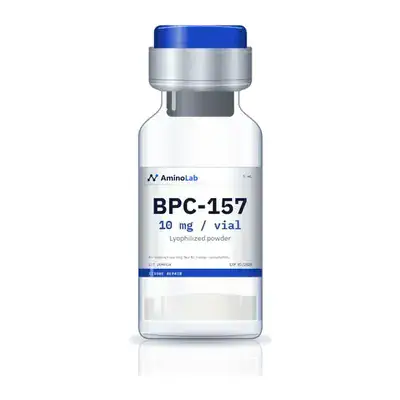
BPC-157
10 mg vial, 60 capsules
From $69
Five small human trials, a few weeks each, all using creams. That is roughly the full extent of measured GHK-Cu before and after evidence, and none of it covers a GHK-Cu peptide injection before and after comparison. Researchers ran those studies for one to three months and checked collagen, density and wrinkle depth with biopsies, imaging equipment and graders who did not know which product was which. What they saw was real, and it was modest. The dramatic transformations posted online, and especially the ones attributed to injecting GHK-Cu, come from no controlled setting at all, so they tell you very little.
GHK-Cu pairs a copper(II) ion with the three amino acid chain glycyl-L-histidyl-L-lysine. On a cosmetic box you will find it written as copper tripeptide-1. If you trace the human "before and after" numbers back to their source, almost all of them share one template. Participants put a cream or serum on their skin morning and night, a placebo base or another active acts as the control, and the result is scored by an imaging system, a skin biopsy or an assessor kept blind to the groups.
Keep that template in mind, because it limits what any claim can honestly say. Cell and animal experiments on GHK-Cu are plentiful, touching on collagen made by fibroblasts, how wounds contract and which genes switch on. The human skin record is much smaller, a few topical product trials, and more than one of them was a conference presentation that never became a full journal paper. If you want the history of the molecule, our guide on where GHK-Cu came from and what it is covers it. So a copper peptide serum before and after claim from any brand, and any GHK-Cu peptides before and after claim, ultimately borrows from that same handful of trials.
Below are the copper peptide trials that turn up in nearly every discussion, alongside what was actually measured in each. Two review papers by Loren Pickart, who first isolated GHK, bring them together, one in BioMed Research International (2015) and one in the International Journal of Molecular Sciences (2018).
| Who and when | Group and timeframe | What they checked | What they found |
|---|---|---|---|
| 1998, Abdulghani and colleagues, published in Disease Management and Clinical Outcomes | One month, 20 healthy volunteers, creams put on the thigh | Immunohistology of skin biopsies for procollagen | Seventy per cent (70%) of GHK-Cu users made more collagen, versus 50% using a vitamin C cream and 40% using retinoic acid |
| 2002, Leyden and colleagues, face cream presented at the American Academy of Dermatology meeting | Twelve weeks, 71 women | Wrinkle depth, fine lines, clarity, laxity, plus skin thickness and density | Better than baseline on every measure |
| 2002, Leyden and colleagues, eye cream | Twelve weeks, 41 women | Skin thickness and density, along with lines and wrinkles | Ahead of placebo and ahead of a vitamin K cream |
| 2005, Finkley, Appa and Bhandarkar | Twelve weeks, 67 women aged 50 to 59, used twice a day | Biopsy histology, mottled pigmentation, wrinkles, firmness and laxity | Gains reported, with biopsies showing more keratinocyte proliferation |
| 2016, Badenhorst and colleagues, published in the Journal of Aging Science | Eight weeks, 40 women aged 40 to 65, double-blind and randomised | Imaging of wrinkle depth and wrinkle volume | Against the base serum, wrinkle volume fell 55.8% further and depth 32.8% further, and against a Matrixyl 3000 product, wrinkle volume was 31.6% lower |
If you only trust one row, make it the 2016 Badenhorst study. Participants were randomly allocated, neither they nor the assessors knew the groups, and GHK-Cu faced both a plain vehicle and a competing active, delivered inside lipid nano-carriers so it could get further into the skin. The 1998 Abdulghani pilot deserves a mention for a different reason, as the single study that looked at collagen in the tissue itself, though its sample was tiny.
One study is worth singling out because it found no measurable benefit. Miller's team, publishing in Archives of Facial Plastic Surgery in 2006, gave GHK-Cu skin care to patients recovering from CO2 laser resurfacing of the face. Computer analysis and blinded evaluators alike found no significant gap in wrinkles, redness or skin quality between that group and the comparison group. The GHK-Cu patients nonetheless rated their own skin as clearly better.
That one result neatly explains why before and after claims mislead. Belief that a product is active is enough to make people report more improvement, whether or not an instrument or an independent dermatologist can confirm anything.
The published timelines are easy to summarise. The biopsy pilot checked skin at one month. The nano-carrier study waited eight weeks. Leyden's and Finkley's cream trials went to twelve weeks. Nobody published a result from day two or week one, and nobody kept watching participants for longer than around three months.
A photo set claiming visible change within days therefore runs well ahead of anything the copper peptide literature measured on collagen.
Plenty of the photos circulating now are labelled GHK-Cu peptide injection before and after. We looked and found no published controlled trial that injected GHK-Cu and then measured how skin looked. Every row in the trial table involves something rubbed onto skin. The US Food and Drug Administration, when it assessed GHK-Cu as a candidate compounding ingredient, flagged a possible immunogenicity risk in compounded injectables, linking it to peptide aggregation and peptide-related impurities, and it also said human data relevant to safety is limited (FDA bulk drug substances list, updated April 2026).
The Australian regulator has gone further. A TGA safety alert issued in April 2026 about unapproved peptide products named GHK-Cu as one of the products never assessed for quality, safety or effectiveness. In short, injection photos have no controlled evidence behind them. Our GHK-Cu side effects and safety data guide sets out what has been studied and where the gaps are.
Consumer reviews shape more buying decisions than clinical trials do. Pick up any ordinary copper peptides review, any niod copper peptide review or any biossance copper peptide serum review and you are reading one of hundreds of short personal accounts. Those accounts are genuinely handy for the practical stuff. Does it feel sticky, does it ball up under sunscreen, how long does a bottle last, does the pump jam. What they cannot tell you is whether collagen changed, since reviewers do not own biopsy kits, imaging rigs or placebo bottles.
The same caveat applies to copper peptide patch reviews, to older product lines built on Dr Pickart's original work, and to the ordinary buffet copper peptides before and after posts left over from when that serum carried an earlier name. Think of reviews as a guide to comfort and tolerance, and of the trials as the guide to how big any effect is. Our GHK-Cu serum guide explains how to confirm what is really in a bottle, and the peptides for skin guide covers the copper-free serums that often get compared with them.
Hair photos stand on even weaker ground. Everything known about GHK-Cu and hair comes from cultured dermal papilla cells and from hair cycle work in mice. Hair trials are normally done by counting strands in a marked zone of scalp under standard lighting, and we could not find a large controlled trial of that kind for any copper peptide hair serum. Copper peptides for hair before and after pictures, copper peptides hair growth results and copper peptides for hair reviews all belong in the anecdote pile.
A common question is whether you can use copper peptides after microneedling. Others ask about copper peptides before or after retinol, or copper peptides before or after hyaluronic acid, and some want to know about niacinamide before or after copper peptides. There is no published controlled study comparing the order of use for any of those pairs. The closest thing is the 2006 laser resurfacing study, where GHK-Cu products on freshly treated skin showed no objective benefit. Anything going onto skin that has just been needled or lasered should be decided by the practitioner doing the procedure, and it is not a question AminoLab, as a research supplier, can answer.
You can make skin look better or worse in a photo without changing it at all. Run any GHK-Cu before and after post past this list of things the proper trials had to control for.
Our rule is simple. No control group, no blinded scoring and no timeframe means the image is advertising. The trials covered here may be small, yet they are still the only GHK-Cu before and after numbers worth repeating.
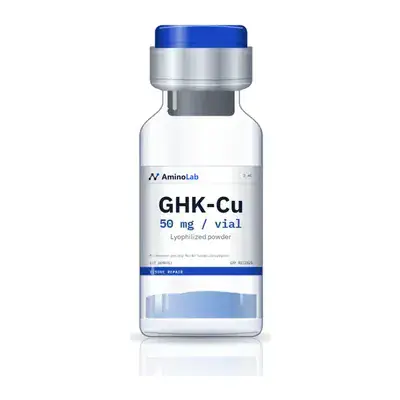
For copper peptide research the starting requirement is a compound you can verify. Genuine GHK-Cu dries to a blue cake because the copper is bound to the peptide, and a white cake carrying a GHK-Cu label suggests the copper never made it in. Certificates are a better guide than GHK-Cu peptide Australia reviews, and our lab tested peptides page breaks down each part of one. Look up the lot number from your vial on the COA lookup page, then set your working concentrations with the GHK-Cu reconstitution calculator. You will find similar compounds in our skin and cellular peptide range.
AminoLab supplies GHK-Cu as a lab reagent to adults 18+ under our research use only policy. It is not for human or animal use, and this guide contains no application or injection advice.
Most GHK-Cu peptide before and after images leave out the basics, namely what was used, how often, and what else was going on. Copper peptides before and after content generally shares that problem. So does material tagged copper peptides before after, the ordinary copper peptides before and after or copper peptides for skin before and after, where a picture shows up without any method. Measured results exist only in the controlled trials above, and those involve creams used over weeks. A GHK Cu peptide before and after result credited to injection has no trial behind it. To compare GHK-Cu with other compounds, browse our full range of research peptides for sale in Australia.
You cannot test a single claim on this page without a reagent of confirmed identity, so put your budget into the compound and not the hype. AminoLab sells GHK-Cu in 50 mg and 100 mg vials, blue freeze-dried cakes whose lot numbers line up with independent certificates in our COA library. If this is your first copper peptide assay, the GHK-Cu starter kit bundles the 50 mg vial, a 3 mL vial of diluent and a 1 mL U-100 syringe in one box. We hold both in Australia and sell them online only as research reagents, with no cosmetic, skin or injection use intended. Buy GHK-Cu online now and file its certificate alongside your lab notes.
Modest improvements from creams. A 1998 biopsy pilot saw collagen production rise in 70% of GHK-Cu users, and a 2016 double-blind study measured wrinkle volume 31.6% below a Matrixyl 3000 product at 8 weeks. A 2006 laser resurfacing study saw no objective difference. All were small and all were topical, with no injections involved.
From one month up to twelve weeks. Abdulghani measured at one month, Badenhorst at eight weeks, and Leyden and Finkley at twelve. No human skin trial reported results after a matter of days, and none followed participants to see if changes remained after they stopped.
Not that we could find. No controlled trial has injected GHK-Cu and then measured skin appearance, since all human skin data involves topical products. The US FDA says human safety data on compounded injectable GHK-Cu is limited, and the TGA has listed GHK-Cu among unapproved peptide products never assessed for safety or effectiveness.
AminoLab sells GHK-Cu online as 50 mg or 100 mg freeze-dried vials, plus a starter kit that adds bacteriostatic water and a syringe. Stock is held in Australia, every lot is independently tested for identity, and each certificate is published in the COA library. It is a research reagent only, not a cosmetic and not for personal use.
Ask the practitioner doing the procedure, because no controlled trial has tested copper peptide serums applied right after microneedling. The closest study, from 2006, used GHK-Cu products after CO2 laser resurfacing and found no objective change in wrinkles or redness. AminoLab GHK-Cu is a research reagent and is not sold for any procedure.
Not for measured change. Reviews of serums from The Ordinary, NIOD and similar brands describe texture, comfort and packaging, but they have no control group, fixed lighting or blinded scoring. Only the controlled cream trials of eight to twelve weeks offer measured results to compare.
10 mg vial, 60 capsules
50 mg vial, 100 mg vial
10 mg vial
3 mL, 3 mL + 1 syringe, 10 mL, 10 mL + 1 syringe, 30 mL, 30 mL + 1 syringe
Research use onlyAminoLab supplies research compounds for laboratory and in-vitro use, not for human or animal consumption. By continuing you confirm you are 18 or older and buying for research.
Leave