$179
Buy Radiance Bundle Australia: Radiance Research Kit With GHK-Cu, KPV and BPC-157 Vials
$179 AUD, GST included
Minimum order before shipping, and you can mix any products to reach it.
In stock, ready to ship from Australia
Sold to buyers aged 18 and over only.
- Certificate of analysis for every lot
- Identity and purity testing
- Research use only
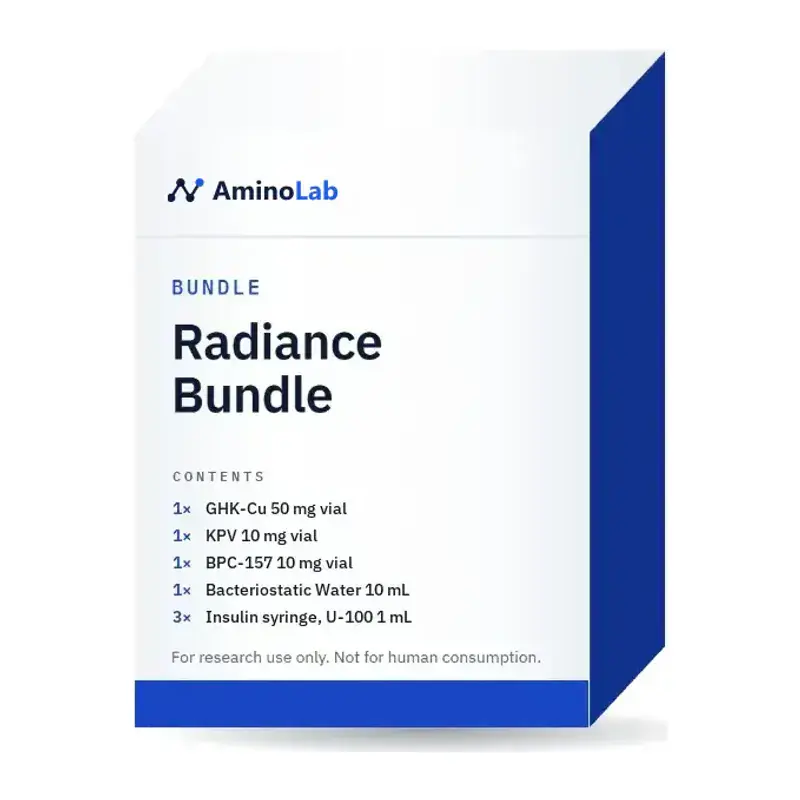
Order Radiance Bundle online in Australia at AminoLab, where the complete research carton is held in local stock. The Radiance Bundle Australia carton puts three separate vials in one box (10 mg of BPC-157, 10 mg of KPV and 50 mg of GHK-Cu) with three 1 mL U-100 syringes and a 10 mL vial of bacteriostatic water. Order the Radiance peptide bundle online and you get a copper complex, a melanocortin fragment and a gastric sequence, each kept apart. For reference, the copper peptide is a copper(II) complex of Gly-His-Lys (C14H22CuN6O4, CAS 89030-95-5). KPV is Lys-Pro-Val, the C-terminal tripeptide of alpha-MSH (CAS 67727-97-3, C16H30N4O4). BPC-157 is a 15-residue chain taken from a stomach protein (CAS 137525-51-0, C62H98N16O22). Identity is confirmed by mass spectrometry and purity is measured by HPLC on every peptide lot, so there are three certificates to review before you pay. Our BPC-157 calculator and GHK-Cu calculator turn any water volume into a concentration. If copper peptide work is all you plan, buy the GHK-Cu Starter Kit instead. Diluent comes in the box, and unopened vials keep at -20 °C out of the light. Buy Radiance Bundle online now while it is in stock, supplied by AminoLab to adults aged 18 and over for research use.
For laboratory research use only. Not for human or veterinary use. Not TGA approved. See our research use policy.
Inside the Radiance Bundle Australia carton you buy
| Product | Radiance Bundle |
|---|---|
| Sequences | BPC-157 reads Gly-Glu-Pro-Pro-Pro-Gly-Lys-Pro-Ala-Asp-Asp-Ala-Gly-Leu-Val. KPV reads Lys-Pro-Val. GHK-Cu reads Gly-His-Lys, complexed with copper(II) |
| Formulas | C62H98N16O22 (BPC-157), C16H30N4O4 (KPV), C14H22CuN6O4 (GHK-Cu) |
| Molecular weights | 1419.5 g/mol (BPC-157), 342.4 g/mol (KPV), 401.9 g/mol (GHK-Cu) |
| CAS | 137525-51-0 (BPC-157), 67727-97-3 (KPV), 89030-95-5 (GHK-Cu) |
| Appearance | Freeze-dried powder, three sealed glass vials |
| Quality checks | Mass spectrometry identity and HPLC purity on every peptide lot, one certificate each |
| In the box | Three sterile 1 mL U-100 insulin syringes, one 10 mL vial of bacteriostatic water with 0.9% benzyl alcohol, and peptide vials of BPC-157 10 mg, KPV 10 mg and GHK-Cu 50 mg |
| Storage conditions | Freeze peptide vials at -20 °C for long holds, or refrigerate at 2 to 8 °C if needed soon, always in the dark. Keep the water and syringes at room temperature |
| Stock status | In stock |
| Intended use | Bench research, in vitro only |
Buy this carton when your design needs all three compounds but must keep them independent. With three vials you can dose a well with one, two or all of them, or none, and that freedom is exactly what a fixed blend takes away.
Buy a toolkit, not a formula
Strip away the name and the Radiance peptide bundle is simply three single research peptides boxed together, GHK-Cu, KPV and BPC-157, with preserved water and syringes so you can dissolve and measure each one. Nothing inside is premixed. Use any vial alone if you like. Treat the set as a starter toolbox for tissue and skin work, not as a recipe.
Three compounds, three layers of a wound model
Injury models involve several overlapping processes, and the three peptides line up against different ones. Matrix rebuilding is GHK-Cu's territory, since this copper carrier is studied for fibroblast collagen output and remodelling. Inflammation is where KPV fits. In published culture experiments, this three-residue tail of alpha-MSH turned down NF-kappa B signalling inside epithelial cells. Blood supply belongs to BPC-157, with years of rodent data connecting it to nitric oxide signalling and angiogenesis. Lined up together, the three let one experiment ask which layer is driving the outcome. Product pages for BPC-157 in vial and capsule form and KPV, the alpha-MSH tripeptide go into more detail on those two.
The case for keeping the vials apart
Once peptides are blended, you can only ever test the mix. Separate vials unlock a complete factorial layout, which is the best argument for choosing this skin research peptide bundle over a premixed product.
- With three compounds there are eight arms, running from vehicle alone up to the full trio.
- Paired arms reveal whether two peptides simply add together, cancel or amplify one another.
- Single-compound arms give each peptide its own baseline to compare with the literature.
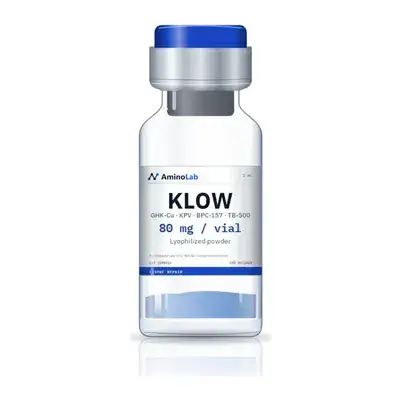
Getting concentrations right is where such designs come unstuck, and molar mass is the usual culprit. Because KPV is only about a quarter the mass of BPC-157, a milligram of KPV holds roughly fourfold more molecules, and GHK-Cu behaves much like KPV here. Equal weights would therefore overload the two tripeptides relative to the 15-residue chain. Settle in advance whether your question concerns matched mass or matched molecule counts, note it in the protocol, and work out stock concentrations at the desk before anyone touches a vial. That flexibility is also the key difference from KLOW, which combines four peptides, TB-500 included, into one fixed cake. AminoLab sells it that way on purpose, so the order fits whatever design you choose.
Buy the Radiance Bundle online for skin research models
All three sit in the same research field, but each works differently. Fibroblast cultures and rodent wound studies on elastin and collagen feature GHK-Cu. KPV is used in rodent and cell inflammation work, including experimental colitis. Rodent papers on BPC-157 and repair of tendon, gut and soft tissue date from the early 1990s onward.
Boxing them together answers a question labs ask often. Within a single tissue model, how does a gastric pentadecapeptide stack up against a melanocortin fragment or a copper peptide, by itself and in mixtures? These are research reagents, and Radiance is just a label with no cosmetic or therapeutic promise attached. The carton is listed in our skin and hair peptides range. AminoLab ships the whole carton from Australian stock.
What is in the box you order, and how each peptide is regulated
Radiance is our label for the box. No paper describes a compound, formula or brand by that name. Lift the lid and there are seven items. Three stoppered peptide vials, one with a blue 50 mg GHK-Cu cake and two with white cakes (BPC-157 and KPV, 10 mg each), and beside them sit a 10 mL bacteriostatic water vial and three sterile U-100 syringes. Each peptide vial carries its own lot code, so you get three reports instead of a single combined one, and no powder has been mixed with another.
One carton, three legal positions
The law looks at each vial on its own terms. The strictest case is BPC-157, prescription only (Schedule 4) in the Poisons Standard from 1 June 2024 and also listed by WADA in class S0. Copper tripeptide-1 is a common cosmetic ingredient, yet pure GHK-Cu for therapeutic purposes is unapproved, and the TGA singled it out in April 2026 when warning about peptides with no ARTG listing. KPV is the quiet one, with no Poisons Standard entry under its name that we could locate and no approved therapeutic use. At October 2026 none of the trio appeared in any registered Australian medicine, and the water and syringes are just supplies for making solutions.
Given those statuses, only lab suppliers stock a skin research peptide bundle of this kind. The Radiance Bundle is packed by AminoLab from Australian stock as material for in vitro studies. Adults 18 and over may order it, and must never be used on humans or animals. Studying just the anti-inflammatory tripeptide? Then the single KPV vial costs less, and the strictest component is explained in detail in the BPC-157 legal status guide. AminoLab sells every item in it as a research reagent to buyers aged 18 and over.
Order the Radiance peptide bundle
There is a single configuration. Buying BPC-157 10 mg, KPV 10 mg, GHK-Cu 50 mg, the 10 mL water and three syringes one by one costs more than the carton. If GHK-Cu is the only peptide your study uses, that saving is gone, and the starter kit makes more sense.
For longer projects, log the lot code of every vial against your results. Three clean analytical records, one per peptide, mean a week-one result can be read against a week-six result knowing exactly which batch sat behind each. Orders are accepted from buyers aged 18 or older only.
Buy three lot-tested peptides at AminoLab, with three certificates to check
Their certificates look nothing alike. BPC-157 shows a mass of 1419.5 g/mol for its 15 residues, with several prolines near the N-terminus. KPV, a plain tripeptide, comes in at 342.4 g/mol. The copper complex, GHK-Cu, sits at 401.9 g/mol and is the only blue cake in the box, so you can spot its vial at a glance.
Three separately tested lots means three reports, each linked to the code on its own label. Pull them up in the COA library and check mass and HPLC purity before you start work. For help with what to look for, see how to read a COA. Every one of those reports is online before you order.
Order the Radiance Bundle Australia wide, then mix and store it
You will not find these three research peptides packed together in any retail store. Our team packs each carton here in Australia, and it is available online only. Pay by 3pm on a business day and it goes out that afternoon, and the delivery information page sets out timing.
Say you put 2 mL in every vial. BPC-157 and KPV then sit at 5 mg per mL, GHK-Cu at 25 mg per mL, and 4 mL of the water remains after 6 mL is used. For other volumes use the BPC-157 reconstitution calculator, and take a fresh syringe for each vial so no solution is carried over. Label each vial with its mixing date and strength straight away, because the KPV and BPC-157 solutions are both colourless and indistinguishable on a shelf.
The 28-day clock starts when the water vial's stopper is first pierced. Either reconstitute all three peptides around the same time, or leave the unopened ones frozen at -20 °C until you need them. Once dissolved, keep each vial at 2 to 8 °C, ideally split into aliquots.
Shop the Radiance Bundle peptides under other names
Older literature refers to BPC-157 as bepecin or PL 14736, and the letters stand for body protection compound. KPV appears as alpha-MSH (11-13), the closing three residues of the alpha-melanocyte-stimulating hormone chain. GHK-Cu turns up as copper tripeptide-1 or prezatide copper.
You might also hear the box described as a skin research peptide bundle or as a GHK-Cu, KPV and BPC-157 kit. Either way it holds three peptide vials, three syringes and a 10 mL bottle of preserved water. At AminoLab you can buy the carton simply as the Radiance Bundle.
Buy the Radiance Bundle or the GHK-Cu Starter Kit?
Working with GHK-Cu alone? Go for the GHK-Cu Starter Kit. Comparing all three compounds? The Radiance Bundle covers them in one carton.
Prefer a single premixed vial with a fixed ratio? Consider the KLOW blend. Our GLOW vs KLOW guide weighs premixed blends against separate vials. AminoLab stocks every option named here, so you can order the one that fits today.
Radiance Bundle at a Glance Before You Buy
Buy a trio for skin research
GHK-Cu, KPV and BPC-157 arrive in their own vials, ready to be tested singly or in combination.
One Carton, Six Items
You get three peptide vials, a 10 mL bacteriostatic water vial and three U-100 syringes, for less than the parts bought separately.
Why labs order it
Labs buy the set for rodent repair work, inflammation models and cultured fibroblasts, never outside the lab.
Need only GHK-Cu? Order the starter kit
Choose the GHK-Cu Starter Kit, a smaller carton with one vial, water and a syringe.
Storage in brief
Unopened vials stay at -20 °C until required. Refrigerate mixed solutions between 2 and 8 °C, with one syringe reserved per vial.
Each lot has its own report
Mass spectrometry and HPLC are run on every peptide lot, and all three certificates can be opened in the COA library.
Radiance Bundle FAQ
How do I order the Radiance Bundle in Australia?
Put the bundle in your cart on this page and complete checkout. Dispatch is from Australian stock, same afternoon if payment lands by 3pm on a business day. The three peptide vials, the 10 mL bacteriostatic water and the three syringes all travel in a single carton.
Can I pick up the Radiance peptide bundle near me?
No, it is sold online only. AminoLab has no shopfront, and no retail store packs these three research peptides together, so every lab orders from this page. We deliver from local stock to every Australian state and territory, and everyone receives the same tested lots.
Are certificates of analysis supplied with the bundle I buy?
Yes, three of them, one for each peptide lot. GHK-Cu, KPV and BPC-157 are each identity-checked by mass spectrometry and purity-tested by HPLC on their own. Search the COA library using the code on each vial label to open its report.
Radiance Bundle or GHK-Cu Starter Kit, which suits my lab?
If your protocol uses all three peptides, the bundle is better value than buying each item separately. If GHK-Cu is your only compound, the GHK-Cu Starter Kit is cheaper and simpler.
Why does AminoLab sell the three peptides in separate vials?
Separate vials keep every option open, whether that is one compound by itself, a custom ratio or leaving a peptide out. Premixing fixes the proportions for good, which is fine for some protocols and limiting for others. Labs wanting a fixed mix can compare the GLOW and KLOW blends instead.
What do laboratories use the Radiance Bundle for?
Side-by-side work in animal and cell tissue models, setting a gastric pentadecapeptide against a melanocortin fragment and a copper peptide, with syringes and diluent supplied. It is sold strictly as research material to customers 18 or older, never for use in people or animals.
Shop Related Research Peptides
$59
Retatrutide Starter Kit
With 10 mg vial, With 20 mg vial, With 30 mg vial
From $134
KLOW
80 mg vial
$139