BPC-157
10 mg vial, 60 capsules
From $69
Both forms of CJC-1295 are built on the same GHRH-derived backbone, yet a single added chemical group splits their behaviour completely. Attach the DAC and the peptide latches onto albumin in circulation, where it remains active for something like 6 to 8 days. Study design hangs on that one point, and getting it wrong is the ordering error we field most often.
| CJC-1295 with DAC | CJC-1295 no DAC (Mod GRF 1-29) | |
|---|---|---|
| Chain length | 30 residues: Mod GRF (1-29) plus a C-terminal lysine carrying the DAC group | 29 residues |
| Binds albumin | Yes, covalent, through the maleimide-based drug affinity complex | No |
| Half-life reported | Roughly 6 to 8 days in human pharmacokinetic work | About 30 minutes |
| Shape of the GH response | Raises baseline (trough) GH for days while pulses continue | Short burst that tracks the natural pulse |
| Design it suits | Sustained elevation, infrequent administration | Pulsatile release, timed sampling |
| Molecular weight, approx. | About 3,647 g/mol | About 3,368 g/mol |
| Stocked vial | CJC-1295 with DAC, 5 mg | CJC-1295 no DAC, 10 mg |
In the body, growth hormone releasing hormone survives only minutes before dipeptidyl peptidase-4 trims off its first two residues. Mod GRF (1-29) answers that problem through four amino acid substitutions, placed at positions 2, 8, 15 and 27, which leave the chain much harder for enzymes to cut and much less prone to oxidation. On its own that change pushes the half-life out to roughly thirty minutes.
With the DAC attached, the picture shifts again. The extra lysine on the chain end carries a reactive maleimide group, which is the drug affinity complex itself. Reaching plasma, it bonds covalently to a free cysteine on serum albumin, so from that moment the peptide travels around fixed to a carrier protein that persists for weeks. Teichman and colleagues reported in their 2006 human studies that one dose lifted mean GH several-fold across six days or longer, kept IGF-1 raised well beyond a week, and gave an estimated half-life between 5.8 and 8.1 days. Ionescu and Frohman followed up and found trough levels climbing while GH pulses carried on as normal.
In the strict sense, the code "CJC-1295" belonged to the DAC molecule. Suppliers later began calling Mod GRF (1-29) "CJC-1295 no DAC", which leaves one set of three words covering two separate compounds. So before you buy CJC-1295 against a published protocol, work out which molecule that paper actually used. Three clues all signal the DAC form, namely any mention of a "drug affinity complex", a half-life stated in days, and administration spaced a week or more apart. Where the subject is pulsatile GH release, a short sampling window or a blend with a GHRP, you are nearly always reading about Mod GRF.
We list them separately for that reason. Mod GRF (1-29) is sold as the CJC-1295 no DAC 10 mg vial, while the albumin-binding molecule is the CJC-1295 DAC 5 mg vial. Which version you have is printed on the label, and identity by mass on the certificate of analysis settles it beyond doubt, since around 280 g/mol separates the two.
Here is how we see it. Let the sampling schedule lead, then pick the compound. Sampling GH at 10 to 20 minute intervals to resolve individual pulses? The DAC form will hold your baseline up for a week and smear that signal, making Mod GRF the right choice. Measuring IGF-1 or another slow-moving marker across several days? Then the DAC form delivers steadier exposure from far fewer additions.
| What you are measuring | Better fit | Reason |
|---|---|---|
| Pulse amplitude and timing | No DAC | Short half-life keeps each pulse distinct |
| IGF-1 over one to two weeks | With DAC | Sustained exposure from a single administration |
| Synergy with a GHRP | No DAC | Timing lines up with ipamorelin's short action |
| Crossover designs | No DAC | Washout is hours, not weeks |
| Fewest handling events | With DAC | Weekly rather than daily schedules |
One factor gets underestimated again and again, and that is washout. Where the half-life runs to several days, a DAC arm takes weeks to drop back to baseline, which drags out any crossover study.
The wider family includes sermorelin, which is GHRH (1-29) left unmodified and lasting only minutes, and tesamorelin, a full-length GHRH (1-44) analogue carrying a trans-3-hexenoyl group at the N-terminus for stability. Think of sermorelin as the benchmark for native-style pulsatile signalling and Mod GRF as its hardier relative, with tesamorelin holding the deepest clinical record and CJC-1295 with DAC standing apart as the long-acting option. Browse the four side by side in our growth hormone peptides range.
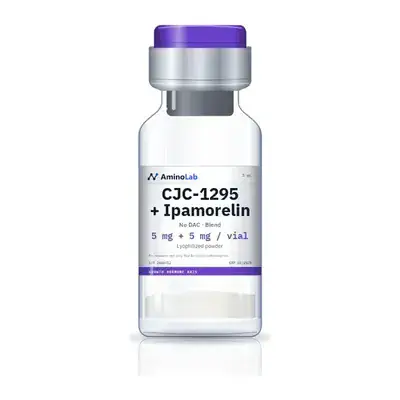
Separate receptors on the same pituitary cells respond to GHRH analogues and to ghrelin receptor agonists, and the two signals stack. Researchers usually pick ipamorelin as the GHRP to run with Mod GRF, since published work shows it selective for GH release with minimal impact on prolactin or cortisol. Short action on both sides keeps the timing in step. Working to a set ratio? One 10 mg vial of our CJC-1295 and ipamorelin blend contains 5 mg of each. Dose-response work is better served by buying the vials apart so either compound can be adjusted alone. Our guide to CJC-1295 and ipamorelin side effects gathers the human study record for the pair.
Lyophilised powder is how both arrive. Add bacteriostatic water gently against the glass wall and swirl, never shake, and our peptide reconstitution guide covers the full sequence. Concentration and syringe units for any fill come straight from the CJC-1295 and ipamorelin calculator, and measuring small volumes is far easier with insulin syringes. Store unmixed vials frozen away from light and move them to the fridge once reconstituted, following the peptide storage guide. Check the lot number against the COA as soon as a vial arrives, and our guide to reading a certificate of analysis shows what to look for.
Settle the half-life question and the rest is straightforward. The Mod GRF (1-29) form, listed as CJC-1295 No DAC, is a 10 mg vial, and CJC-1295 With DAC is a 5 mg vial. Order No DAC for pulsatile designs. Order the DAC version where you need sustained GHRH receptor exposure with few additions. Fixed-ratio work with a ghrelin receptor agonist is simpler again with the CJC-1295 and ipamorelin blend, which removes the need to prepare two vials. Australian stock covers all three, an independent laboratory tests each lot, and the certificates live in our COA library. Shop the growth hormone peptide range online and drop bacteriostatic water into the same order.
Every CJC-1295 product listed here is for laboratory research use only. None carries TGA approval, and none is intended for human or veterinary use.
Adding the drug affinity complex lets the peptide bind serum albumin, which stretches the reported half-life to around 6 to 8 days. Since both molecules are GHRH analogues, duration of activity from one administration is the real point of difference.
It does. Modified GRF (1-29) is sold under the market name CJC-1295 no DAC, a 29 residue GHRH analogue whose four substitutions slow enzymatic breakdown. Confusion arises because the original CJC-1295 code described the DAC molecule, so look for a reference to the drug affinity complex in any study before picking a vial.
Research pairing the two overwhelmingly uses Mod GRF (1-29), the no DAC form. Short action on both sides keeps release timing aligned so the GHRH and ghrelin receptor signals combine within one pulse. Our ready-mixed 10 mg vial holds 5 mg of ipamorelin with 5 mg of CJC-1295 no DAC.
Teichman and colleagues put the estimated half-life at 5.8 to 8.1 days in their 2006 human pharmacokinetic study. GH stayed above baseline for six days or more after one dose, and IGF-1 remained elevated past a week. Allow several weeks of washout if a crossover design uses the DAC form.
AminoLab ships both forms from Australian stock, with CJC-1295 No DAC in a 10 mg vial and CJC-1295 With DAC in a 5 mg vial. Identity and purity on every batch are verified by an independent lab, and you can find the matching report in the COA library under the lot number shown on the label. Supply is for in-vitro and laboratory study only, never for humans or animals.
10 mg vial, 60 capsules
50 mg vial, 100 mg vial
10 mg vial
3 mL, 3 mL + 1 syringe, 10 mL, 10 mL + 1 syringe, 30 mL, 30 mL + 1 syringe
Research use onlyAminoLab supplies research compounds for laboratory and in-vitro use, not for human or animal consumption. By continuing you confirm you are 18 or older and buying for research.
Leave