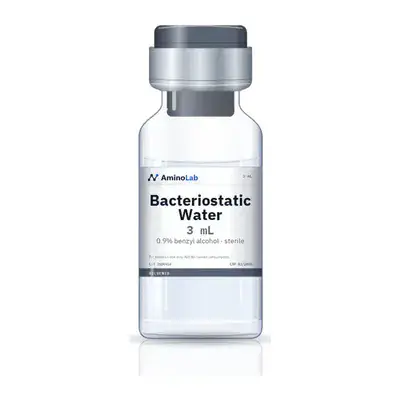
Bacteriostatic Water
3 mL, 3 mL + 1 syringe, 10 mL, 10 mL + 1 syringe, 30 mL, 30 mL + 1 syringe
From $9
$20 AUD, GST included
Minimum order before shipping, and you can mix any products to reach it.
In stock, ready to ship from Australia
Sold to buyers aged 18 and over only.
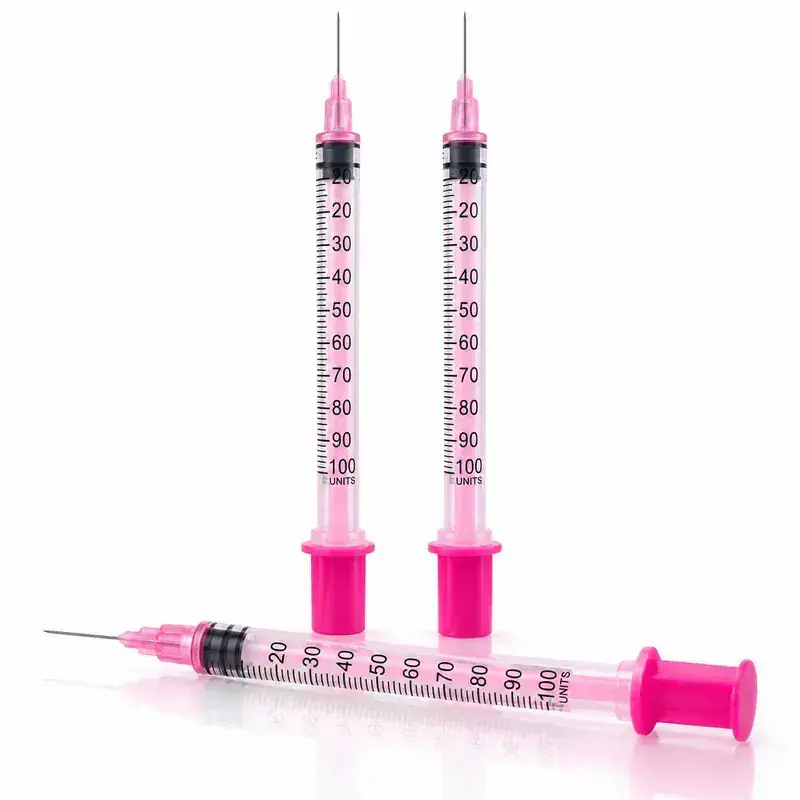
Buy Insulin Syringes online from AminoLab, available in Australia as the 30 pack or single 1 mL, 0.5 mL and 0.3 mL barrels. Insulin syringes Australia researchers can add straight to a peptide order, all U-100 and all sterile. Each barrel carries U-100 graduations, meaning a full millilitre reads 100 units and a tenth of a millilitre reads 10, so the lines on the plastic agree with the unit results from our peptide calculator with no conversion. Every syringe comes in its own sterile wrapper and the needle, fixed for good, sits under an orange cap. HPLC lot testing is for peptides, not plastics, so syringes skip it, while the peptide vials themselves each have a certificate posted in the COA library. Put bacteriostatic water in the same cart and a fresh vial can be prepared the day the parcel lands. Store unopened syringes dry, at room temperature and out of the sun, use each once and drop it into a sharps bin afterwards. Secure your Insulin Syringes from AminoLab now, available to researchers aged 18 and over for in vitro use.
For laboratory research use only. Not for human or veterinary use. Not TGA approved. See our research use policy.
| Product | U-100 insulin syringes |
|---|---|
| Stock | In stock |
| Needle details | |
| Graduation scale | |
| Maximum reading per barrel | |
| Packaging | Sterile, individually wrapped, single use |
| Quantity supplied | |
| How to store | |
| Purpose |
Let your most common volume choose the barrel. The 30 pack takes care of diluent transfers and day-to-day draws, while the smaller singles make tiny volumes far easier to read by eye. Buy the pack, a single barrel or both in the same order as your peptides.
Think of an insulin syringe as a miniature, throwaway syringe whose very fine needle is bonded into the tip for good, and with graduations counted in units instead of millilitres. Its layout was set by one hormone's standard concentration, yet those same traits have made it the default bench tool for measuring small quantities of reconstituted peptide.
First, a transparent barrel moulded from medical-grade polypropylene. Second, a plunger rod tipped with a rubber or elastomer stopper that seals tight against the inside wall. Third, a stainless steel cannula glued into the nose of the barrel. A fine layer of silicone oil coats the needle and the barrel interior, helping the needle pierce a vial stopper and letting the plunger glide.
What really sets this design apart is that there is no detachable hub. On a standard syringe with a removable needle, some liquid is always stranded in the hub and needle base when the plunger hits bottom. On high dead space designs that leftover volume can approach 80 microlitres. Bond the needle permanently and the residue shrinks to a few microlitres. On a draw of 20 or 30 microlitres in total, that shrinkage is the difference between an accurate reading and a misleading one.
It is also the plainest answer to which syringe suits small peptide measurements, namely a unit-marked barrel with the needle fixed in place. Tuberculin syringes look alike and also hold 1 mL, yet their scale counts millilitres, usually to the second decimal, and many accept a detachable needle with extra dead space. They work for a millilitre-based method, not for a calculator giving units. General Luer syringes of 3 or 5 mL are the other common substitute. They move larger amounts of diluent well, but their graduations cannot resolve anything below a tenth of a millilitre.
One rule applies whatever size you choose. Draw and dispense in a single motion, and never leave liquid sitting in the barrel. Over time the silicone lubricant can release microscopic droplets into solution, a recognised cause of protein aggregation and of inflated counts in particle assays, and a peptide left in plastic for hours also has more surface to stick to. Anyone comparing the best insulin syringes for peptides purely on cost should know this habit matters more than whose logo is on the packet. For needle length and gauge in detail, see the complete insulin syringe buying guide for Australia. Every syringe AminoLab sells is built this way, so readings stay consistent from one order to the next.
Reconstitution calculators report their answers in U-100 units, and that is the main reason fine-needled, unit-graduated syringes became standard for peptide work. Read the barrel, read the screen, and the numbers line up without any arithmetic.
Every syringe in our range is U-100, and a single unit is 0.01 mL on the smallest barrel and the largest alike. You will find them in the lab supplies range beside the diluents, which lets one parcel carry the compound, its diluent and the syringe that measures them. AminoLab keeps the whole range on that one scale on purpose, so any barrel you buy reads the same way.
All of our syringes are sterile, single-use plastic barrels with U-100 markings and a permanently fixed needle under an orange cap. Inside the 30 pack are thirty 1 mL 29G syringes with pink plungers. Singles come one per unit, with the longer 29G needle offered on a 1 mL barrel and the short 31G needle on all three sizes. Every barrel counts 100 units to the millilitre, so a smaller barrel only spreads the same scale out more, it never alters it.
In this country an insulin syringe counts as a medical device rather than a medicine, and the Australian Register of Therapeutic Goods carries entries for them from a number of sponsors. No prescription is required and no poisons schedule applies. Chemists stock them on open shelves, often by the hundred, and the National Diabetes Services Scheme hands them out at no charge to registered insulin users with diabetes. None of that relates to buying for a lab, and our comparison of insulin syringe sources in Australia lays the routes out together.
A pharmacy box of 100 in a single gauge is frequently more than a lab project uses, so plenty of teams prefer to buy syringes online along with their diluents. Every size is warehoused locally by AminoLab, sold to adults 18 and over as bench consumables for research solutions, and never intended for people or animals. Buy them as a pack or as individual barrels so each bench can match its syringe to its typical volume, or choose bac water vials with an optional syringe to get diluent and measuring tool in a single line item.
Only two figures really decide it. Volume drives the best syringe size for peptides, since you want the barrel that suits your most common measurement, and the vial drives the gauge. The higher the gauge, the thinner the needle, which is why a 31G needle slips through rubber easily with little risk of coring, and a 29G needle draws and expels faster.
For a typical bench, the best syringes for peptides start with the 30 pack, plus a handful of the smallest singles whenever your protocol deals in very small volumes. Put simply, pick the smallest barrel that still fits your largest single measurement. These consumables are sold only to adults 18 and over. Order both sizes at AminoLab if your bench handles large transfers and tiny volumes.
A syringe stays sealed and sterile until its wrapper is torn, and it is built for one draw only. A needle that has punctured rubber once has lost its edge, can cut a plug from the stopper and may introduce contaminants, so a used syringe never re-enters a vial. Inspect each wrapper before use and throw out any syringe with a broken seal.
Mixing scales is the most expensive error. U-40 syringes look almost identical but mark 40 units per mL, so a U-100 calculation read off one would be wrong by a factor of 2.5. Everything we stock is U-100, so a calculator-driven bench never has to convert. The lot-tested items are the peptides you draw, and our explainer on how to read a COA walks through their mass spectrometry and HPLC reports.
What a pharmacy carries in barrel sizes, needle lengths and scales differs from one counter to the next. Put the syringes in with the vials and water and the whole kit arrives together on one U-100 scale. We have no shopfront, only the online store, and every state and territory is served from Australian stock. Payments received by 3pm on a business day mean same-day dispatch, and the delivery information page lists timings.
Here is a quick case. A 10 mg vial plus 2 mL of water, delivered as two full 1 mL draws, ends up at 5 mg per mL. Other combinations can be run through the peptide calculator turns the numbers into units on the barrel, and the full aseptic method is in our reconstitution guide.
Until the moment of use, syringes should stay wrapped in a dry cupboard at room temperature, shielded from sunlight. Once used, they go straight into an approved sharps container.
Every graduation on these barrels represents a fixed slice of a millilitre, and getting comfortable with that slice is the quickest way to avoid errors. On any of our syringes a single unit holds 0.01 mL, ten units hold 0.1 mL and the full 100 units on the 1 mL barrel hold exactly one millilitre. What changes between barrels is only the physical length that each unit occupies. On the 0.3 mL barrel the same 30 units are spread along nearly the whole length of the plastic, so the gap between two lines is wide and easy to judge by eye. On the 1 mL barrel those 30 units take up less than a third of the scale, and the lines sit much closer together.
That is why the calculator result and the barrel choice belong together. If the calculator returns a figure under 30 units, the 0.3 mL single gives the clearest reading. Figures between 30 and 50 units suit the 0.5 mL barrel, and anything larger belongs on the full 1 mL barrel or the 30 pack. Read the scale at eye level, with the top edge of the plunger stopper lined up against the graduation, and check the figure a second time before dispensing. A short pause here costs nothing and protects the whole experiment. Buy the smaller barrels when most of your readings sit under 30 units.
Suppliers list this one item under many labels, including insulin syringes, U-100 syringes and unit syringes, or by volume as 0.3 cc, half-cc (0.5 mL) and 1 cc (1 mL) syringes. Cubic centimetres and millilitres are interchangeable, while the gauge appears as 29G and 31G or written in full as 29 gauge and 31 gauge.
You may also see them called low dead space syringes, a nod to the missing hub that would otherwise trap fluid. Do not confuse them with tuberculin syringes, which are graduated in millilitres. At AminoLab you can order them under the simple name insulin syringes.
For a single reconstitution, the simplest route is the 1 mL 29G syringe offered with our bacteriostatic water options. Longer studies with many draws are cheaper on the 30 pack and leaves spares on the bench, which is why labs running long series usually settle on it. Add whichever suits your method to the same cart as your vials.
When preparing IGF-1 LR3 in acetic acid 0.6%, labs typically add the acid in one complete 1 mL draw, which calls for a 1 mL barrel. For a first order that arrives as one complete box, consider the GHK-Cu Starter Kit, which bundles a syringe and diluent with the peptide.
Compact sterile syringes marked in units, with 100 units filling 1 mL, so readings match what peptide calculators display.
The pack gives thirty 1 mL 29G syringes, and individual barrels come in three volumes.
The largest barrel handles transfers and general draws, while the two smaller ones bring clarity to tiny volumes.
A single syringe added to a water vial suits a one-off job, while the pack of thirty becomes the better buy past six or seven draws.
Keep them wrapped, shaded and at room temperature. One use each, then straight into a sharps bin.
Every syringe is sterile and U-100, so there is never a U-40 reading to convert.
Choose the pack of thirty or any single barrel, then add it to your cart with your peptides and diluent. Everything ships from Australia, with same-day dispatch for anything paid by 3pm on a working day.
Fixed-needle U-100 insulin syringes, sterile and unit-marked, because the scale agrees with reconstitution calculators and without a hub very little liquid is lost. The 30 pack handles routine jobs, and a few smaller singles cover low-volume measurements.
Most draws and all diluent additions suit the full millilitre barrel. For small amounts, the half and third millilitre barrels space their marks more widely. Short vials pair with the 6 mm 31G needle, tall bottles with the 12.7 mm 29G needle.
They do not, as a syringe is a sterile consumable and not a reagent, so neither HPLC nor mass spectrometry applies. Sterility is kept by the individual wrapper until you open it. Lot certificates belong to the peptides, and you can read them in the COA library.
For a one-off reconstitution, add a single syringe to a water vial. Once you expect more than six or seven draws, the pack of thirty is the better buy, because every syringe is used only once.
Their job is accurate measurement of diluent and dissolved peptide, read in units that agree with reconstitution calculators (1 mL is 100 units). AminoLab sells them as research consumables only, to adults 18 and over, and they are not for use on people or animals.
3 mL, 3 mL + 1 syringe, 10 mL, 10 mL + 1 syringe, 30 mL, 30 mL + 1 syringe
3 mL
10 mg vial, 60 capsules
10 mg vial
Research use onlyAminoLab supplies research compounds for laboratory and in-vitro use, not for human or animal consumption. By continuing you confirm you are 18 or older and buying for research.
Leave