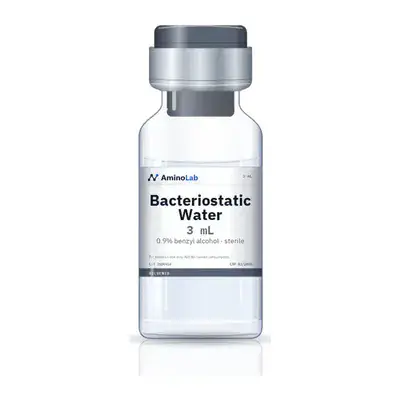
Bacteriostatic Water
3 mL, 3 mL + 1 syringe, 10 mL, 10 mL + 1 syringe, 30 mL, 30 mL + 1 syringe
From $9
$9 AUD, GST included
Minimum order before shipping, and you can mix any products to reach it.
In stock, ready to ship from Australia
Sold to buyers aged 18 and over only.
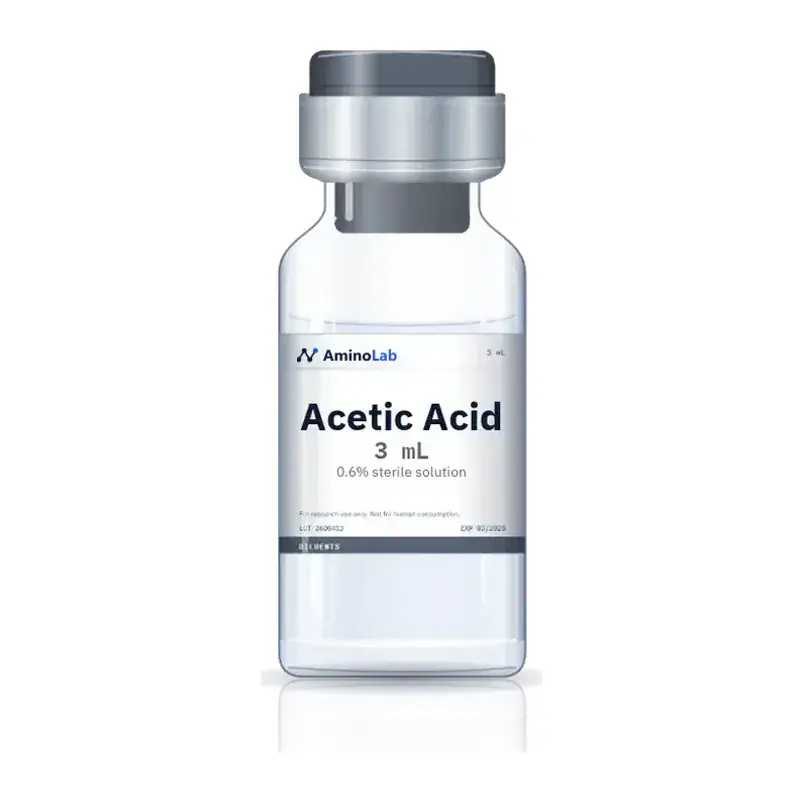
Shop Acetic Acid 0.6% at AminoLab and buy the sterile 3 mL vial from stock kept here in Australia. Acetic acid 0.6% Australia supply from AminoLab is a small sterile vial built for one task, getting difficult peptides into solution. The 3 mL vial holds water with a low level of acetic acid added, close to 0.1 molar, which sets the pH just under 3. That mild acidity is what many data sheets recommend when a freeze-dried peptide goes hazy or leaves flakes behind in ordinary water. Our clearest case is IGF-1 LR3, and most customers who buy that peptide add one acid vial to the same cart. The label carries the strength, fill volume, batch code and use-by date, so the solvent can be logged next to the peptide lot and its test report. To plan a stock solution, enter your numbers in the peptide calculator. When your protocol thins the acid stock in a second step, order bacteriostatic water too. Store unopened vials on a shelf at room temperature, out of sun and heat. Order your Acetic Acid 0.6% online today from AminoLab's Australian stock, for laboratory research by buyers aged 18 and over.
For laboratory research use only. Not for human or veterinary use. Not TGA approved. See our research use policy.
| Product | 0.6% acetic acid, sterile |
|---|---|
| Base | Sterile water |
| Acid content | Around 6 grams per litre, about 0.1 M |
| Chemical details | CAS 64-19-7, formula CH3COOH, molar mass 60.05 |
| pH | Close to 2.9 |
| Vial | 3 mL clear glass, rubber stopper, grey cap |
| Printed on label | Strength, fill, batch code, use-by date |
| Peptide included | None |
| Shelf life once opened | 28 days from the first puncture |
| Stock | Ready to ship |
| Purpose | Dissolving research peptides |
Buy it in the same order as the peptide that needs it. A typical IGF-1 LR3 method uses about 1 mL per vial, so a single 3 mL acid vial can serve three IGF-1 LR3 vials if your lab works through them inside the 28 days after the stopper is first pierced.
Picture a peptide that sits as a cloudy suspension no matter how gently you swirl it. That is usually a charge problem. Each peptide has one pH, its isoelectric point, where its plus and minus charges cancel. Near that pH the chains feel no repulsion, so they cling together, settle out or coat the wall of the vial. Shift the pH a long way from that point and every chain picks up the same net charge. Like charges repel, the chains drift apart and the solution clears.
For peptides with an isoelectric point around 7 or higher, a gentle acid makes that shift. This is the reagent AminoLab stocks for the purpose, and it is the reason so many labs keep one vial on the shelf.
Acetic acid is weak, with a pKa of 4.76. In a 0.1 molar solution only around one molecule in a hundred releases its proton. That is enough to give side chains and the free chain end a positive charge, yet the solution stays mild enough that peptide bonds are not attacked. Hydrochloric acid at a similar strength would drive the pH much lower. Acetate is also the counterion that many purified peptides already carry from their last purification step, so this solvent brings nothing foreign into the vial, and it is volatile if a method later dries the sample down.
Trouble often starts after the peptide has dissolved. Bringing an acid stock back toward neutral pushes the peptide through its isoelectric point a second time. If that happens slowly, or with a concentrated stock, the peptide can crash out. The safer habit is to pour the acid stock into a large volume of buffered medium in one move, mixing gently, so that it is diluted at least ten times in seconds. Adding buffer to the stock a few drops at a time, or titrating with base, gives the chains time to stick together again. Earlier steps are covered in our reconstitution walkthrough.
Plain bacteriostatic water handles the great majority of freeze-dried peptides. The exceptions tend to be long chains packed with charged or oily residues, which may cloud over or leave a ring on the glass. A small drop in pH puts extra protons on those residues, and the chains repel each other instead of forming clumps.
IGF-1 LR3 is the main reason this vial exists in our range. It is an 83-residue relative of insulin-like growth factor 1 weighing 9117.6 g/mol, and the standard instruction for its stock solution is 0.1 molar acetic acid. The acid is too weak and too dilute to damage the sequence. Shop it in our lab supplies range, where it sits beside the water and the syringes.
Out of the box you will find a single small vial of clear liquid under a grey cap. Pierce the stopper and you may notice a faint vinegar note, which is normal. The contents are sterile water and acetic acid at 0.6 percent, with no preservative and no added salts. Think of it as the acidic partner to our preserved water, used only for the handful of peptides that ask for a low pH.
Acetic acid is an everyday laboratory chemical in Australia, sold in large bottles of the concentrated glacial form by scientific and industrial suppliers. Scheduling only starts at much higher strengths. The current Poisons Standard, in force in October 2026, lists acetic acid in Schedule 5 when it is stronger than 30 percent and in Schedule 6 when it is stronger than 80 percent, and it has a separate Schedule 2 entry for therapeutic preparations above 80 percent. At 0.6 percent this solution is around fifty times below the lowest threshold, so no schedule applies. The real challenge for a lab is format, because bulk suppliers sell concentrated litres, not sterile pre-diluted vials sized for one peptide.
That gap is why labs buy acetic acid 0.6% from a peptide supplier. AminoLab holds it in Australian stock as a reagent for dissolving research peptides, sells it to adults aged 18 or over, and does not supply it for any human or veterinary use. If your protocol has two steps, read our step-by-step reconstitution guide, and remember that the 1 mg IGF-1 LR3 vial is the product most customers pair it with.
We sell one format, a 3 mL vial. Used at about 1 mL per IGF-1 LR3 vial, it lasts for three reconstitutions. If your IGF-1 LR3 orders are spread months apart, it is better to buy a new acid vial with each order than to keep an opened one beyond 28 days. Next to the peptide it serves, the acid is a minor cost, and far cheaper than wasting a vial of powder that will not dissolve.
Larger projects that use several IGF-1 LR3 vials can buy two or three acid vials at once, and we will pick them from one batch where stock allows, which keeps the solvent record tidy. Household vinegar will not do the same job, since it is much stronger than 0.6 percent and is not sterile. Orders are open to adults only.
Because 0.6 percent works out at roughly 6 grams per litre, or about 0.1 molar, this vial matches any method that specifies 0.1 M acetic acid, and the pH sits close to 2.9. It is a supply item rather than a peptide, so it is not analysed by mass spectrometry or HPLC. Its quality rests on sterile filling and a clear label showing strength, batch and use-by date.
The peptide is what gets the full analysis. Every IGF-1 LR3 lot has a certificate confirming its identity and purity, stored in the COA library under the number printed on its vial. If the numbers on a certificate are new to you, our COA reading guide explains them. Buy the acid and the peptide from AminoLab in one checkout and they travel in the same parcel.
Vinegar from a supermarket or hardware store has the wrong strength and is not sterile, and few pharmacies keep a dilute acid suitable for peptides. Ordering online with your peptides is simpler. AminoLab sends parcels from local stock to every state and territory, ships the same day when payment arrives before 3pm on a business day, and lets you check progress on track order.
Here is a common way to use it. Draw 1 mL of acid into a 1 mg IGF-1 LR3 vial, which gives 1 mg per mL, and swirl slowly until clear. If your experiment needs a gentler working solution, dilute that stock afterwards with bacteriostatic water. For other volumes, the peptide calculator does the maths.
Sealed vials keep at room temperature, out of direct heat and sunlight, until their use-by date. Mark the date on the vial when you first pierce it and discard it after 28 days. Dissolved IGF-1 LR3 belongs in the fridge at 2 to 8 °C in single-use portions, as set out in our peptide storage guide.
Protocols describe the same solution in several ways, for example 0.6% acetic acid, 0.1 M or 0.1 N acetic acid, dilute AcOH or HOAc. Ethanoic acid is its systematic name. Glacial acetic acid, by contrast, is the undiluted chemical and must never go near a peptide vial.
A few suppliers suggest 10 mM hydrochloric acid instead for IGF-1 analogues. That is another reagent, and our vial contains acetic acid only. At AminoLab you can buy it under the simple name acetic acid 0.6%.
For nearly every peptide in our catalogue, bacteriostatic water is the solvent to use, and its preservative lets you draw from one vial many times. Acetic acid 0.6% is kept for the few peptides that stay cloudy at neutral pH. Plenty of IGF-1 LR3 protocols use the two together, acid to dissolve and water to dilute, and one vial of each covers both stages.
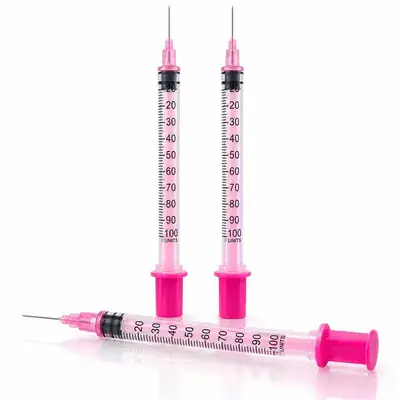
Not every assay tolerates a low pH, so use the acid only where the method calls for it. A U-100 1 mL barrel from our insulin syringes makes it easy to measure 1 mL precisely, and you can order all three items in one checkout.
Sterile 0.6% acetic acid, about 0.1 molar with a pH near 2.9, for peptides that go hazy in water. In stock at AminoLab.
Only the 3 mL size is offered. At 1 mL a time it covers about three IGF-1 LR3 vials, within 28 days of the first puncture.
Mainly to make IGF-1 LR3 stock solutions for cell work. It is a laboratory supply and nothing more.
Preserved water suits most peptides. Acid is for the exceptions and is often followed by a water dilution, and both are on our shelves.
Keep the closed vial at room temperature away from heat and light. Once opened, write the date on it and discard it after 28 days.
Each vial shows its strength, batch and use-by date. The peptide you dissolve comes with its own HPLC report.
Put the 3 mL vial in your cart, preferably together with the IGF-1 LR3 you plan to dissolve, and check out. Parcels leave our Australian stock the same day for orders paid by 3pm on a business day, and tracking covers every state and territory.
Online from AminoLab, with delivery anywhere in Australia. Store-bought vinegar is too strong and is not sterile, and very few pharmacies hold a dilute acid made for peptides, so most labs simply add it to their peptide order.
IGF-1 LR3 is the main one in our catalogue. Its data sheets ask for 0.1 M acetic acid, which is exactly what this vial contains. Almost everything else we sell dissolves in bacteriostatic water without an acid step.
No. As a sterile supply item it is not run through HPLC or mass spectrometry. Instead each vial is labelled with strength, batch and use-by date. The IGF-1 LR3 you dissolve does have a full lot certificate, available in the COA library.
Choose bacteriostatic water for almost every peptide. Choose acetic acid 0.6% only if a peptide stays cloudy at neutral pH or its protocol names an acid. Many IGF-1 LR3 methods need both, one vial of each, used one after the other.
As a sterile, mildly acidic solvent for peptides that clump in neutral water. The lower pH gives the chains extra positive charge so they repel each other and stay dissolved. AminoLab sells it only for laboratory research, to buyers who are 18 or older.
3 mL, 3 mL + 1 syringe, 10 mL, 10 mL + 1 syringe, 30 mL, 30 mL + 1 syringe
30 pack, 1 mL, 29G 12.7mm, 1 mL, 31G 6mm, 0.5 mL, 31G 6mm, 0.3 mL, 31G 6mm
10 mg vial, 60 capsules
10 mg vial
Research use onlyAminoLab supplies research compounds for laboratory and in-vitro use, not for human or animal consumption. By continuing you confirm you are 18 or older and buying for research.
Leave