Retatrutide
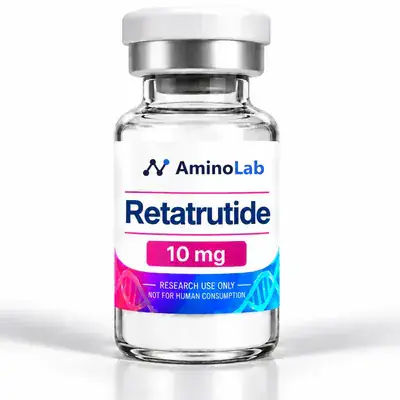
10 mg vial, 20 mg vial, 30 mg vial
From $129
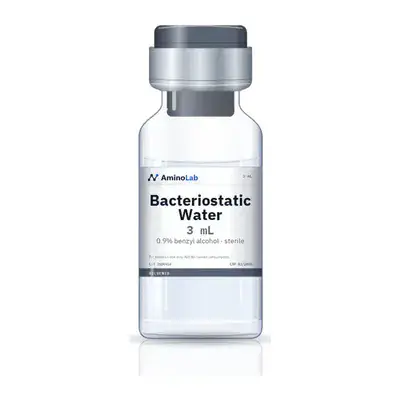
Use this retatrutide dosage calculator once you know which vial is on the bench. AminoLab ships retatrutide as a freeze-dried powder in 10mg, 20mg and 30mg vials, and it needs to be dissolved in bacteriostatic water before any amount can be drawn or measured. The peptide content of the vial stays fixed while the strength depends on how much liquid goes in. Put 1 mL into a 10mg vial and the result is 10 mg per mL, whereas 2 mL brings it down to 5 mg per mL. Many labs pick whichever volume places their working amounts somewhere in the 10 to 100 unit range, since that stretch of the barrel is the easiest to read accurately.
The standard 3 mL vial will not take much beyond 3 mL of fluid, which means 10 mg per mL at 3 mL is as dilute as the 30mg fill practically gets. When the volumes are tiny, a 0.3 mL or 0.5 mL U-100 syringe gives more room between graduations than a 1 mL barrel does.
Every vial size is matched with every water volume below. For reference, 10 units on a U-100 insulin syringe is 0.1 mL, and a full 100 units is 1 mL.
| Retatrutide fill | Water volume | Strength | In 10 units (0.1 mL) | In 1 unit |
|---|---|---|---|---|
| 10 mg | 1 mL | 10 mg per mL | 1000 mcg (1 mg) | 100 mcg |
| 10 mg | 2 mL | 5 mg per mL | 500 mcg (0.5 mg) | 50 mcg |
| 10 mg | 3 mL | 3.333 mg per mL | 333.333 mcg (0.333 mg) | 33.333 mcg |
| 20 mg | 1 mL | 20 mg per mL | 2000 mcg (2 mg) | 200 mcg |
| 20 mg | 2 mL | 10 mg per mL | 1000 mcg (1 mg) | 100 mcg |
| 20 mg | 3 mL | 6.667 mg per mL | 666.667 mcg (0.667 mg) | 66.667 mcg |
| 30 mg | 1 mL | 30 mg per mL | 3000 mcg (3 mg) | 300 mcg |
| 30 mg | 2 mL | 15 mg per mL | 1500 mcg (1.5 mg) | 150 mcg |
| 30 mg | 3 mL | 10 mg per mL | 1000 mcg (1 mg) | 100 mcg |
Strength in mg per mL equals the milligrams of retatrutide in the vial ÷ the millilitres of water you put in.
U-100 marks are found by taking the amount you want in mg ÷ that strength in mg per mL, × 100.
Microgram entries are converted to milligrams by dividing by 1,000 before anything else happens. The tool only runs the arithmetic and never proposes an amount to use. AminoLab supplies retatrutide solely for laboratory research use only.
Each row of the chart lines up with a fill we stock, so you can order the exact retatrutide vial you just modelled. Shop the retatrutide starter kit if you would rather receive the vial, water and syringe together, or choose the pre-mixed retatrutide pen and skip reconstitution entirely. Everything ships from Australian stock through our online store, so there is no need to find a supplier near me.
The retatrutide dosage calculator reports four linked figures. The first figure is retatrutide per millilitre, found by dividing the 10, 20 or 30mg fill by the water you added. The next line, mcg per 0.1 mL, is that strength multiplied by 100. The volume figure is your target mass divided by the strength, and the units figure shows that same volume on a U-100 scale, so 0.2 mL is displayed as 20 units.
A few pairings fall between graduation marks. With the 30mg vial at 1 or 2 mL, a 2 mg target becomes 6.7 or 13.3 units, and neither can be read precisely. Add 3 mL to that vial instead and you get an even 10 mg/mL, so 2 mg is exactly 20 units. Choosing a volume that turns the strength into a whole number, for example 2 mL in the 20mg or 3 mL in the 30mg retatrutide vial, means every unit represents a clean amount.
Retatrutide is a 39 residue peptide carrying a fatty acid modification, with a mass near 4.73 kDa, or roughly 4,731 g/mol. On that basis a 10 mg/mL stock sits at about 2.1 mM, and a working solution of 1 micromolar contains about 4.73 mcg per mL. For more on the compound itself, read what retatrutide is.
No one volume is right for every lab. With 1 mL the strength is 10 mg per mL, with 2 mL it is 5 mg per mL, and with 3 mL it is roughly 3.33 mg per mL. Pick the option that makes your protocol's amounts simple to read on a U-100 syringe, and the calculator will show the figures for whatever volume you enter.
Putting 2 mL into the 20mg fill produces 10 mg per mL, while 3 mL produces roughly 6.67 mg per mL. Because a 3 mL vial has little spare room beyond that, a weaker solution is better made by dividing the work across two smaller vials.
Take the amount in mg, divide it by the strength in mg per mL to find the volume in millilitres, then multiply by 100 for a U-100 syringe. As an example, 0.5 mg at 5 mg per mL equals 0.1 mL, or 10 units.
After adding bacteriostatic water, store the vial at 2 to 8 °C and finish it within about 28 days of the first puncture, which is the normal limit for a multi-dose vial. Dry powder lasts longer, and the storage guide explains how to keep it.
10 mg vial, 20 mg vial, 30 mg vial
3 mL, 3 mL + 1 syringe, 10 mL, 10 mL + 1 syringe, 30 mL, 30 mL + 1 syringe
Research use onlyAminoLab supplies research compounds for laboratory and in-vitro use, not for human or animal consumption. By continuing you confirm you are 18 or older and buying for research.
Leave