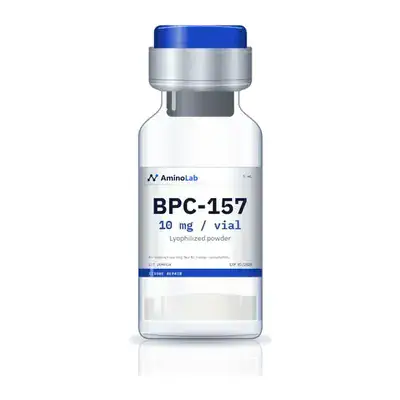
BPC-157
10 mg vial, 60 capsules
From $69
Nobody can honestly hand you a list of BPC 157 side effects, because the human data needed to build one do not exist. Rodent work turns up very little in the way of adverse effects, the three small published human reports mention nothing serious, and the questions still worth asking are partly theoretical, about blood vessel growth, and partly practical, about what an untested vial really holds.
Medicines earn a side-effect profile by passing through phase 1 to phase 3 trials, where hundreds or thousands of volunteers are compared against placebo and every adverse event is logged at each visit. BPC-157 has skipped that entire path. You will not find it on the Australian Register of Therapeutic Goods (ARTG), no regulator in any country has approved it, and when Vasireddi and colleagues ran their 2025 systematic review for HSS Journal, searching PubMed, Cochrane and Embase as far as June 2024, there were no clinical safety data to pool.
Treat any page that offers a tidy, percentage-backed list of BPC-157 side effects as fiction. The real evidence sits in four separate places. There are rat and mouse experiments, a few small human reports, concerns that follow on paper from how the peptide works, and the everyday hazard of a product that is impure or carries the wrong label. Each is covered below in turn.
Chemically, BPC-157 is a 15 amino acid stretch (GEPPPGKPADDAGLV) taken from a protein in human gastric juice. The bulk of its published record comes out of the University of Zagreb, from the group led by Professor Predrag Sikiric. Across roughly three decades of rat experiments covering tendon, ligament, muscle, gut, liver and vascular models, those papers have repeatedly called it free of toxic effects in the animals tested. Groups with no Zagreb link reached the same view in their own settings, with Chang et al. 2011 (a Taiwanese group publishing in the Journal of Applied Physiology) seeing no toxicity in tendon models.
Read those findings with two caveats. One laboratory wrote most of the literature, and replication by independent teams remains sparse. More importantly, a rat study is designed around the result it sets out to measure, normally repair, and is not built to catch rare harms or ones that take a long time to appear. A short tendon experiment that saw no adverse effects over two weeks tells you something, but it is a long way from a safety profile.
Just three human reports have reached print, and a single Florida clinician, Dr Edwin Lee, is behind all of them. A 2025 narrative review in Current Reviews in Musculoskeletal Medicine summarises the three as follows.
Going further back, Pliva, a Croatian drug company, carried an enema product coded PL 14736 into phase II testing for ulcerative colitis, and the Zagreb authors say it was well tolerated in those trials. Full independent reports of that work are difficult to locate.
Add it all up and you have around 30 people, not a single randomised placebo-controlled trial, and follow-up lasting days to months. Nothing uncommon can be excluded on that basis. The Australian men's health body Healthy Male draws the same conclusion, describing the shortage of safety evidence as the main drawback.
When people raise BPC 157 side effects in men, the worry is usually hormonal, covering testosterone, fertility and libido. Not one published study has measured these in humans, and no adverse event data split by sex exist for either men or women. With one man and one woman in the intravenous pilot, no difference could show up in any direction. Statements that BPC-157 changes male hormones, or that it leaves them alone, both run ahead of what has been tested.
The issue debated most is not something anyone has observed but a matter of mechanism. Animal models show BPC-157 to be pro-angiogenic, so it promotes the formation of new blood vessels. Hsieh and colleagues reported in the Journal of Molecular Medicine in 2017 that it increases expression of VEGFR2, which is the principal vascular endothelial growth factor receptor, and that endothelial cells then show activation of Akt-eNOS signalling further downstream. For a recovering tendon that is helpful, yet a tumour that grows past a millimetre or two depends on the very same receptor to build its blood supply.
There is no study showing that BPC-157 starts or speeds up cancer. In one human melanoma cell line, a 2004 Melanoma Research paper actually saw the reverse, with slower growth and lower VEGF signalling. On the other hand, nobody has run a long-term carcinogenicity study, while the 2025 Current Reviews in Musculoskeletal Medicine paper names nitric oxide effects, pathological angiogenesis and tumour promotion among the theoretical risks still unresolved. AminoLab's position is simple. Until better data arrive, consider the cancer question unanswered in both directions, and plan research around that uncertainty.
Ask whether BPC-157 is safe and, in practice, the larger danger is usually the product rather than the molecule. The TGA warned in April 2026 that unapproved peptide products, including BPC-157, often reach buyers in poorly labelled or blank vials, carrying risks of contamination, incorrect content and non-sterile manufacture. It also reported receiving adverse event notifications linked to such products, among them severe allergic reactions. Synthesis of a 15-residue chain containing three consecutive prolines is easy to get wrong, and untested material commonly shows truncated sequences, residual synthesis reagents and vials filled short.
For this peptide a certificate of analysis therefore carries extra weight. A good COA identifies the lot, confirms identity using mass spectrometry (the molecular weight of BPC-157 is about 1419 Da) and states purity from HPLC. An independent laboratory runs both tests on every AminoLab lot, and each vial's printed lot number leads straight to its certificate through our lot-matched COA lookup. To learn what to look for, work through our guide on reading a peptide certificate of analysis. And for how lots are cleared for sale, read about our testing process.
The World Anti-Doping Agency added BPC-157 to its Prohibited List in 2022, placing it in class S0, Non-Approved Substances, a class that captures any substance no government health authority currently approves for human therapeutic use. S0 substances are prohibited both in competition and out of it, and Sport Integrity Australia keeps a BPC-157 page showing that same status. TB-500, a related peptide, falls under S2 instead, and that part of the story is told in our TB-500 explainer.
The compound's origins are covered in what BPC-157 is and where it came from, and its legal position in BPC-157 and Australian law. To work out the concentration after mixing a 10 mg vial, use the BPC-157 reconstitution calculator, and you can browse the full tissue repair peptide range in one category.
Product quality is the one risk on this page a buyer can actually control. Before you order BPC-157 for laboratory research, check the lot number on the vial against its entry in our COA library, which shows that lot's HPLC purity figure and mass spectrometry identity result from an outside laboratory. If your project pairs it with thymosin beta-4, put the TB-500 10 mg vial or the premixed Wolverine blend to the same cart, along with bacteriostatic water for reconstitution. Order online and buy no more than the protocol calls for.
BPC-157 from AminoLab is sold to adults 18 and over for laboratory research only. It is not for use in people or animals, and nothing here is medical or dosing advice.
No dependable list exists, since BPC-157 has never completed controlled trials in people. Few adverse effects turn up in rat work, and nothing serious was logged across three small human reports involving roughly 30 people. What remains unanswered is theoretical, like its influence on how blood vessels grow, and practical, like contamination in untested products.
Human safety has not been established. The 2025 systematic review in HSS Journal found no clinical safety data, and the one intravenous safety study enrolled only two healthy adults. The animal results look clean but were never set up to detect rare or delayed harms. No country, Australia included, has approved it as a medicine.
No study has demonstrated it. The concern rests on mechanism, because in animal models BPC-157 raises VEGFR2 and drives angiogenesis, a pathway tumours also exploit. A 2004 melanoma cell study actually reported the reverse. With no long-term carcinogenicity study in print, the question stays open.
None have been recorded. No published work has measured testosterone, fertility or any other male hormone marker after BPC-157, and only one man took part in the sole human safety pilot. Any claim about effects on men, in either direction, goes beyond the available evidence.
No. WADA has listed BPC-157 under S0, Non-Approved Substances, since 2022, and every S0 substance is banned in competition and out of it. Sport Integrity Australia also shows it as prohibited at all times.
Order BPC 157 online from AminoLab as a 10 mg lyophilised vial or a 60-capsule bottle, both shipped from Australian stock for laboratory research only. An independent certificate covers identity and purity for every lot, and the label's lot number opens that report in our COA library. It is supplied for in-vitro and lab work, never for personal use.
10 mg vial, 60 capsules
50 mg vial, 100 mg vial
10 mg vial
3 mL, 3 mL + 1 syringe, 10 mL, 10 mL + 1 syringe, 30 mL, 30 mL + 1 syringe
Research use onlyAminoLab supplies research compounds for laboratory and in-vitro use, not for human or animal consumption. By continuing you confirm you are 18 or older and buying for research.
Leave