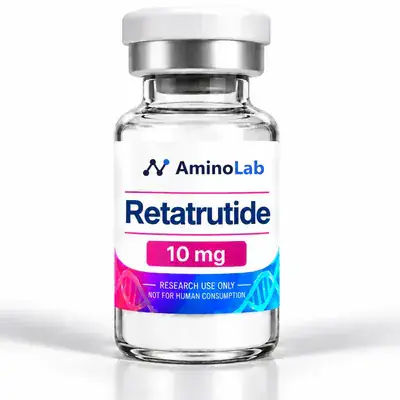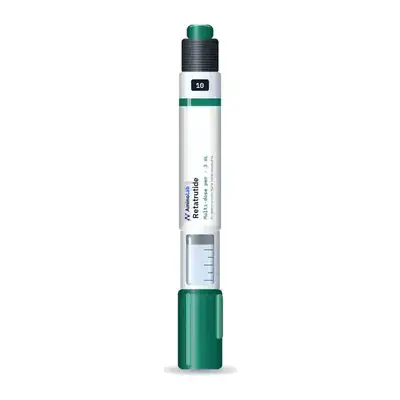
Retatrutide Pen
10 mg pen, 3 mL
$149
$59 AUD, GST included
Minimum order before shipping, and you can mix any products to reach it.
In stock, ready to ship from Australia
Frequently ordered with
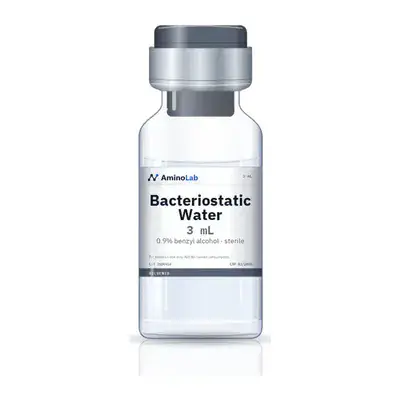 Bacteriostatic Water
Sold to buyers aged 18 and over only.
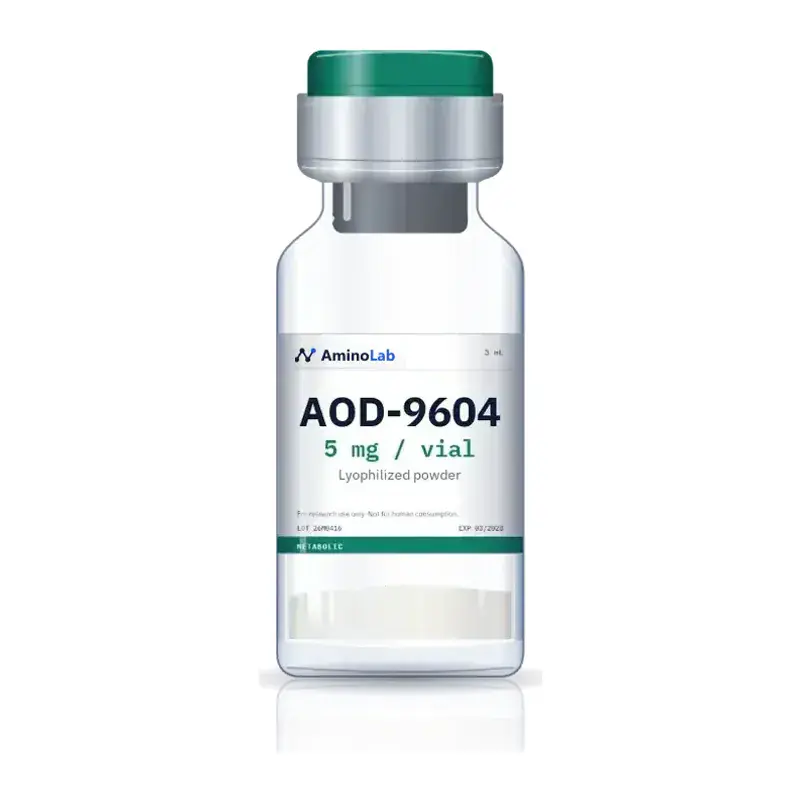
Buy AOD-9604 online from AminoLab, available in Australia as the 5 mg vial or 10 mg vial. AOD 9604 Australia orders ship from AminoLab's local stock as freeze-dried 5 mg or 10 mg vials, and the compound is one of the cornerstones of our metabolic peptides range. The AOD 9604 peptide is a 16-residue analogue modelled on the far end of the human growth hormone chain, built from a leading tyrosine plus residues 177 to 191, with one disulfide bridge forming a small loop. Its reference data are C78H123N23O23S2, 1815.1 g/mol and CAS 221231-10-3, so you can check any lot against them. Before you pay, open the certificate of analysis, which reports mass spectrometry for identity and HPLC for purity on every lot. Scientists at Monash University in Melbourne first synthesised it. Labs that also approach fat cell metabolism through an enzyme can add 5-Amino-1MQ to the order. Since the powder arrives without diluent, order bacteriostatic water or 0.6% acetic acid in the same cart. Keep each sealed AOD-9604 vial frozen at -20 °C, dry and out of the light. Add AOD-9604 to your cart now and it ships from our Australian warehouse, sold to adults for in vitro research only.
For laboratory research use only. Not for human or veterinary use. Not TGA approved. See our research use policy.
| Compound | AOD-9604 |
|---|---|
| Fills | 5 mg vial, 10 mg vial |
| Amino acid sequence | Tyr-Leu-Arg-Ile-Val-Gln-Cys-Arg-Ser-Val-Glu-Gly-Ser-Cys-Gly-Phe, the two cysteines joined by a disulfide bridge |
| Chain length | 16 residues |
| Formula | C78H123N23O23S2 |
| Molecular weight | 1815.1 g/mol |
| CAS | 221231-10-3 |
| Presentation | Freeze-dried powder sealed in a glass vial |
| Analysis | HPLC purity and mass spectrometry identity, reported on a certificate for each lot |
| In the box | A single 5 mg or 10 mg vial of AOD-9604, with diluent sold separately |
| Storage | Unopened at -20 °C away from moisture and light, and 2 to 8 °C once in solution |
| Stock status | In stock |
| Intended use | Laboratory research in vitro only |
Buy AOD-9604 when your work needs the C-terminal segment of growth hormone on its own, separate from the full 191-residue protein. Both fills are on the shelf, HPLC testing covers every lot, and every certificate names AOD-9604 rather than a generic fragment.
Think of AOD 9604 as a small synthetic copy of the last stretch of human growth hormone. Its designers wanted to know whether that tail section, by itself, could influence fat metabolism while leaving out the growth-promoting actions of the intact hormone. The initials stand for anti-obesity drug, a working title from the development years, not evidence of any proven effect.
Growth hormone has two broad jobs. One works via the GH receptor, plus the IGF-1 that the liver releases in response, driving tissue growth and pushing blood glucose up. The other acts on adipocytes, prompting them to break down stored triglyceride (lipolysis) and to hold back from building more (lipogenesis). The hypothesis behind AOD-9604 was that these jobs live in different regions of the 191-residue chain, with the C-terminal piece carrying the fat-related message.
The landmark animal paper is Heffernan and colleagues, Endocrinology, 2001. Obese mice given either the intact hormone or the fragment for 14 days lost body weight and body fat, and both treatments increased how much beta-3 adrenergic receptor was expressed, this being, the main lipolytic receptor on adipocytes. Mice lacking that receptor showed no change in weight or lipolysis, even though the authors concluded the fragment was not binding that receptor itself. A related study by the same team found the fragment did not compete at the growth hormone receptor and did not stimulate cell proliferation as the hormone does.
For a peptide, the clinical route was unusual, since it was given as tablets. In the Options trial, 24 weeks long and registered as ACTRN12605000067673, researchers compared daily oral doses of 0.25, 0.5 and 1 mg against placebo, and published summaries show no statistically significant difference in weight between arms. Whether a peptide of this size survives digestion intact is a reasonable doubt hanging over that outcome. So when people look for AOD 9604 before and after evidence, the controlled human data simply do not supply it. We report these findings neutrally, as research history, and they say nothing about how this vial should be used.
A frequent error is to treat AOD-9604 as a scaled-down growth hormone. If the fragment never engages the GH receptor, then receptor readouts such as STAT5 phosphorylation will mostly give a flat result. In vitro, a lipolysis endpoint is the better fit, for example glycerol release from differentiated 3T3-L1 adipocytes, with full-length growth hormone as the positive control and a scrambled or vehicle arm alongside. That design tests the idea the fragment was actually created to probe. Labs buy it online from AminoLab as a defined reagent for exactly that question, in a 5 mg or 10 mg vial.
Few research peptides have such a local backstory. During the 1990s Professor Frank Ng and his Monash University colleagues produced the fragment, following evidence that growth hormone's fat metabolism effects sat in its tail while the rest of the chain handled growth. Melbourne-based Metabolic Pharmaceuticals carried it forward, running human trials through the 2000s, yet no registration as a medicine ever followed, so it remains a research chemical.
In the laboratory, the AOD 9604 peptide narrows the question to one segment. What does the C-terminal piece do in adipose tissue models when the IGF-1 stimulation of the full hormone is absent? We list it in the metabolic peptides category as a bench reagent only.
Preclinical work has concentrated on three topics. The first is lipolysis, the release of stored fat from adipocytes. The second is lipogenesis, the creation of new fat. The third is whether IGF-1 stays unchanged, as the designers intended, and that question is what made the compound notable, because it lets researchers split a metabolic signal away from the growth signal in a way the parent hormone never allows. Order it here and that same Monash sequence ships from Australian stock with its lot certificate.
Monash was only the beginning. Metabolic Pharmaceuticals ran clinical trials during the 2000s and halted the obesity programme in 2007 after reporting no clinically meaningful weight result. Neither the TGA nor any other regulator ever approved it as a pharmaceutical, and as of October 2026 we found nothing to suggest that has changed, so no registered Australian medicine contains it.
Public awareness spiked in 2013 during the Essendon supplements investigation. The World Anti-Doping Agency stated on 22 April 2013 that AOD-9604 belongs in S0, the non-approved substances class of its Prohibited List, a class for compounds that are still in development or have been abandoned, all prohibited at all times. ASADA was replaced by Sport Integrity Australia in 2020, and the newer body applies that same WADA list, so athletes under the code remain barred from it at all times.
For laboratories, AOD 9604 peptide Australia supply is a research reagent, not a medicine. Both fills are held in AminoLab's Australian stock for online purchase by adults 18 and over, for in vitro work only and never for human or veterinary use. Groups that want a second, non-hormonal route into adipocyte metabolism usually add the NNMT inhibitor 5-Amino-1MQ.
Larger series can go through a single checkout. Note the lot code from each vial in your lab records so that every result traces back to its certificate. Sales are restricted to adults aged 18 and over.
Dry, the fragment is short and stable, so many labs keep a frozen reserve vial next to the working one. When an experiment is repeated months later, the lot record tells you whether the material has changed, and the certificate for each lot is always there to compare.
A tyrosine starts the 16-residue chain, and growth hormone residues 177 to 191 follow it. Cysteine at position 7 links to cysteine at position 14 through a disulfide bond, creating a small loop that holds the shape steady and improves resistance to degradation. The whole fragment weighs a little over 1.8 kDa, tiny next to the 22 kDa parent hormone.
Each vial, whether 5 mg or 10 mg, has a green flip-off cap and a white label over a small white freeze-dried cake. Because 1815.1 g/mol is a light mass, a milligram of AOD-9604 contains about 2.6 times the number of molecules found in the same weight of tirzepatide (4813.5 g/mol), which matters when a protocol compares the two on a molar basis.
Product names get muddled in this market, so learning how to read a COA pays off. Make sure the report says AOD-9604, that its lot code matches your label, and that the measured mass is near 1815.1 g/mol. Every lot's HPLC purity is published in the COA library. Check that report before you buy, then order the fill that matches the length of your series. AminoLab publishes that report for every lot it sells.
We trade online only and ship nationwide from Australian stock, so a Melbourne institute, a rural postcode and a group ordering peptides in Townsville all buy from the same shelf. Payment before 3pm on a business day means dispatch the same day, as explained on our delivery information page.
The box contains powder only. Bacteriostatic water is the usual choice, and some groups switch to 0.6% acetic acid when a cake is slow to dissolve. For AOD-9604 reconstitution, start with a vial at room temperature, trickle the liquid along the vial wall and swirl it, never shake. A 5 mg vial made up with 2 mL comes to 2.5 mg/mL, and other volumes can be worked out in the peptide calculator.
Unopened vials belong at -20 °C. Mixed solution goes in the fridge at 2 to 8 °C, shielded from light and divided into single-thaw aliquots that are not frozen again.
You will see AOD-9604, AOD9604 and AOD 9604 on labels, and the literature adds Tyr-hGH(177-191) or the phrase modified hGH fragment. Every one of these names means the same 16-residue chain registered as CAS 221231-10-3.
A neighbouring product, HGH fragment 176-191, has its own listing, and people frequently use the two names interchangeably. The parent hormone is somatotropin, and much of its growth activity runs through IGF-1, insulin-like growth factor 1. Whatever spelling your protocol uses, order from this listing to receive Tyr-hGH(177-191) in a 5 mg or 10 mg vial.
These two reach adipocyte metabolism from opposite directions. Adipose models use AOD-9604, a growth hormone fragment, to look at lipolysis and lipogenesis, while 5-Amino-1MQ is a small molecule acting as an NNMT enzyme inhibitor. Go with AOD-9604 when your focus is the growth hormone axis, 5-Amino-1MQ when the question is enzymatic, and both when you want to compare routes. Labs adding a mitochondrial arm often choose MOTS-c, which signals through AMPK and sits neatly beside an AOD-9604 series. Both can go in one cart and ship together from stock held in Australia. AminoLab keeps both compounds on the shelf, so neither arm of a study waits on the other.
Sixteen residues copied from the C-terminal end of growth hormone, looped by a disulfide bridge, first produced at Monash University and now in stock in Australia.
Add bacteriostatic water or 0.6% acetic acid at checkout.
Labs buy it for lipolysis and lipogenesis work in adipose models, away from the growth actions of the whole hormone, strictly in vitro.
A hormone fragment beside a small-molecule enzyme inhibitor gives two separate routes into adipocyte metabolism.
Hold the sealed vial at -20 °C, then keep any solution refrigerated in single-use aliquots.
Every lot gets mass spectrometry and HPLC, and the report naming AOD-9604 is online before you order.
Add the 5 mg vial or the 10 mg vial to your cart and check out. Paid orders received before 3pm on a business day leave Australian stock that afternoon with tracking. The vial holds powder only, so add bacteriostatic water or 0.6% acetic acid.
No, we have no retail counter. Everything is sold online and shipped from local stock to any Australian address, so a city institute and a regional lab receive the same lot-tracked vials, the same published certificate and the same dispatch times.
Yes. No lot is released until HPLC has measured its purity and mass spectrometry has confirmed its identity. You will find the report, naming AOD-9604 and listing the measured mass, in our COA library, filed by the lot code on your vial.
The two are close relatives listed as separate products. AOD-9604 is the version created and studied at Monash University, written Tyr-hGH(177-191). Since sellers often blur the names, confirm that both the label and the certificate say AOD-9604 before using the vial.
Bacteriostatic water is the standard, and 0.6% acetic acid helps when a cake dissolves slowly. Let the vial come to room temperature first, add the liquid along the glass and swirl gently. Two mL in the 5 mg vial gives 2.5 mg/mL, and our calculator covers other volumes.
Use 5-Amino-1MQ when the NNMT enzyme is your target, and AOD-9604 when the study centres on the growth hormone axis and its fat metabolism segment. Ordering both lets one design compare a peptide route with a small-molecule route in a single delivery.
10 mg pen, 3 mL
10 mg vial, 20 mg vial, 30 mg vial
2 mg vial
With 10 mg vial, With 20 mg vial, With 30 mg vial
Research use onlyAminoLab supplies research compounds for laboratory and in-vitro use, not for human or animal consumption. By continuing you confirm you are 18 or older and buying for research.
Leave