BPC-157
10 mg vial, 60 capsules
From $69
This bacteriostatic water chemist warehouse guide starts with the question most labs ask. Planning to grab bacteriostatic water at Chemist Warehouse on the way home? Probably not going to happen. Their online catalogue showed no such product when we looked, and Australian retail chemists as a rule do not shelve it. A pharmacy can usually get you Water for Injections, which is preservative-free and comes in single-use ampoules, but that is not the same thing. Labs that want a diluent they can draw from again and again generally buy bacteriostatic water through a research supplier.
We checked the Chemist Warehouse website in September 2026 and no bacteriostatic water product turned up. Nearby items in the injectables area were limited to things such as insulin syringes and ampoules dispensed on prescription, with no preserved diluent vials among them. Look at the other major retail chains and you find the same gap, because in Australian retail pharmacy bacteriostatic water is simply not an everyday over-the-counter line.
Once you understand the product, that makes sense. Bacteriostatic Water for Injection is a pharmaceutical diluent, essentially sterile water with benzyl alcohol mixed in to preserve it, and it is distributed through hospitals and clinics. Take the US version made by Pfizer, whose label reads "Rx only" and also "NOT FOR USE IN NEONATES", a warning that exists because benzyl alcohol is toxic to newborns. Chemists fill shelves with products shoppers actually buy, and hardly anyone off the street asks for a multi-dose diluent vial.
Ranges do change, so call the dispensary of a specific store if you need a firm yes or no. AminoLab is not affiliated with Chemist Warehouse or with any other pharmacy chain, and we are only describing what their public website displayed on the day we checked, not their policies.
Ask at the counter and you are likely to be offered Water for Injections BP, a sterile and pyrogen-free water that contains no preservative of any kind. Several sponsors hold it on the Australian Register of Therapeutic Goods (ARTG), among them Pfizer with 10 mL plastic ampoules, and healthdirect records it as not scheduled under the Poisons Standard. Medical suppliers and pharmacies most often carry the 10 mL ampoule, and some will order the 2 mL, 5 mL or 20 mL versions on request.
Everything hinges on that ampoule format. Water for Injections is intended for a single use, so once you crack the ampoule, any liquid left behind should go in the bin. There is no benzyl alcohol in it, which means nothing holds microbes back if you try to store the leftovers. When a lab reconstitutes a peptide vial and keeps drawing from it for weeks, this is not the product to use. For a full side by side of the two liquids, see bacteriostatic water vs sterile water.
| Water for Injections, bought at a pharmacy | Bacteriostatic water, bought from a research supplier | |
|---|---|---|
| Added preservative | None | Benzyl alcohol, usually 0.9% |
| Packed in | Single-use ampoule | Multi-draw vial with rubber stopper |
| Once it is opened | Discard the remainder | Conventionally used within 28 days of first puncture |
| Sizes you will see | 2, 5, 10, 20 mL | 3, 10, 30 mL |
For most Australian researchers, bacteriostatic water comes from wherever their peptides come from, and that is about more than convenience. A peptide supplier sells diluent in volumes that suit the vials on its list, so you are never stuck buying 30 mL just to dissolve one 5 mg peptide. It can also tell you which diluent a particular compound calls for, a question a retail pharmacist would have no reason to be across when the compound is a research peptide.
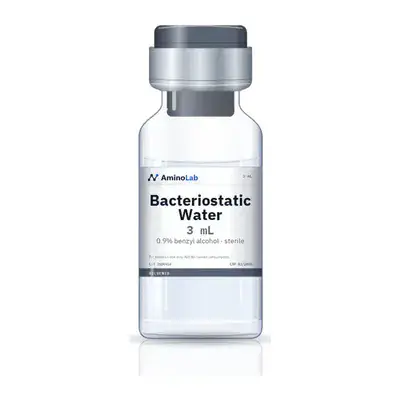
At AminoLab you can order bacteriostatic water in 3, 10 and 30 mL vials, and any of the three can be bundled with a single sterile U-100 syringe.
Comparing suppliers? Read three details off the label, namely the fill volume, the benzyl alcohol concentration it states and the expiry date. A vial near the end of its shelf life is money wasted, because the 28-day window opens at the first puncture however long the stock has been sitting in storage.
Go for the smallest vial you will really use up inside 28 days. Of all the bac water advice we could offer, this matters most, yet the mistake we see again and again is the reverse, where a lab buys a 30 mL vial for one 10 mg peptide and ends up throwing away 28 mL a month down the track.
Plug your fill into our peptide reconstitution calculator before you buy. It works out the water a vial needs for your target concentration, which in turn shows how many peptide vials one bottle of diluent will get you through.
Bacteriostatic water is not right for everything. Some peptides struggle to dissolve at the roughly neutral pH of plain water, and labs usually make those up in a weak acid instead. The standard example is IGF-1 LR3, which is exactly why we carry 0.6% acetic acid. A few protocols also demand preservative-free water, since benzyl alcohol can upset certain assays. Whenever your method names a diluent, the method wins over any general rule of thumb.
Outside those cases, bacteriostatic water is the go-to choice. You will find the whole procedure, including why the water should trickle down the vial wall rather than hit the powder directly, in our peptide reconstitution guide.
Hunting for a chemist near me is unlikely to end with a multi-draw vial, so the quicker option is to order bacteriostatic water online in the same cart as the peptides it will dissolve. Our bacteriostatic water page offers 3, 10 and 30 mL vials from Australian stock. Working with a tricky compound like IGF-1 LR3? Add a vial of 0.6% acetic acid as well, and if your bench is short on measuring gear, a 30 pack of sterile insulin syringes. Pick the diluent, add the peptide and check out once, and browse the water and supplies category for every other consumable.
Bacteriostatic water, like every AminoLab product, is sold for laboratory research use only to adults 18+. None of it is for human or veterinary use, and this bacteriostatic water chemist warehouse guide is not medical advice.
Rarely. Chemist Warehouse had no bacteriostatic water in its online catalogue when we checked, and retail pharmacies typically leave it off the shelf. What most chemists can provide or order in is Water for Injections, a preservative-free product in single-use ampoules. Labs that need a diluent for repeated draws usually buy bacteriostatic water online from a research supplier.
It is. AminoLab keeps bacteriostatic water in Australian stock and sells it online as 3 mL, 10 mL and 30 mL vials, with an optional U-100 syringe for any size. Sourcing diluent from the supplier that sells your peptides means the vial sizes fit the job and everything arrives in one order. It is supplied as a laboratory diluent for research use only.
Water for Injections has no preservative and is a one-use product, so leftovers are thrown out. Bacteriostatic water carries benzyl alcohol, usually 0.9%, to keep bacterial growth in check, which lets a vial be drawn from many times, conventionally for up to 28 days after it is first punctured.
We have not seen a clear public statement either way, so we are not in a position to give a legal answer. In the United States, pharmaceutical bacteriostatic water is labelled for prescription use. AminoLab supplies it as a laboratory diluent for research, not as a therapeutic good meant for people.
10 mg vial, 60 capsules
50 mg vial, 100 mg vial
10 mg vial
3 mL, 3 mL + 1 syringe, 10 mL, 10 mL + 1 syringe, 30 mL, 30 mL + 1 syringe
Research use onlyAminoLab supplies research compounds for laboratory and in-vitro use, not for human or animal consumption. By continuing you confirm you are 18 or older and buying for research.
Leave