BPC-157
10 mg vial, 60 capsules
From $69
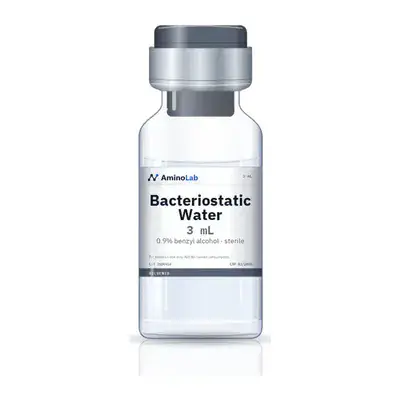
Picture two clear vials on a bench. Both hold purified, sterile water, and to the eye they are identical. The comparison of bacteriostatic water vs sterile water comes down to a preservative, benzyl alcohol, present at around 0.9% in the first vial and absent from the second. With it, bacteria that slip in cannot build up, so the vial tolerates a needle through its stopper week after week. Without it, the contents are good for one session. That is why peptide labs, whose vials get drawn from over and over, treat the preserved version as their everyday diluent.
The full pharmaceutical name is Bacteriostatic Water for Injection, a sterile, non-pyrogenic water carrying benzyl alcohol as its preservative. Hospira, part of Pfizer, produces the US Pharmacopeia product. Its label lists 9 mg of benzyl alcohol per mL, the source of the 0.9% you will see printed on most bottles, and a pH near 5.7, within an allowed range of 4.5 to 7.0. Pfizer packs it in multiple-dose vials and states plainly that it is meant for repeated withdrawals when diluting or dissolving drugs.
Notice the word bacteriostatic rather than bactericidal. The alcohol at this level kills nothing outright and sterilises nothing. Its job is to stop stray bacteria from growing and dividing once they are inside, and the usual route in is a needle passing through the rubber stopper. Peptide work creates that exact risk, because a mixed vial can easily see ten or twenty punctures over its life.
What is bacteriostatic water used for in hospitals and clinics? Dissolving and diluting medicines that ship as dry powder. The Pfizer label carries two cautions that a researcher should still be aware of. First, newborns must not be given it, because benzyl alcohol is toxic to neonates. Second, the water alone must not be put into a vein, since water lacking dissolved solutes bursts red blood cells, which is known as haemolysis.
In Australia, sterile water for injection carries the label Water for Injections BP. Its purity matches the preserved product, yet nothing at all has been added to it, not a preservative, not a buffer, not even salt. Pharmacies supply it in single-dose ampoules or vials with instructions that are hard to misread, a single use and then the leftover goes in the bin. Any microbe introduced after opening finds an undefended liquid to grow in.
That makes unpreserved water a sound pick in two settings, when the whole volume is consumed immediately, or when benzyl alcohol could distort the work, for example a cell culture or an assay with known sensitivity to it. It is a poor pick for a peptide vial expected to sit refrigerated for weeks while being drawn from.
| Bacteriostatic water | Sterile water (Water for Injections) | 0.6% acetic acid | |
|---|---|---|---|
| Ingredient besides water | Benzyl alcohol, usually 0.9% | None | Acetic acid 0.6% |
| How many draws | Many | One | Few, over a short window |
| Life after the first needle | Conventionally 28 days | Discard remainder | Follow the method |
| Where it fits in peptide work | Default diluent for most lyophilized peptides | Single-use preparations, preservative-sensitive assays | Peptides that dissolve poorly at neutral pH, such as IGF-1 LR3 |
| Cautions printed | Not for neonates | Hypotonic; single use | Acidic; not a general diluent |
That is bacteriostatic water vs sterile water in a nutshell, and here is the rule we give customers. Default to bacteriostatic water, and switch only for one of two genuine reasons, either the peptide will dissolve only in acid, or the protocol forbids any preservative. Having a box of ampoules on hand does not count. Drawing a multi-use vial with single-use water is the most common path to a contaminated stock.
Two different limits run side by side. A vial that has never been opened lasts until the printed expiry, as long as storage follows the label, and for its unopened stock Pfizer specifies 20 to 25 °C. From the moment the stopper is first broken by a needle, labs work to 28 days. The origin is US Pharmacopeia General Chapter 797, under which a multiple-dose container gets a 28 day beyond-use date counted from first entry, except where the manufacturer sets its own date. Guidance from the US CDC says the same thing in practical form, write the first-puncture date on the vial, dispose of it within 28 days unless the maker states another limit, and never keep it beyond the original expiry.
Chilling an opened bottle does not buy extra time. A fridge at 2 to 8 °C is still a sensible home for it, more so once peptide is dissolved in it, but the count still begins at that first puncture. Date the label as soon as you open it. Can bacteriostatic water expire? Certainly. The benzyl alcohol oxidises gradually, and every stopper has a ceiling on how many punctures it handles cleanly, so the printed date matters.
The great majority of lyophilized research peptides, BPC-157 and GHK-Cu among them, go into solution in bacteriostatic water. A 0.9% benzyl alcohol content does not react with these compounds, and it shields a vial that will be entered over and over. How you add the liquid is as important as which liquid you add. Let it trickle down the side of the glass, rotate the vial softly rather than shaking it, and wait until no powder remains. The full routine sits in our step-by-step reconstitution guide, while the reconstitution calculator converts fill weight and added volume into a working concentration.
Bear in mind that the diluent's shelf life and the mixed peptide's shelf life are not the same thing. Many peptides lose integrity in solution well before the water would reach its own limit, which means the peptide is usually the deciding factor. For common windows by compound, see the peptide storage guide.
Acetic acid. Certain peptides hardly dissolve at neutral pH but clear readily once the liquid is slightly acidic. IGF-1 LR3 is the textbook case and is normally mixed with 0.6% acetic acid. Should a peptide stay hazy in bac water after a gentle roll, check its written method for an acidic diluent rather than pouring in more water.
Sterile water. Pick this one if the solution will be used up in a single sitting, or where benzyl alcohol could affect the outcome, as happens with some cell culture work. Prepare just the volume needed and discard the rest.
Bacteriostatic sodium chloride. This product puts the same preservative into saline. It is not the same thing as bacteriostatic water, and it should only replace it in peptide work when a protocol names it specifically.
Decided on bac water? Match the bottle to your monthly volume instead of defaulting to the biggest one. We sell bacteriostatic water with 0.9% benzyl alcohol at 3, 10 and 30 mL, and the product page lets you add a U-100 syringe to any size. If a compound needs acid, the acetic acid 0.6% in a 3 mL vial is stocked as well. Benches mixing several vials a month usually include the 30 pack of U-100 insulin syringes. Everything ships from stock held in Australia, so buy online and put the peptide itself in the same checkout.
For drawing up and measuring any diluent, the standard tool is a sterile U-100 insulin syringe, and you can browse every option in our diluents and supplies category. AminoLab supplies all diluents and peptides strictly for laboratory research, to adults 18 and over, and none is intended for human or veterinary use.
Yes, one ingredient. Bacteriostatic water carries benzyl alcohol, typically at 0.9%, so bacteria introduced after the first puncture cannot multiply freely. Sterile water has none, which limits it to a single use before the leftover is thrown out. That is why labs drawing peptide vials repeatedly choose the bacteriostatic version.
Labs work to 28 days counted from the first needle, following US Pharmacopeia General Chapter 797, unless the manufacturer gives its own limit, and never past the label expiry. Unopened stock is good until that printed date if stored properly. A fridge does not extend the 28 days.
Only if the entire vial will be consumed straight away, or the protocol rules out preservatives. A vial that you return to over several days or weeks has no defence against microbes entering through the stopper when sterile water is used, so the preserved option is the safer lab choice.
That is the formal pharmacy name for sterile, non-pyrogenic water preserved with benzyl alcohol, sold in multiple-dose vials for diluting or dissolving drugs. Each mL of the Hospira product holds 9 mg of benzyl alcohol. Its label rules out use in neonates and intravenous injection of the water on its own.
Sealed vials are fine without it, and Pfizer specifies 20 to 25 °C for its unopened product. After opening, and more so once a peptide has been mixed in, plenty of labs keep it at 2 to 8 °C. Either way, the 28 day count from first puncture still stands.
We sell bacteriostatic water at 3, 10 and 30 mL plus 0.6% acetic acid at 3 mL, both posted from Australian stock through our lab supplies range. We do not stock plain sterile water, which pharmacies sell as single-use Water for Injections ampoules. Our diluents are for laboratory work only and never for people or animals.
10 mg vial, 60 capsules
50 mg vial, 100 mg vial
10 mg vial
3 mL, 3 mL + 1 syringe, 10 mL, 10 mL + 1 syringe, 30 mL, 30 mL + 1 syringe
Research use onlyAminoLab supplies research compounds for laboratory and in-vitro use, not for human or animal consumption. By continuing you confirm you are 18 or older and buying for research.
Leave