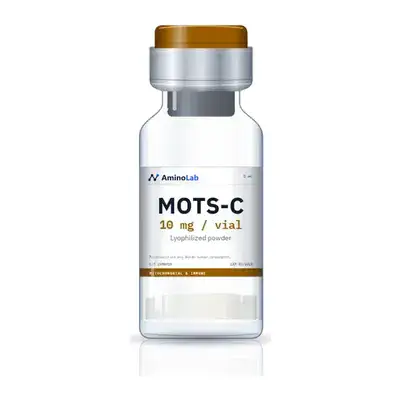
MOTS-C
10 mg vial, 20 mg vial, 40 mg vial
From $69
$69 AUD, GST included
Minimum order before shipping, and you can mix any products to reach it.
In stock, ready to ship from Australia
Frequently ordered with
 Bacteriostatic Water
Sold to buyers aged 18 and over only.
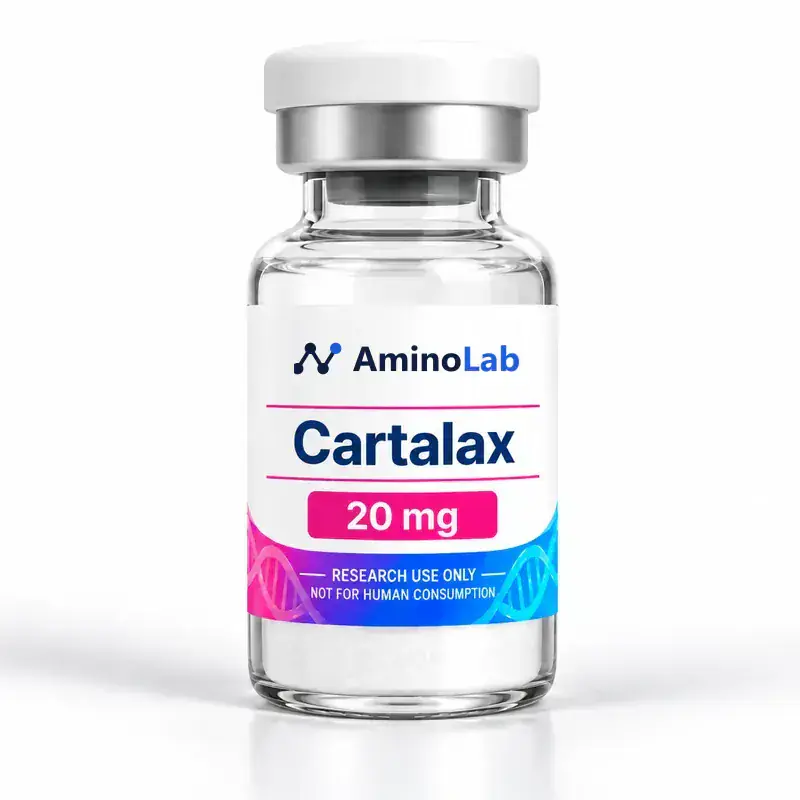
Shop Cartalax at AminoLab and buy the 20 mg vial from stock kept here in Australia. Cartalax Australia orders at AminoLab arrive as one 20 mg vial of freeze-dried tripeptide, sent from our local warehouse. Cartalax is alanine, glutamic acid and aspartic acid in a row, written AED, and it is the member of Vladimir Khavinson's short bioregulator family that his St Petersburg team linked to cartilage. Researchers test it on cartilage cells and skin fibroblasts, looking at how those cells age and how they make their surrounding matrix. Its formula, C12H19N3O8, and its weight of 333.3 g/mol are the figures to check on the batch report, which we publish before sale after mass spectrometry and HPLC testing. To decide how much liquid to add, use the peptide calculator. Because the AED sequence is the start of Epitalon, buying one vial of each sets up a tidy comparison. No solvent comes in the box, so add bacteriostatic water, and keep the closed vial in the freezer. AminoLab sells Cartalax as a research reagent to adults only. Place your Cartalax order today and we send it from Australian stock, strictly for laboratory work by adult buyers.
For laboratory research use only. Not for human or veterinary use. Not TGA approved. See our research use policy.
| Peptide | Cartalax, short code AED |
|---|---|
| Sequence | H-Ala-Glu-Asp-OH, three residues in a straight chain |
| Mass and formula | 333.3, C12H19N3O8 |
| Supplied as | White freeze-dried powder in a sealed vial |
| Batch testing | Mass check by mass spectrometry, purity by HPLC, report for each batch |
| In the box | One vial holding 20 mg, solvent bought separately |
| Storage | Freezer and darkness while sealed, fridge in portions once mixed |
| Stock | Ready to ship |
| Intended use | In vitro research |
Buy Cartalax for cell ageing and connective tissue work. The 20 mg fill is twice what most bioregulator vials hold, so a single vial can carry a long culture series, and every batch is certified before we ship it.
Cartalax is a three amino acid synthetic peptide researched for what it does to ageing support-tissue cells, such as cartilage cells and skin fibroblasts. AminoLab sells it to labs that want to examine those claims themselves. Most papers refer to it simply as AED, the one-letter code for its sequence.
The St Petersburg group behind Cartalax starts from one main idea. They argue that each tissue makes its own short peptide fragments, that those fragments keep gene activity looking young, and that a lab-made version can partly restore that activity in older cells. Every peptide in the series was linked to a particular organ, and AED was matched with cartilage and other connective tissue. Nobody has found a receptor for it. The developers suggest the tripeptide reaches the cell nucleus and acts on chromatin, but this idea has not been confirmed outside their own labs.
The clearest data come from skin fibroblasts rather than cartilage. Lin'kova's team, writing in a Russian experimental biology bulletin in 2016, took fibroblasts through many rounds of subculture to age them, then compared four short peptides, including AED, using confocal microscopy. They tracked four markers.
All four peptides reduced MMP-9 and increased Ki-67 and CD98hc, and AED and the related four-residue AEDG also reduced caspase-driven cell death. A 2020 follow-up in the same journal compared AED with the dipeptide KE in fibroblasts aged the same way. Work on cartilage cells exists as well, though much of it is in Russian sources that are harder to verify.
For a lab planning its own study, the practical lesson is to choose readouts that match those papers, so results can be compared. Ki-67 staining, an MMP-9 assay and a caspase-3 activity kit are all standard and inexpensive. Buy one vial first to set up the method, then order the rest of the study in one batch once the assays are working.
One point is worth stressing. All of those changes were reported in aged cells. So set up young and old cultures from one donor and treat them in parallel. A shift that appears only in the old plates agrees with the papers. A shift that appears in both suggests a general effect unrelated to ageing, and you have found that out cheaply from one vial.
Khavinson's St Petersburg group designed a whole series of very short peptides and gave each one a target tissue. Cartilage was the target chosen for this one, which explains the name. With only alanine, glutamic acid and aspartic acid in its chain, it is one of the lightest compounds AminoLab sells.
It helps to know where the evidence stands before you order. Nearly all the published data come from that group and its collaborators, and nearly all of it is cell work, with cartilage cells taken from older donors or cultured for many passages, aged skin fibroblasts, and readouts of collagen and other matrix genes. The idea that short peptides switch tissue genes by acting on chromatin is still a hypothesis with little independent testing, and that is exactly why defined material is useful. You will find it in two of our ranges, longevity peptides and recovery peptides, always as a reagent. That makes it easy for a connective tissue lab to set it against longer repair peptides in the same culture system.
In the parcel is a single vial of white powder, 20 mg of AED, which is double the amount in Pinealon and other bioregulator vials, which helps labs that like to keep a strong master stock. The sequence emerged from Khavinson's work in St Petersburg, at the gerontology institute he set up in 1992 after leading a bioregulator lab at a military medical academy for many years. Because the research base is still concentrated in that one group, the evidence is limited and comes mainly from cells in dishes.
Is Cartalax legal in Australia? We checked the October 2026 Poisons Standard and found no entry for Cartalax, AED or Ala-Glu-Asp, so it is not scheduled by name. Being unscheduled does not make it a therapeutic product. Supplying a peptide for treatment requires it to be on the ARTG first, and the TGA has named unapproved peptides as a compliance target. That is why Cartalax Australia buyers find it in reagent catalogues rather than through medical suppliers.
AminoLab holds Cartalax in Australian stock and supplies it only as a laboratory reagent. We accept orders from adults, and the vial is never for use in people or animals. If you are planning a wider connective tissue comparison, our research use policy page sets out the terms of supply.
There is just one size, 20 mg. Because each molecule weighs only about 333, the vial holds close to sixty micromoles, which stretches across a lot of culture plates. The larger fill also suits labs that like to make one concentrated stock and dilute working portions from it, without opening another vial.
If a study will run for months, buy every vial at the start so we can send them from one batch wherever stock allows, so one certificate covers the whole project. Cartalax is sold to adults only.
AED has two acidic side chains and a free acid at its tail, so it is very water-loving and dissolves easily. Its small size is also its weak point for analysis, because a tripeptide with a similar make-up could look much the same on HPLC alone. The mass result is what confirms its identity. Labs that verify incoming material by LC-MS should see the singly charged ion at about m/z 334.
Before you order, open the report and check three things. The measured mass should agree with 333.3 g/mol, the HPLC trace should show one main peak, and the purity figure should refer to your batch number. Find the report in the COA library using your batch code, and if any figure is unfamiliar, the how to read a COA guide explains it.
You will not find Cartalax in a shop. Orders are placed on our website and posted from Australian stock, leaving the same day when paid before the 3pm weekday cut-off. Transit times for each region, including for labs that buy research peptides in Perth, are on the delivery information page.
Let the sealed vial warm to room temperature, then let the water run slowly down the vial wall and rotate it until the powder has gone. Four millilitres of bacteriostatic water in the 20 mg vial gives 5 mg per mL, and two millilitres gives a stronger 10 mg per mL stock. The peptide calculator works out any other volume.
Keep the closed vial in the freezer, away from damp and light. Once mixed, divide it into small tubes for the fridge so you only take out what each experiment needs. Write the date and strength on every tube, because months later that label is what links a portion back to its certificate.
Because AED carries two acidic groups, a concentrated stock in unbuffered water will be mildly acidic. That rarely matters once it is diluted into culture medium, but it is worth knowing if you plan a very strong stock or a buffer-sensitive assay. Checking the pH of your working solution takes a minute and removes one possible source of error.
Other labels for the same molecule include the code AED, the three-letter sequence and the full chemical name, L-alanyl-L-glutamyl-L-aspartic acid. Russian authors class it among the cytogens, a name for the short peptide bioregulators, and link it to cartilage and connective tissue. Every one of these names describes the same tripeptide, and some catalogues simply call it AED peptide or a cartilage bioregulator. Whatever name your protocol uses, you can order it here as Cartalax.
Add a glycine to the end of Cartalax and you get Epitalon. Despite that small difference, research has sent them in separate directions, with Epitalon used for telomerase and pineal questions and Cartalax for cartilage and fibroblast work. Buy Cartalax for matrix outcomes, Epitalon for telomerase outcomes, and the pair if you want to see what that one glycine does. Because they differ only at the tail end, any gap between their results points straight at that glycine. AminoLab stocks both.
For a contrast among tissue repair tools, consider BPC-157. It is a 15-residue fragment of a stomach protein with a large soft tissue literature, and it shares neither structure nor proposed mechanism with Cartalax.
Three residues from the St Petersburg bioregulator series, linked by its designers to cartilage. Ready to ship from AminoLab.
Twice the usual bioregulator amount, supplied dry. Water for mixing is sold separately.
For cultured cartilage cells and skin fibroblasts, to follow ageing markers and matrix genes. Lab use only.
The two sequences differ by a single glycine, so buying both isolates that one change.
Keep the closed vial frozen. After mixing, refrigerate it in portions that you thaw only once.
Mass and purity results are published and match the batch code on your label.
Choose the 20 mg vial here and pay at checkout. We post it from stock in Australia, and weekday payments made before 3pm are dispatched the same day. Cartalax comes as dry powder, so add bacteriostatic water if you need a solvent.
No shop is needed. AminoLab sells online only, so labs in capital cities and regional centres alike order from this page and receive a tracked parcel from the same local stock and the same certified batch.
Yes. We weigh each batch by mass spectrometry and grade it by HPLC, and the results are published in our COA library. The code on your vial matches the report, so your paperwork lines up with the powder in your hands.
Cartalax is the better buy for cartilage, fibroblast and matrix questions, Epitalon for telomerase and pineal ones. As the two differ by a single residue, many labs order both and compare them directly. Both arrive dry and need a solvent.
Labs use the Ala-Glu-Asp tripeptide as a defined reagent in connective tissue cell culture, to test whether a very short peptide changes ageing markers or matrix gene activity in cartilage cells. We supply it only for bench work, not for use in people or animals.
Yes, as a lab reagent. It is unscheduled, with no listing in the October 2026 Poisons Standard, yet it is not an approved medicine, so it may not be supplied as a treatment. AminoLab sells the 20 mg vial from Australian stock to adults, strictly for in vitro research.
Research use onlyAminoLab supplies research compounds for laboratory and in-vitro use, not for human or animal consumption. By continuing you confirm you are 18 or older and buying for research.
Leave